Grill BTU Calculator: How Many BTUs Do You Actually Need?
BTUs are the most quoted — and most misunderstood — number on a gas grill spec sheet. Here's the rule that actually matters for sizing, and why the biggest number isn't always the hottest grill.
The BTU-per-square-inch rule
Aim for 75–100 BTUs per square inch of primary cooking area, with 80–100 being the sweet spot for fast, even heat. Below that and a full grill struggles to recover temperature; well above it usually just burns more gas.
How to calculate it the right way
Divide the main burners' total BTUs by the primary cooking area (square inches). Critically, ignore side burners, rear/rotisserie burners, and sear zones in that math — manufacturers often add those into the headline BTU number to inflate it. Use only the main cooking burners over the main grate.
Worked example: a grill with 60,000 main-burner BTUs over a 600 sq-in primary grate = 100 BTU/in² — right in the ideal range. The same 60,000 BTUs over 900 sq in (80 BTU/in²) is still fine; over 1,200 sq in (50 BTU/in²) it'll feel underpowered.
BTUs aren't the whole story
A higher BTU number does not automatically mean a hotter grill. BTU is fuel input, not heat output. Build quality decides how much of that heat reaches your food and stays there — thick stainless, quality grates, and good lid insulation retain heat far better than a thin-walled grill with a huge BTU rating. Look at max temperature and temperature range alongside BTUs.
Shop built-in grills
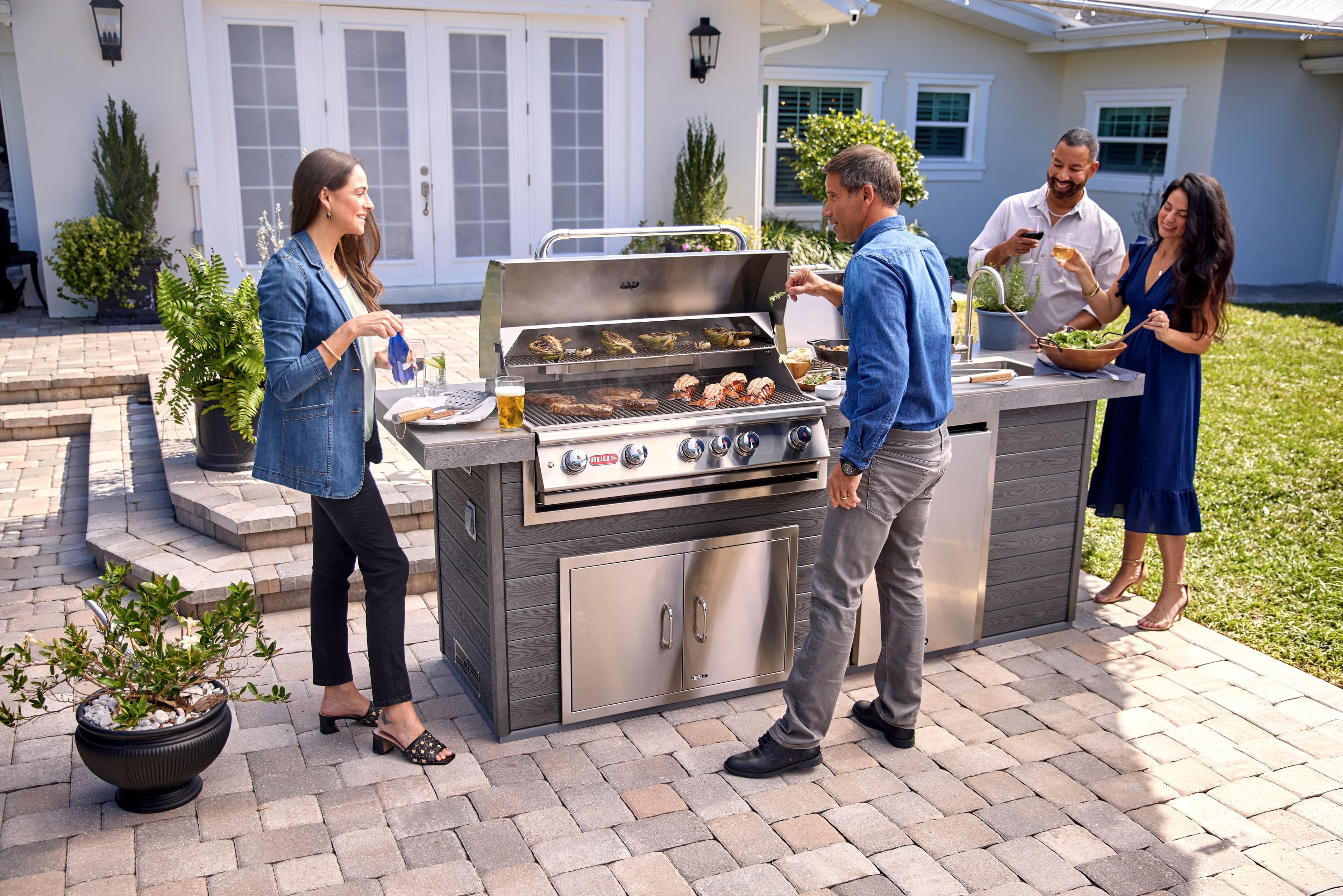
Compare BTU output and build across our built-in gas grills, including Bull BBQ.
Frequently Asked Questions
How many BTUs do I need for a grill?
Aim for 75–100 BTUs per square inch of primary cooking area (80–100 is ideal). A 600 sq-in grate wants roughly 48,000–60,000 main-burner BTUs.
How do I calculate BTU per square inch?
Divide the main burners' total BTUs by the primary cooking area in square inches. Exclude side, rear, and sear burners — only count the main burners over the main grate.
Do more BTUs mean a hotter grill?
Not necessarily. BTU is fuel input, not heat delivered. Heat retention — thick stainless, quality grates, lid insulation — matters as much as raw BTUs, so check max temperature and range too.