Prism Hardscapes: The Honest Guide to America's Hand-Cast Concrete Fire Features
By Reed · Published September 2026
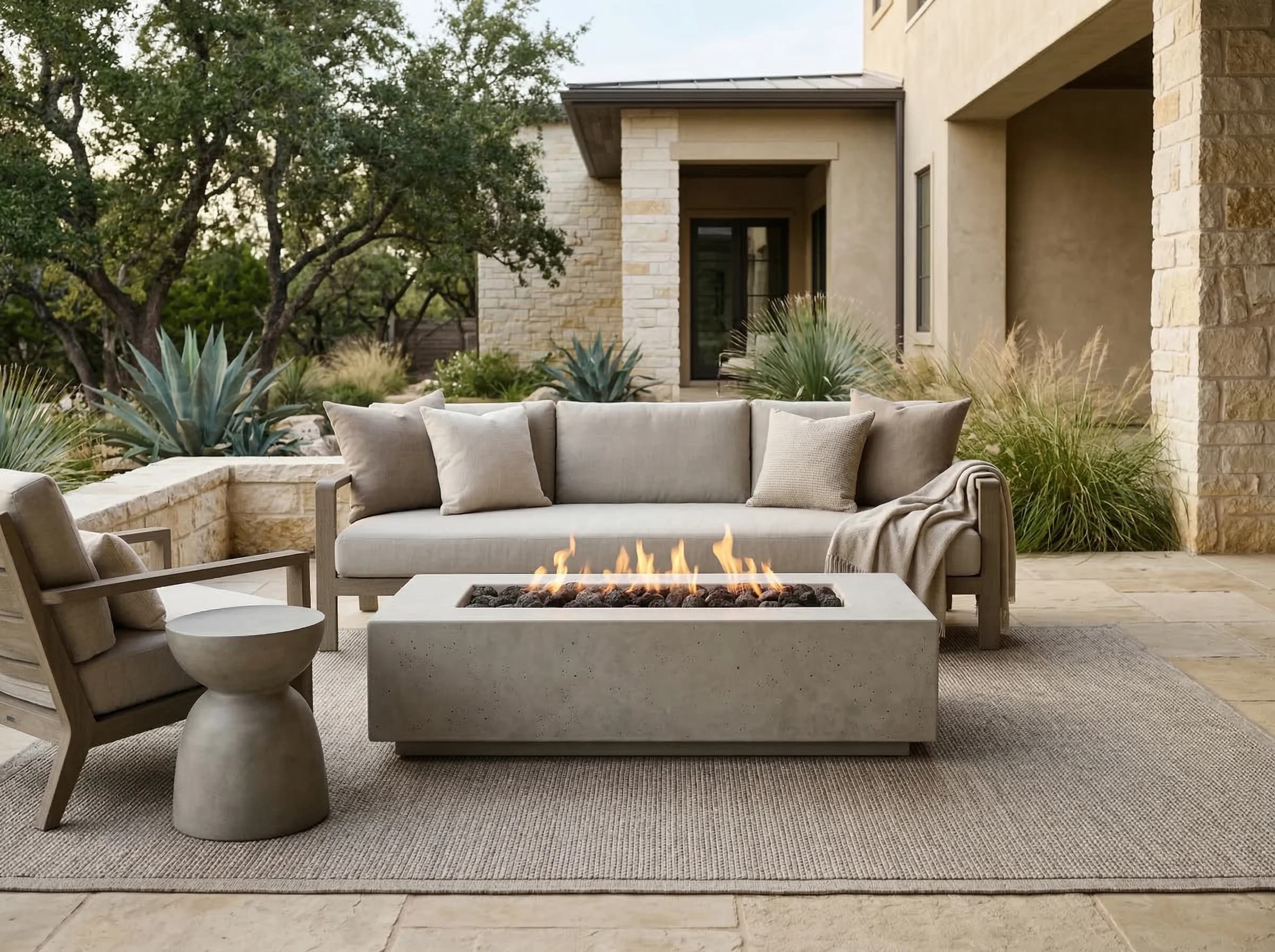
Updated September 2026. Prism Hardscapes is the Chino, California boutique that quietly became the concrete fire feature specifier’s pick for high-design outdoor installations. Every Tavola, Moderno, Cilindro, and Fairmont is hand-cast to order from architectural-grade GFRC. This is the honest guide to their series, when each fits, and how to order without derailing your project timeline.
Brand Background
Prism Hardscapes was founded in 2006 by a family with a background in commercial concrete architecture — not in fire features. That origin is why the brand’s catalog reads more like an architectural-hardscape collection than a fire-pit lineup. Their fire tables and pits are cast from the same GFRC (glass fiber reinforced concrete) used on commercial building facades and high-end poolside installations. The engineering priorities carry over: dimensional stability across thermal cycles, freeze-thaw durability, and a finish that reads intentionally architectural rather than utilitarian.
Every Prism piece is hand-cast in the Chino, California workshop. There is no warehouse of finished units waiting to ship. When you order a Tavola 10 in Pewter, the actual mold gets prepped, the concrete gets poured, the piece cures, the finish gets applied, and then it ships. This is why lead times run 3-5 weeks on standard configurations and 6-10 weeks on custom — the manufacturing model is genuinely order-to-cast, not order-to-pick-from-inventory.
That approach is also why Prism is specified by landscape architects and outdoor kitchen designers for high-design residential projects. When the design brief calls for a specific concrete color to match a paver installation, or a size that doesn’t exist in a competitor’s catalog, Prism will custom-cast it. The Cilindro 36-inch column in Sandalwood matching a Belgard paver tone, for example, is a common landscape-architect specification.
The Series Lineup
Prism’s catalog splits into eight series. Understanding which is which is how you narrow their full lineup into a shortlist of two or three.
Tavola. Rectangular fire tables in 8, 10, and 16-foot sizes. Coffee-table-height silhouette designed to sit as the centerpiece of a conversation seating area. The Tavola line is the design-magazine flagship — the profile is intentionally minimal and the concrete is often specified in Pewter or Charcoal to read as monolithic. Roughly 65,000 BTU on the 8-foot; 90,000 BTU on the 16-foot. About $3,800-9,500 depending on size and finish.
Moderno. Round low-profile fire tables. The modernist-round counterpart to the Tavola’s modernist-rectangular. Reads as a sculptural low-slung form suitable for both conversation areas and pool-deck installations. About $3,200-5,800 depending on size.
Cilindro. Cylindrical fire columns in 20, 28, and 36-inch heights. Vertical rather than horizontal — reads as sculpture, not furniture. Best in pairs bracketing seating areas, pool corners, or entry courtyards. Cilindros work particularly well in high-design contexts where the fire feature should not compete visually with existing furniture. About $2,800-4,600.
Fuego. Round fire pits on an integrated pedestal base. Traditional fire-pit silhouette executed in concrete rather than steel. Best for buyers who want the concrete look with a familiar bowl-and-base shape. About $3,600-5,400 depending on size.
Falo. Asymmetric round bowls at 21-inch entry size. The smallest and most affordable Prism piece and often specified as an accent in poolside or corner-patio installations. About $2,200-2,800.
Elevate. Elevated fire tables at bar-height (roughly 36 inches tall). Designed to pair with bar-stool seating rather than conversation-height sofas. Right for outdoor bar areas and standing-cocktail installations. About $5,200-6,800.
Embarcadero. Square and rectangular fire tables in mid-range sizes (31-inch pedestal, 48-inch table). The volume mid-tier — a Tavola aesthetic at a Tavola-minus-one price point. About $3,400-4,800.
Fairmont / Largo / Dune / Hampton. The large-format series. Fairmont 72 and Largo 72 are the largest pieces Prism builds in production, seating 10-14 people around a single centerpiece fire feature. Dune 42 and Hampton 48 sit in between. Best for large outdoor entertaining spaces and resort-style backyard installations. About $6,500-9,500.
The Concrete: What GFRC Actually Means
The single biggest technical difference between Prism and other concrete-look fire pits is the GFRC construction, and it’s worth understanding what the material actually is.
Standard concrete relies on steel rebar for tensile strength. That works fine for driveways and foundations but produces walls that need to be 4-8 inches thick, which is why cast concrete fire pits from most manufacturers look chunky and heavy. Standard concrete also has a thermal expansion mismatch with steel rebar that produces micro-cracks around a live fire over 5-10 years of thermal cycling.
GFRC replaces steel rebar with alkali-resistant glass fibers distributed uniformly through the concrete matrix. This gives roughly 3x the tensile strength at 1/3 the wall thickness. Practically, that means Prism can build fire pits and tables with walls that are 1-2 inches thick where standard concrete would need 4-6 inches, and the resulting silhouette reads architectural-clean instead of chunky-utilitarian. GFRC also has no steel-vs-concrete thermal expansion problem, so it doesn’t develop those micro-cracks around thermal cycling.
GFRC is the same material used on the exterior facades of many commercial buildings, on premium pool copings, and on high-end hardscape installations. Prism uses it because they came out of that commercial-architecture world. It costs more than standard concrete; the finish and longevity earn the premium.
Color and Finish Choices
Prism ships six standard colors and offers custom-color matching for architectural specifications. All colors are integral pigment — the color is dispersed through the depth of the concrete during casting, not surface-applied.
Ultra White is the brightest and most modern option. Reads clean and Scandinavian. Best in contemporary poolside installations and against dark landscape backgrounds. Requires the most sealer maintenance to keep the white looking crisp.
Pewter and Charcoal are the design-magazine defaults — deep gray tones that read as intentionally monolithic. Best for modern architecture, monochromatic palettes, and installations where the fire feature should sit visually quiet.
Cafe and Sandalwood are the warm neutral tones. Best for Southwestern, Tuscan, or transitional design contexts where a cool gray would feel wrong. These finishes match well with stone paver installations in beige/tan tones.
Gray is the mid-tone universal — most forgiving with mixed landscape and material palettes. Right when you’re not sure which color to pick.
Custom color matching is available for architect-specification projects. Provide a target color chip or Belgard/Cambridge paver reference and Prism will pigment-match. Custom colors add 2-3 weeks to the standard lead time.
Prism vs The Outdoor Plus vs Ohio Flame
The three brands are the natural comparison set for a high-design residential fire feature. They’re different products for different buyers.
Prism Hardscapes is the concrete boutique. Hand-cast GFRC, architectural-clean silhouettes, six-color palette, order-to-cast lead times. Right when the fire feature needs to read as an integrated architectural element in a design-specified outdoor space. Premium price and premium lead time.
The Outdoor Plus is the configurable multi-material volume leader. Copper, corten steel, GFRC concrete, or stainless. Match-lit, spark, or electronic ignition. Sizes 24-72 inches. If you want a specific combination of shape / material / size / ignition, TOP has it or will build it. Right when you know exactly what you want and need a manufacturer with the SKU breadth to deliver it.
Ohio Flame is the American-made wood-burning brand. Hand-cut 1/4-inch American steel, no gas plumbing, 30-year structural warranty, natural rust patina. Right when the buying decision is driven by real fire experience (woodsmoke, crackling logs, ash management) and American-made construction rather than gas convenience.
Buyers commonly cross-shop Prism and The Outdoor Plus when they want gas convenience and a clean-modern look. Prism wins on the pure concrete aesthetic and boutique specification; TOP wins on breadth of options and shorter lead times on stock configurations. Both are quality choices — the decision usually comes down to design language.
Install Considerations Most Buyers Miss
A Prism fire feature installed correctly runs 25+ years. Installed incorrectly, most failures show up in the first two seasons. Four things worth getting right at design time.
Weight. Prism concrete tables are heavier than they look. A Tavola 10 weighs roughly 550 pounds; a Fairmont 72 weighs 900+. Plan for 4-person lift or a piano dolly for placement. On a suspended deck or elevated pool coping, verify the structure can carry the point load — sometimes the answer is a load-spreading pad or additional structural support.
Level surface. GFRC is dimensionally stable but the burner tray inside sits level to the frame. A patio surface that’s pitched more than 1 degree will show as an off-level flame surface. Verify with a bubble level at install and shim under the base if needed. Concrete shims are available in matching finishes.
Gas line sizing. A 90,000 BTU fire table draws real gas volume. If the line feeding it also feeds a grill and patio heater, verify the combined draw doesn’t exceed the line’s capacity. Underserved gas lines produce weak, flickering flames that visually never look right. Have the gas fitter size the line to total simultaneous draw plus 20% headroom.
Cover during off-season. Prism sells cover accessories sized specifically for each SKU. Order the matching cover with the fire feature — a generic cover doesn’t fit and leaves the burner tray exposed to rain and debris. Concrete does not care about rain, but the stainless burner tray inside does.
Who Should Buy Which
Buy a Tavola 8, 10, or 16 if the fire feature is the centerpiece of a conversation seating arrangement. Rectangular, coffee-table-height, clean modernist silhouette. Best in Pewter or Charcoal for design-magazine installations. About $3,800-9,500.
Buy a Moderno round table if you want the Tavola aesthetic in a round rather than rectangular form. Best for round conversation arrangements and pool-deck installations. About $3,200-5,800.
Buy a Cilindro 20, 28, or 36 column in pairs to bracket a seating area, pool corner, or entry courtyard. These read as sculpture rather than furniture. About $2,800-4,600 each.
Buy a Fuego if you want the concrete look in a traditional bowl-and-base silhouette. Right for buyers who prefer familiar shapes to modernist ones. About $3,600-5,400.
Buy an Elevate 80 if you’re building an outdoor bar or standing-cocktail area. Bar-height rather than coffee-height. About $5,200-6,800.
Buy a Fairmont 72, Largo 72, or Hampton 48 if you need to seat 10-14 people around a single fire feature. These are the large-format specifications for resort-style backyards and large outdoor entertaining. About $6,500-9,500.
Buy the matching Prism cover alongside any fire pit. About $150-350 depending on SKU. Saves the burner tray from off-season weather exposure.
What to Ask Before You Order
Confirm your fuel type (natural gas vs propane) at order. Field-converting requires a licensed gas fitter and a conversion kit. Getting fuel right at order avoids the second visit.
If you’re specifying Electronic Ignition (available on most series), confirm your 120V power run to the fire feature location is designed alongside the gas line. Both should live in the same trench during construction.
Choose a color that will read right against your existing hardscape at your typical viewing distance. Prism will ship physical color samples for design projects — order these before committing on a large purchase. Concrete color reads very differently in a paint chip vs a 6-foot table.
Order at least 4-6 weeks before you need the piece in place. Standard configurations are 3-5 weeks in-shop plus shipping. Custom colors or sizes run 6-10 weeks.
Order the matching cover with the fire pit. It’s $150-350 and it’s the difference between a burner tray that lasts 20 years and one that needs replacing at year seven.
Register the warranty within 30 days of installation to lock in the 5-year burner coverage.
Frequently Asked Questions
Is Prism Hardscapes actually made in America?+
What is GFRC and why does Prism use it instead of standard concrete?+
How long does a Prism Hardscapes fire pit take to arrive?+
What's the difference between the Tavola, Moderno, Cilindro, and Fuego series?+
What finish colors are available and how do they hold up outdoors?+
How much do Prism Hardscapes fire pits cost and what's the warranty?+
Products & brands in this guide
Related reading
Reed — Reed writes the buying guides at BBQs.com — fifteen years selling and installing built-in grills means the picks here are what we'd actually put in our own outdoor kitchen.