The Outdoor Plus: The Honest Guide to America's Deepest Custom Fire Feature Catalog
By Reed · Published September 2026
Updated September 2026. The Outdoor Plus (TOP) builds the deepest custom fire feature catalog in the American market — over 1,900 configurations across bowls, pits, tables, torches, and fireplaces. This is the honest guide to their major series, when to choose one over another, and how to spec ignition, material, and BTU for a real installation.
Brand Background
The Outdoor Plus is a Los Angeles-based fire feature manufacturer that has quietly become the volume leader in the custom-configured outdoor fire market. Where most fire pit brands offer a dozen SKUs with fixed options, TOP builds fire features on a modular platform — pick a shape (bowl, pit, table), pick a material (hammered copper, corten steel, GFRC concrete, stainless steel), pick a size, pick an ignition tier — and any combination is a real product they will build.
That configurability is why the TOP catalog runs to 1,900+ SKUs. It also explains why the brand is heavily specified by landscape architects and outdoor kitchen designers: if the design calls for a 42-inch square hammered-copper fire-and-water bowl with electronic ignition and a specific finish, TOP has that exact SKU. Most competitors would require a full custom order at 2x the cost and 3x the lead time.
The engineering underneath the catalog is straightforward and serious. 304 or 316 stainless-steel burners, brass gas valves, manufacturer-stamped safety certifications, and finish materials chosen for real outdoor thermal cycling. TOP’s 5-year limited warranty on the burner and gas system reflects the quality of the internals, not marketing generosity — residential installations typically see 15+ years of usable life.
The Six Product Categories
TOP’s catalog splits into six categories. Understanding which is which is how you narrow 1,900 SKUs into a shortlist of three.
Fire Bowls are round or square vessels sized for accent placement — pool-deck corners, entry columns, patio conversation spots. The Maya, Cazo, and Sedona series are all bowls, differing in silhouette and rim treatment. Most bowls run 45,000 BTU at typical 24-27-inch sizing, which covers a 6-8-foot conversation area comfortably.
Fire Pits are typically larger, rectangular or square, designed to sit as the centerpiece of a seating arrangement. Regal and La Grande are the flagship rectangular pit series, typically running 65,000 BTU at 60-inch sizing. Buy a fire pit when the fire is the focal point of the space, not an accent.
Fire Tables include a functional tabletop surface around the burner opening — usable for drinks, small plates, and setup during entertaining. Cabo, Uptown, and Grand Colonial are the primary table lines. The tabletop material matches or complements the burner surround (corten with corten, concrete with concrete). Fire tables are the right pick when you want the fire feature to also serve as coffee or cocktail table for the seating arrangement.
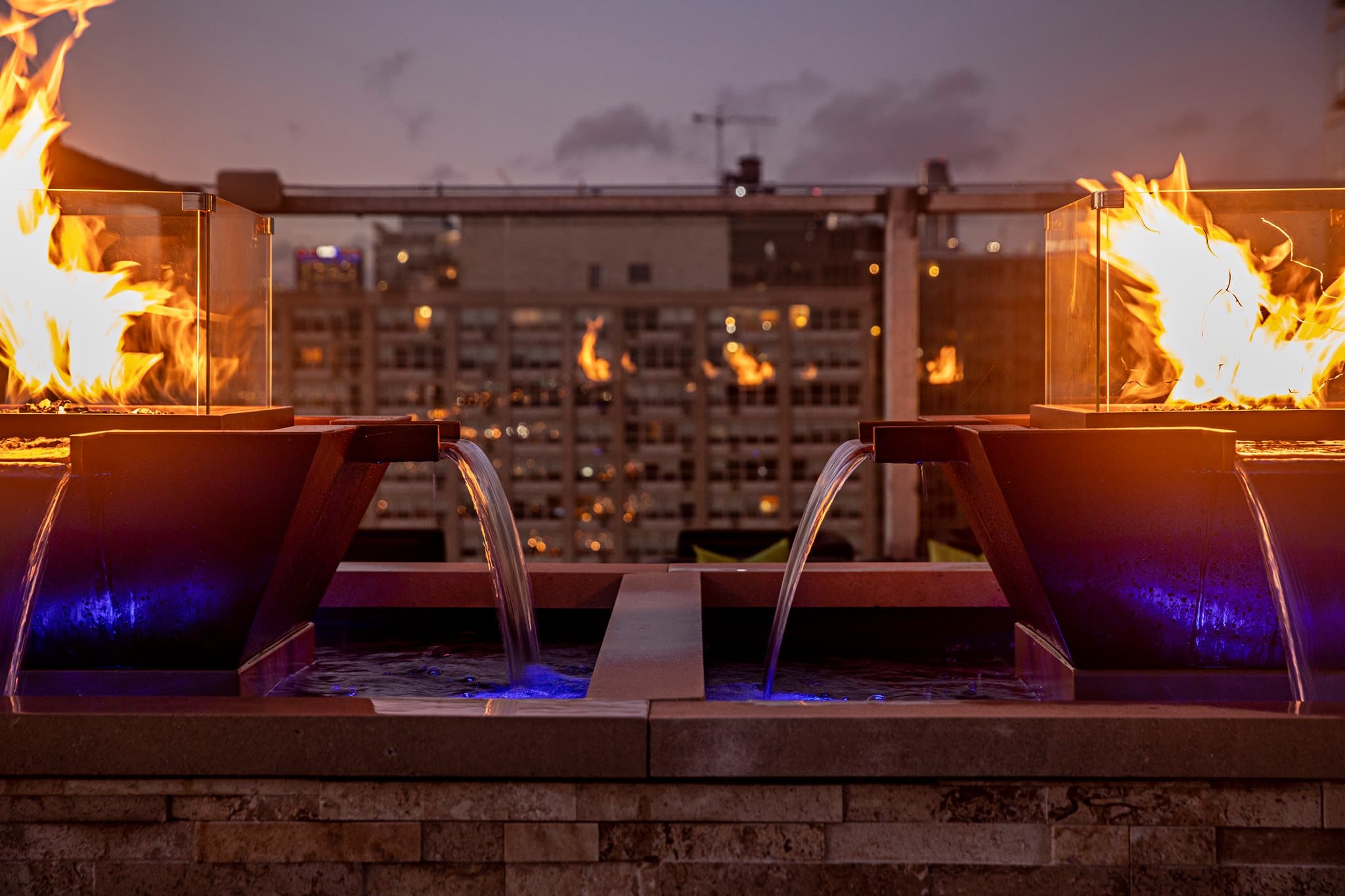
Fire + Water Bowls combine the fire feature with a water spillway that flows continuously from the bowl edge into a lower catch basin (pool or ground-level water feature). The Maya 4-Way is the most-photographed version — four spillway directions creating a symmetric water plume around the flame. These are landscape-designer specifications for pool-deck installations where fire and water read together as a single architectural element.
Fire Torches and Towers are vertical fire elements — posts, columns, or towers designed to bracket seating areas, driveways, or entryways rather than serve as the fire centerpiece. Multiple heights available depending on the sight-line the designer wants. Best used in pairs or fours for symmetric composition, rarely alone.
Fireplaces are the built-in category — masonry or veneer surrounds housing a fire feature that reads as a traditional fireplace but with modern gas plumbing. TOP’s fireplace line is smaller than the pit and bowl lines, but it’s the right pick when the outdoor space is enclosed enough to read as a room and the fire feature needs a hearth silhouette.
Fire Pit vs Fire Bowl vs Fire Table: Which Belongs in Your Space?
The biggest decision for a first-time TOP buyer is which category fits the intent of the outdoor space.
Buy a fire pit if the fire feature is the primary reason people gather in the space — you’re building around it, seating faces it, and it’s the anchor of the design. A 60-inch Regal rectangular pit reads as a serious architectural element in a way a small bowl doesn’t. Best for main-patio installations, poolside entertaining areas, and outdoor living rooms built around fire.
Buy a fire bowl if the fire is an accent to the primary function of the space — a pool deck where swimming is the main event, a patio corner that needs a warm focal point, an entry courtyard where the fire signals arrival. The Maya, Cazo, and Sedona bowls at 24-27 inches read as sculpture-scale rather than furniture-scale. Best for landscape design contexts where the fire feature earns its keep by defining a corner or edge.
Buy a fire table if the space needs the fire feature to also function as a table — conversation area with drinks and small plates, outdoor bar where the table doubles as service surface, poolside lounge that hosts both fire and cocktails. Cabo and Grand Colonial fire tables give you the flame plus a real usable tabletop, which changes how the space works during entertaining.
Buy a fire + water bowl if the design brief explicitly calls for the water-and-fire composition — pool-deck installations by a landscape architect, resort-style backyard designs, and any project where the water feature and fire feature need to read as one continuous element.
Material Choice: Hammered Copper vs Corten vs GFRC
Material choice is aesthetic first and weathering behavior second. Real differences worth naming before you commit.
Hammered Copper is the traditional and warm choice. Ships polished (bright orange-red) and develops a natural patina over 12-24 months that shifts through brown, blue-green, and mottled gray. Many buyers actively want this aging pattern — the fire feature looks better in year five than year one. Copper reads as premium in every design context and is the default for pool-deck installations because the material complements water. Downside: cost. Copper is 20-40% more expensive than corten or GFRC for the same shape.
Corten Steel is the modern-industrial choice. Arrives with a controlled rust finish that continues to darken over the first 12 months, then stabilizes. Corten was engineered originally for outdoor architectural use precisely because the rust layer becomes protective and the material doesn’t rot through. Reads as intentionally industrial — right for modern-farmhouse, industrial-loft, or contemporary-desert design contexts. Corten fire pits and tables are the volume sellers in TOP’s lineup.
GFRC (Glass Fiber Reinforced Concrete) is the modern-minimalist choice. Smooth, uniform, available in multiple base colors (natural gray, black, buff, custom pigment tints). Doesn’t change appearance over time — the color you receive is the color it stays. Best for contemporary-minimal designs where the fire feature reads as a monolithic form rather than a metal object. Also best for pool-deck installations in salt-air climates where copper’s patina reads inconsistent.
Ignition Types: Match-Lit vs Spark vs Electronic
Ignition choice affects both cost and daily-use experience.
Match-Lit is the entry option. You turn the gas valve, use a long lighter or match to ignite the burner manually, and adjust flame height at the valve. No electronics, cheapest at $200-400 below the other tiers, and simplest to install (no battery or 120V power required). Right for buyers who genuinely enjoy the ritual of lighting the fire and don’t mind manual valve adjustment. Also right for occasional-use installations (weekend homes, secondary patios) where reliability of infrequently-used electronics matters more than convenience.
Spark Ignition adds a battery-powered spark generator alongside the gas valve. You turn the valve, press the ignition button, spark lights the flame automatically. Middle tier at $200-400 above match-lit. Right for regular-use installations where daily convenience matters but you don’t need remote control or automatic safety shut-off.
Electronic Ignition Systems (EIS) are the premium tier. Full electronic control including remote start, flame-height regulation, automatic safety shut-off if the flame extinguishes for any reason. Requires both the gas line and 120V household power at the fire feature location. Adds $600-1,200 over match-lit. Right for daily-use installations where reliability, remote convenience, and the automatic safety features (kids, pets, unattended operation) meaningfully change the value proposition.
How to Size for Real Coverage
BTU-to-warmth conversion isn’t linear and TOP’s published coverage numbers assume specific installation conditions worth naming.
A 45,000 BTU fire bowl (Maya, Cazo, Sedona at 24-27 inches) comfortably warms a 6-8-foot conversation circle in a covered or semi-covered installation. Fully open-air installations lose roughly 30% of the effective coverage to wind and convection, so plan on 4-6 feet of usable warmth in exposed conditions.
A 65,000 BTU rectangular fire pit or table (Regal, Cabo at 60-66 inches) comfortably warms 10-12 feet of seating in covered or semi-covered installations, dropping to 7-9 feet in fully exposed conditions. This is the right size for a typical L-shape sectional or rectangular table with 6-10 seated guests.
For larger arrangements, TOP builds 90,000+ BTU custom configurations, but our recommendation for most residential installations is to install two 65,000 BTU features rather than one very large one. Two features create better seating geometry and give redundancy if one has an ignition or gas-line issue on entertaining night.
Install Considerations Most Buyers Miss
A TOP fire feature installed correctly runs 15+ years. Installed incorrectly, gas-line or ignition failures show up in year one or two. Four things worth getting right at design time.
Gas line sizing. A 65,000 BTU fire pit draws real gas volume. If the line feeding it also feeds a grill and a patio heater, verify the combined draw doesn’t exceed the line’s capacity. Underserved gas lines produce weak, flickering flames that visually never look right. Have the gas fitter size the line to the total simultaneous draw plus 20% headroom.
Shut-off valve accessibility. Local code often requires a shut-off valve within 3-6 feet of the fire feature and accessible without tools. This valve is easy to design in at build time and expensive to retrofit through finished stone or stucco. Confirm the plumber includes it in the drawing.
Wind direction and prevailing wind. A fire pit that’s well-designed for one wind direction is uncomfortable in the other. Take a few visits to the installation site at different times of day and note the prevailing wind. Orient the fire feature so the seating arrangement is upwind of the plume during typical entertaining hours.
Electronic Ignition System 120V routing. If you’re specifying an EIS, the 120V power run to the fire feature location needs to be designed alongside the gas line. Both live in the same trench during construction. Retrofitting electrical to an already-built fire pit surround is expensive and often visible.
Who Should Buy Which
Buy a Maya, Cazo, or Sedona fire bowl (hammered copper, 24-27 inches) if you need an accent fire feature for a pool deck, entry column, or patio corner. The bowls read as sculptural rather than furniture. About $2,400-$3,800 depending on size and finish.
Buy a Regal or La Grande rectangular fire pit (corten steel, 60 inches) if the fire is the anchor of the outdoor space and you want a modern-industrial aesthetic. About $3,800-$5,200 depending on size and ignition tier.
Buy a Cabo or Grand Colonial fire table (corten or GFRC, 66-72 inches) if the space needs both fire and a usable tabletop — conversation area with drinks, poolside bar, outdoor lounge. About $4,500-$6,800.
Buy a Maya 4-Way Fire + Water Bowl (hammered copper) if the design brief calls for the water-and-fire composition — landscape architect specifications, pool-deck installations, resort-style backyards. About $4,200-$6,500.
Buy Fire Torches or Towers in pairs or fours to bracket seating areas, driveways, or entryways — not as standalone fire features. About $1,800-$2,600 per torch.
What to Ask Before You Order
Confirm the ignition tier and gas type (natural gas vs propane) at order. Field-converting between fuels requires a licensed gas fitter and a $150-300 conversion kit. Getting fuel right at order avoids the second visit.
If you’re specifying Electronic Ignition, confirm your 120V power run to the fire feature location is in the electrical drawing alongside the gas line trench. Retrofitting is expensive.
Confirm lead times before committing to a project completion date. Stock configurations ship 1-2 weeks; custom size/finish combinations run 6-10 weeks. Order the fire feature first in the project sequence — it’s the long pole in the tent.
If you’re specifying hammered copper, decide upfront whether you want the polished-new appearance or the naturally-patinaed year-two appearance. Copper doesn’t stay polished outdoors and there’s no maintenance that keeps it bright. Buying copper is committing to the patina.
Register the warranty within 30 days of installation to lock in the 5-year burner and gas-system coverage. Small step, expensive to skip.
Frequently Asked Questions
What's the difference between The Outdoor Plus fire pits, fire bowls, and fire tables?+
What ignition types does The Outdoor Plus offer and which should I choose?+
How do I choose between hammered copper, corten steel, and GFRC concrete?+
What BTU output do I actually need for a residential fire feature?+
What's the install requirement — plug in or plumbed gas line?+
What's The Outdoor Plus warranty and lead time?+
Products & brands in this guide
Related reading
Reed — Reed writes the buying guides at BBQs.com — fifteen years selling and installing built-in grills means the picks here are what we'd actually put in our own outdoor kitchen.