Concrete vs Stainless Steel Fire Pit Tables: The Honest Buyer's Comparison
By Reed · Published September 2026
Updated September 2026. If you’re specifying a serious fire pit table, the material decision comes down to two real choices: hand-cast GFRC concrete or marine-grade stainless steel. Both last 20+ years installed correctly. Both fit high-design outdoor spaces. They’re different products for different design contexts and this is the honest breakdown of when each fits.
The Short Answer
Choose GFRC concrete (Prism Hardscapes) if the fire feature needs to read as an architectural element integrated into a design-specified outdoor space — monolithic silhouette, quiet visual weight, pigmented finish that matches your hardscape. Choose marine-grade stainless steel (The Outdoor Plus 304/316) if the fire feature is an intentional focal point in a metal-and-glass design language — reflective, visibly engineered, easy to move if you ever redo the patio. Both are 20+ year materials. The decision is aesthetic and installation-driven, not durability-driven.
Material Behavior: What Actually Happens Outdoors
GFRC concrete is architectural-grade concrete reinforced with alkali-resistant glass fibers rather than steel rebar. The reason this matters is thermal cycling. A traditional cast-concrete fire pit with steel rebar develops micro-cracks over 5-10 years of hot-cold cycling because the steel and concrete expand at different rates. GFRC eliminates that failure mode entirely — the glass fibers expand at the same rate as the concrete around them, so no cracking. GFRC also has 3x the tensile strength of standard concrete at 1/3 the wall thickness, which is why Prism can build clean modernist silhouettes that would collapse if attempted in standard cast concrete.
Marine-grade stainless steel (304 or 316 grade) is the same material specified for coastal boat railings, brewery fermentation tanks, and commercial kitchen fabrication. It doesn’t rust, doesn’t patina, and doesn’t change appearance over its lifetime. 304 is fine for most inland installations; 316 adds molybdenum for salt-air corrosion resistance and is worth the ~15% upcharge for coastal or poolside installations where chlorine or salt exposure is a real factor.
Cheap stainless (unbranded eBay fire pits) is typically 201 or 202 grade — substitute grades that look identical when new but pit and rust within 3-5 years. Cheap concrete (big-box fire tables under $800) is standard cast concrete with steel rebar and develops the thermal-cycling micro-cracks within 8-12 years. Both material categories have quality tiers; the failure modes on the cheap tiers are real.
Cost Comparison
Stainless steel is generally 15-25% cheaper than GFRC concrete for the same size and manufacturer tier. A representative comparison at 60-inch rectangular:
The Outdoor Plus 60-inch rectangular stainless steel fire pit: $3,600-4,400 depending on ignition and configuration.
Prism Hardscapes Tavola 8 (roughly 60-inch equivalent) GFRC concrete fire table: $4,400-5,200 depending on color and ignition.
The concrete premium comes from labor — each Prism piece is hand-cast, hand-finished, and hand-polished in the Chino, California workshop. Stainless steel fire pits are welded from stock sheet, which is a faster and more automatable manufacturing process. On larger sizes (72+ inches) the labor share of the concrete cost grows and the price gap widens further — the largest Prism pieces (Fairmont 72, Largo 72) run $7,500-9,500 vs $5,500-7,000 for equivalent-size stainless.
Weight and Installation
This is the single biggest practical difference between the two materials and it’s worth understanding before you order.
A 60-inch stainless steel fire pit table weighs 120-180 pounds. Two adults can position it on any level patio surface without special equipment. If you ever remodel the patio or move houses, the pit is portable.
A 60-inch GFRC concrete fire table weighs 500-700 pounds. Placement requires four people, a piano dolly, or in some cases a small crane. Once positioned, it is not moving until the next patio remodel. On elevated decks or raised pool copings, verify the underlying structure can carry the point load before ordering — a Prism Fairmont 72 concentrates 900+ pounds on a footprint of roughly 4 square feet. Standard residential decks (built to code for 40 psf live load) can handle it, but marginal cases warrant a load-spreading pad or engineered support.
For elevated concrete pool copings around an in-ground pool, the coping is typically designed for people-walking loads, not for a stationary 900-pound point load. Confirm with your pool builder or a structural engineer before ordering large concrete pieces for a poolside installation. This is not a hypothetical concern — failure to check has cracked pool copings in real projects.
Aesthetic Language
Both materials fit high-design outdoor spaces. They speak different visual languages and the right choice depends on the rest of the space.
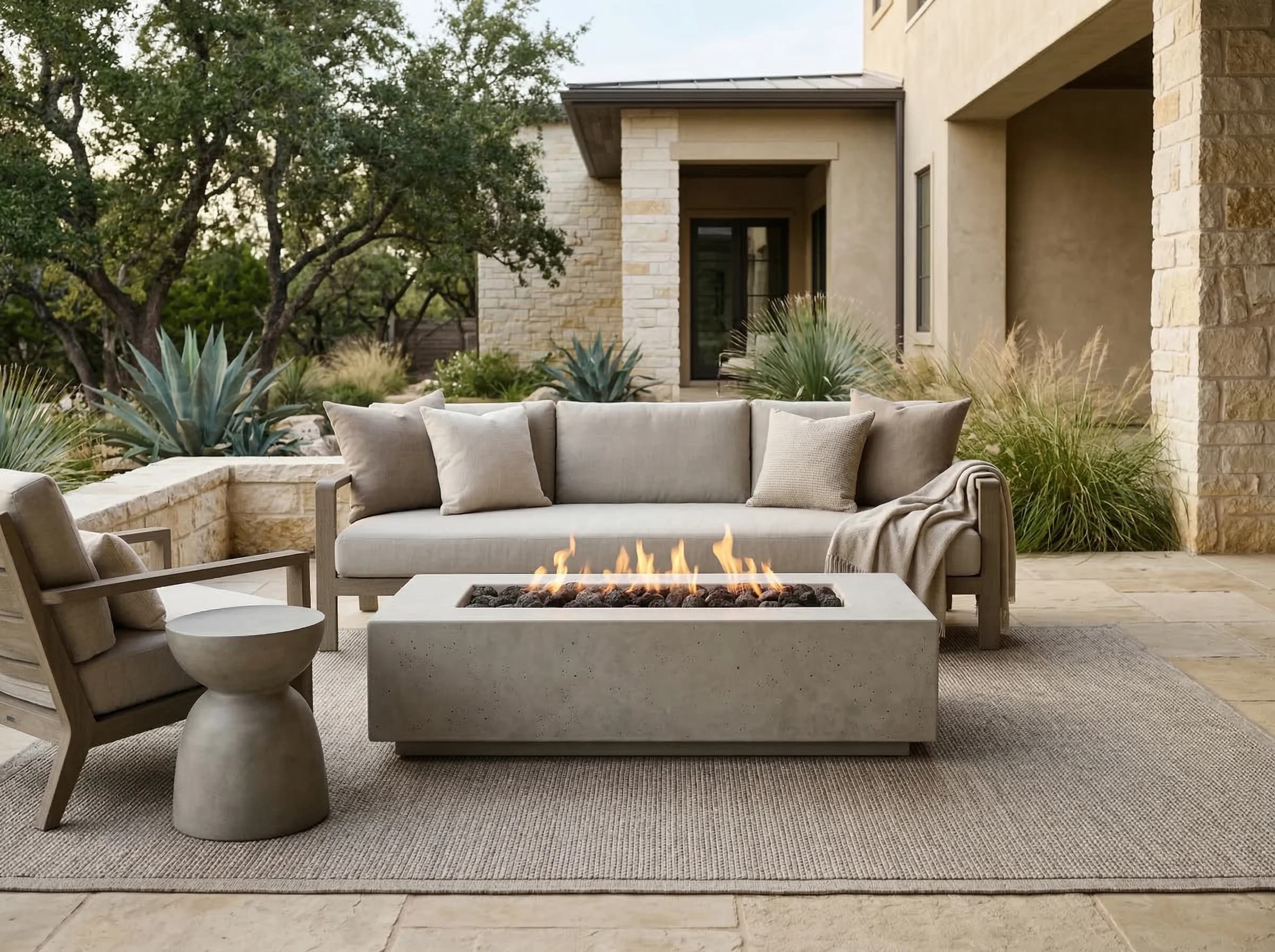
Concrete reads architectural and quiet. The fire feature sits as an integrated design element — a monolithic form that shares visual DNA with the hardscape, the walls, and the pool coping around it. When specified in Pewter or Charcoal for modernist palettes, concrete visually recedes and lets the flame become the focal point. When specified in Sandalwood or Cafe for Tuscan or Southwestern palettes, it reads as warm textural. Concrete fire features photograph beautifully in architectural-magazine spreads specifically because they read integrated rather than added-on.
Stainless steel reads engineered and reflective. The fire feature is a visible object that catches light, reflects surroundings, and asserts its presence. Best in outdoor spaces that already speak metal-and-glass — outdoor kitchens with stainless appliances, modern railings, glass windbreaks, or steel-and-cable pergolas. Stainless is also lower visual weight, which matters in smaller patios where a heavy concrete silhouette would dominate.
Corten steel (a third option, offered by The Outdoor Plus) sits between these two — industrial and weathered rather than reflective. Reads modern-farmhouse or contemporary-desert. Different aesthetic conversation entirely from either GFRC concrete or bright stainless.
Heat Performance
The material has essentially no effect on radiant heat output. Both concrete and stainless steel are heat-conductive enough that the surface warms during use, and the flame itself provides the same warmth regardless of what surrounds it. BTU rating drives radiant coverage, not the material choice.
One marginal difference worth noting: concrete has slightly higher thermal mass, so a concrete fire table stays warm to the touch for 30-45 minutes after the flame goes out. This can be a positive (residual warmth at the seating surface after extinguishing) or a safety concern (kids or pets touching the surface after the flame is gone). Stainless steel cools within 10-15 minutes of flame-out.
Maintenance Reality
Concrete benefits from a sealer refresh every 2-3 years, which is a 30-minute DIY task with a spray-on penetrating sealer ($40-60 per bottle). Skip the sealer and the concrete develops a light natural patina over time that many buyers actually want. Cleaning is a soft brush and water; avoid pressure washing which can etch the finish.
Stainless steel requires no sealer or coating maintenance because the material itself is corrosion-resistant. Cleaning is a mild soap solution and a soft cloth; avoid steel wool or abrasive pads which scratch the finish. In coastal or hard-water areas, an occasional wipe-down with a stainless steel polish keeps the reflective finish looking new.
Both materials benefit from a matching cover during off-season use to protect the internal burner tray from rain and debris. The exterior material handles weather fine; the stainless burner tray inside does not want to sit full of rainwater over a winter.
Who Should Buy Which
Buy a GFRC concrete fire table (Prism Hardscapes) if your outdoor space is designed by an architect or landscape architect, if the fire feature needs to match existing hardscape colors, if you want a monolithic architectural silhouette, and if you’re willing to plan around the installation weight. Best in Pewter or Charcoal for modernist palettes, Cafe or Sandalwood for warm-neutral. Lead times are 3-5 weeks standard, 6-10 weeks for custom colors. About $3,800-9,500 depending on size.
Buy a marine-grade stainless steel fire pit table (The Outdoor Plus 304 or 316) if your outdoor space has other metal elements to rhyme with, if you value reflective and engineered aesthetics, if the fire feature might move to a different patio location someday, and if you want a shorter lead time. Best in 316 grade for coastal or poolside installations. Lead times are 1-2 weeks for stock, 6-10 for custom. About $3,600-7,000 depending on size and grade.
Buy a corten steel fire pit table (The Outdoor Plus corten line) if you want a middle-ground material — the industrial-weathered look sits between concrete’s architectural quietude and stainless’s bright reflection. Corten is the volume-seller in TOP’s lineup for a reason: it fits modern-farmhouse, contemporary-desert, and industrial-loft design contexts that neither concrete nor bright stainless fully addresses. About $3,800-5,200.
What to Confirm Before You Order
Verify the underlying structure can carry the weight if you’re specifying concrete. Standard on-grade patios are fine; elevated decks, roof decks, and raised pool copings warrant a structural check for concrete pieces over 400 pounds.
Verify the color or finish reads correctly against your existing hardscape at typical viewing distance. Both concrete and stainless manufacturers will ship physical samples for design projects — use them.
Order the matching cover with the fire pit regardless of material. $150-450 well spent.
Confirm your fuel type at order (natural gas vs propane). Field-converting requires a licensed gas fitter and a conversion kit either way.
Order 4-6 weeks before you need the piece in place. Stainless steel stock configurations ship faster; concrete is always order-to-cast. If you have a specific completion date, the fire feature is usually the long pole in the tent.
Frequently Asked Questions
Which lasts longer, concrete or stainless steel?+
Which is cheaper?+
Which handles cold weather and freeze-thaw cycling better?+
Which is easier to install?+
Which looks better in a modern design context?+
Do either need to be covered during off-season?+
Products & brands in this guide
Related reading
Reed — Reed writes the buying guides at BBQs.com — fifteen years selling and installing built-in grills means the picks here are what we'd actually put in our own outdoor kitchen.