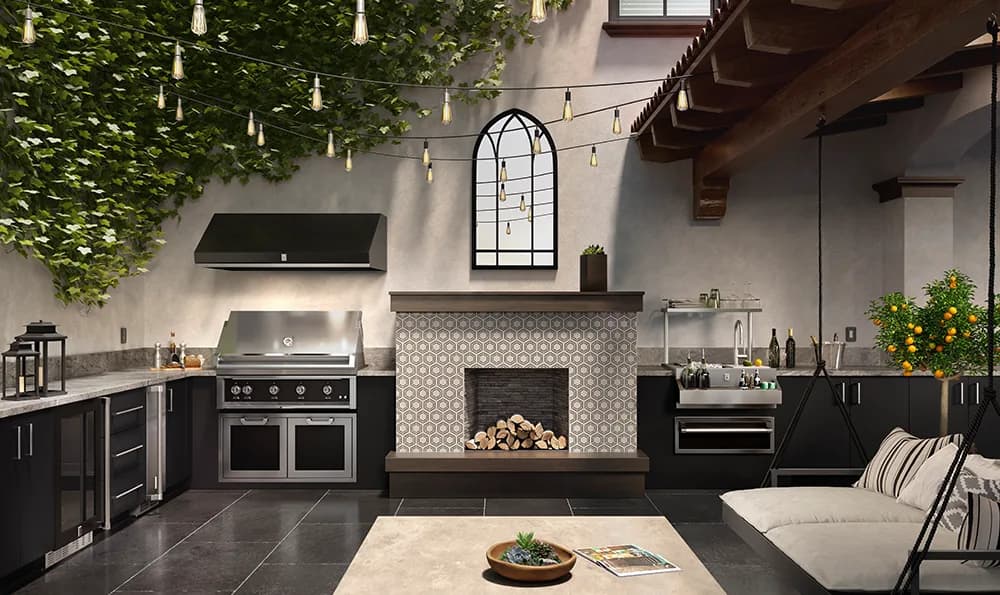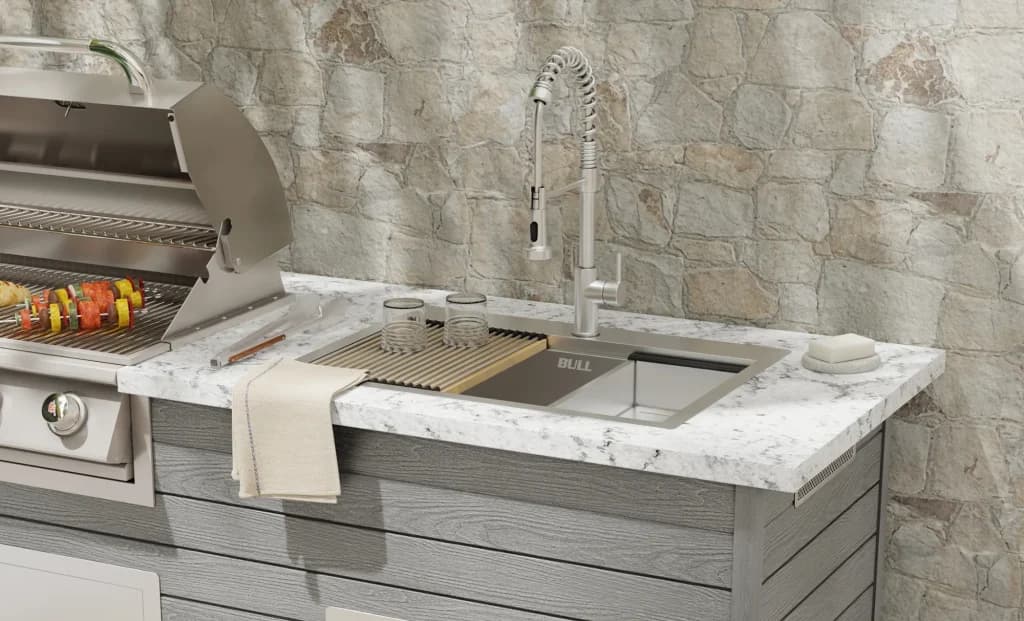
I've been selling the Bull BBQ Angus for years, installing them into stone islands from coastal patios to inland Idaho backyards, and running warranty claims when something breaks. That's the vantage point this review comes from — not a spec-sheet writeup and not a manufacturer press release. The Angus is the grill I recommend more often than any other single model in the $2,500 to $3,500 range, and it's also the grill I've told buyers to skip when their use case pointed elsewhere. This is the honest read: what the Angus is excellent at, what it isn't, and who should actually spend $2,839 on one.
What the Angus Is Built For
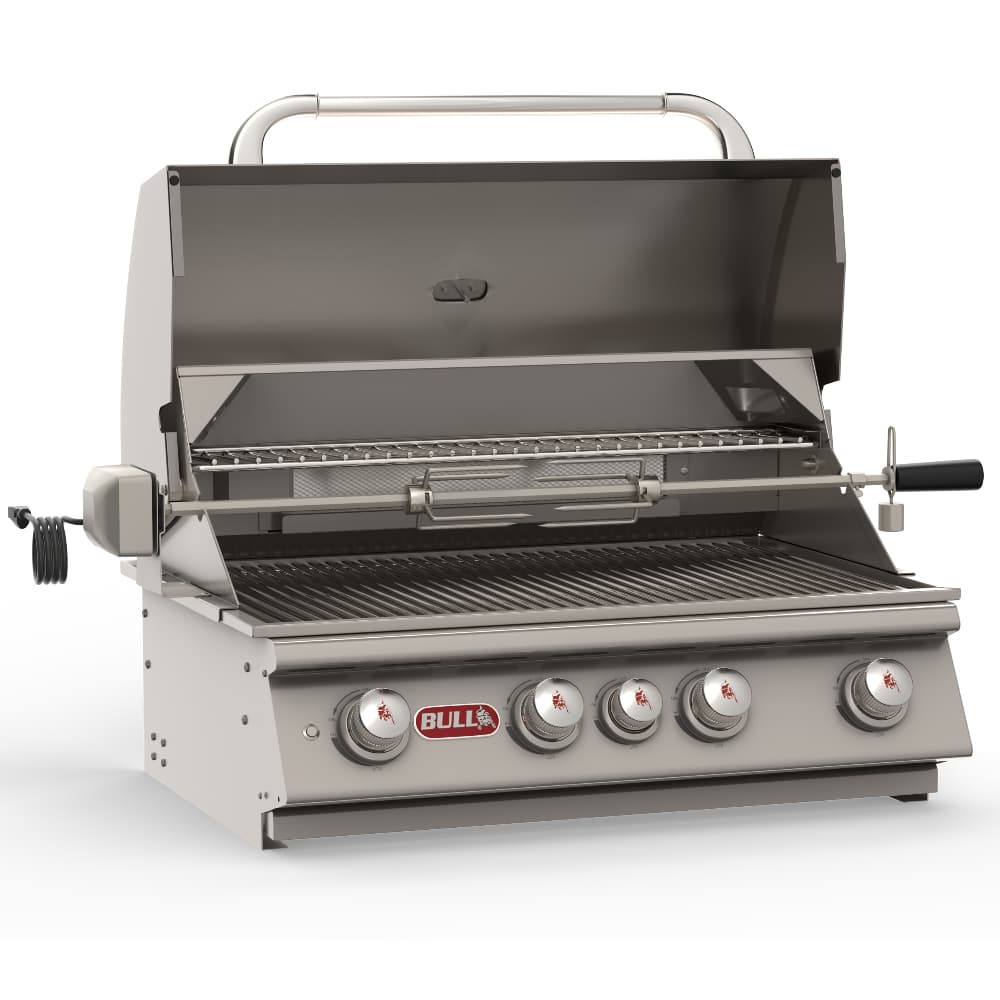
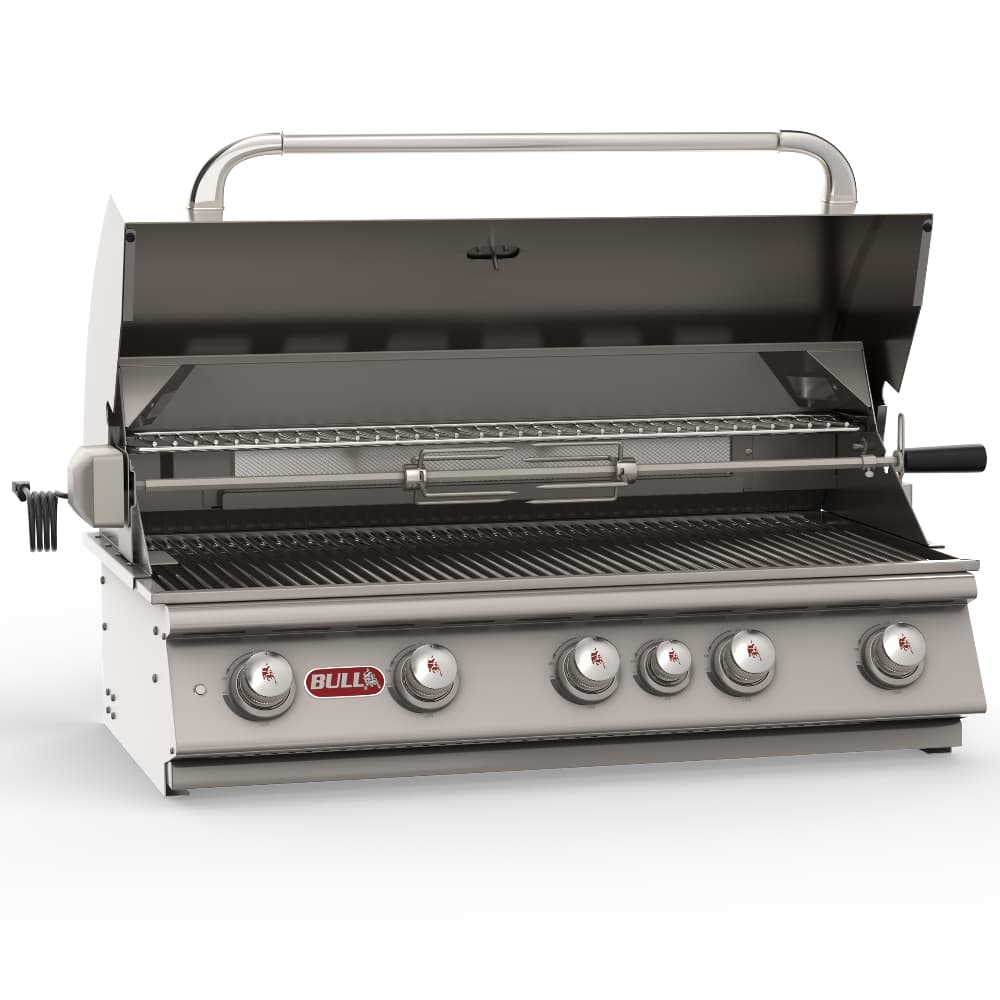
- 60,000 BTU main across 4 burners
- 10K rear infrared rotisserie burner + cast kit
- 304 stainless, 8mm grates, halogen interior
- Lifetime warranty — made in Chatsworth, CA
Bull’s outdoor grill lineup ladders in a clear order: Lonestar Select at the entry tier (around $1,900 for a 30-inch built-in), Angus in the mid-premium tier at $2,839, Outlaw and Brahma above it, and specialty units like the Bison charcoal and the Steer Premium topping out the range. The Angus sits at the exact spot where Bull moves from ‘good gas grill’ to ‘serious dealer-tier product’ — it’s the smallest configuration in the line that gets the full warranty structure, the rotisserie hardware, and the halogen interior lighting.
Positioning-wise, the Angus is aimed at the buyer building a proper outdoor kitchen who doesn’t need the 5-burner Brahma footprint. 60,000 BTU across four main burners is enough grill for a family of four cooking regularly plus occasional weekend crowds of eight to ten. The rear infrared rotisserie plus cast rotisserie kit gives you real whole-bird and roast capability that the Lonestar Select can’t match. And the warranty tier — lifetime on burners, cast bases, and housing — is the coverage structure that keeps this grill viable at year 12.
If you’re shopping in the $2,500 to $3,500 window and specifically buying a 30-inch built-in with rotisserie capability, the Angus is the default recommendation. Most of the alternatives at this price point are stepping down on warranty coverage (Coyote CL at 2 years on ignition), stepping down on rotisserie hardware (Summerset Sizzler doesn’t include the cast kit), or stepping up on price into Hestan Aspire territory.
The Bull Lineup Explained: Steer / Outlaw / Lonestar / Angus / Brahma
Bull’s residential lineup can look confusing from the outside because the model names don’t telegraph tier position the way Weber’s Genesis / Summit / SmokeFire naming does. Here’s the honest ladder from a dealer who moves all five: the Lonestar Select is the entry tier — 30 inches, 4 burners, 60,000 BTU main, stainless-rod grates rather than 8mm round, no rear infrared, limited-lifetime warranty structure. It’s a legitimate grill starting around $1,899 and the right buy if you’re strictly grilling steaks and burgers without any interest in rotisserie work.
The Outlaw is the value-play 4-burner at roughly $2,199 — same 60K BTU, upgraded warranty over the Lonestar, still no rear IR rotisserie. It’s Bull’s answer to Coyote C-Series at a similar price band. The Angus (this review) at $2,839 is where the lineup crosses into serious dealer-tier build — 8mm round 304 grates, rear IR burner, cast rotisserie kit included, halogen interior lighting, and the lifetime warranty that covers cast bases and housing, not just burners. This is the smallest grill in the line that gets the full warranty treatment.
The Brahma at $3,789 is the 38-inch, 5-burner flagship residential — same 304 build, same 8mm grates, same lifetime warranty, just scaled up with 15,000 more main BTU and roughly 180 more square inches of grate. And the Steer Premium at 60 inches sits above the residential line entirely — a 7-burner, dual-rotisserie head built for permanent outdoor kitchens with matching Bull refrigeration and side burners. Steer is the anchor-grill spec for a full outdoor kitchen build; it’s not the right grill for a drop-in island retrofit. See the full Bull brand page for the complete residential lineup.
Build Quality — What 304 Stainless + 8mm Grates Actually Get You
The Angus is 304-grade stainless throughout — hood, burner box, grates, structural. The distinction between 304 and 430 stainless matters more than most buyers realize: 304 contains roughly 8 percent nickel where 430 has almost none, and that nickel is what gives 304 its rust resistance in salt air. On a coastal install, a 430 grill starts pitting in year two. A 304 grill like the Angus doesn’t. I’ve pulled Angus grills out of oceanfront installs 8 years in with only minor surface oxidation on the exterior panels — the burners and structural components look factory-fresh. See our 304 vs 430 stainless breakdown for why this metallurgy call is the biggest single durability decision on a built-in.
“In eight years of coastal installs I’ve yet to pull a rusted-through Angus. Put a 430-grade competitor on the same salt-air deck and we’d already have replaced the whole head twice.”
The 8mm diameter round cooking grates are the spec that separates a real built-in grill from a promotional-tier unit. Thinner grates (5mm to 6mm) deflect under a rack of ribs or a full brisket, transfer heat unevenly, and warp within 3 to 5 years of use. The 8mm round grates on the Angus hold their shape under load — I’ve seen them still perfectly true 10 years in. They also mass up enough to deliver visible sear marks without the burner needing to over-fire, which is where the ‘more BTU is better’ myth breaks down (see our BTU sizing guide for the math).
Where the Angus doesn’t match Hestan-tier build: the stainless gauge on the hood is lighter than a Deluxe hood, the pivots are fastened rather than welded, and the interior finishing has occasional visible weld beads that a $7,000 grill wouldn’t. Bull is not restaurant-grade construction — it’s serious residential construction. That’s the honest distinction and it’s reflected in the price gap.
Warranty Deep Dive: What Bull Actually Covers
Warranty structure is the second-most-scrutinized spec on any dealer-tier built-in (right after BTU-per-square-inch) and it’s where a lot of brands quietly cut corners at this price. Here’s the current Bull residential warranty on the Angus tier, as we’ve actually run claims: lifetime on the main stainless burners, lifetime on the cast stainless housing and cast burner bases, 5 years on the cart and stainless components, 2 years on the valves and manifold, and 1 year on ignition electronics — piezo modules, wiring harnesses, halogen light components. Rotisserie motors get 1 year.
What that means in practice: the two most expensive parts of the grill (burners and housing) are covered for the life of the original owner. Everything else is a wear-and-repair item after year 1 to 5. We’ve run warranty claims on Angus burners at year 7 and 9 and Bull shipped replacements without an argument — I filed the claim with photos and the serial number, and the burners were on our doorstep within 5 business days. That responsiveness is the operational reality behind the warranty language, and it’s a real dealer differentiator versus overseas brands where claims can take 6 to 8 weeks and require you to ship the failed part back at your expense.
Honest weak spot in the warranty structure: 1-year coverage on ignition electronics is where you’ll eventually pay out of pocket. Piezo modules typically die between year 5 and 7 of daily use. Replacement piezo assemblies run roughly $40 to $80 and take 20 minutes to swap — not a crisis, but it’s the maintenance cost you should budget for at the 6-year mark. Bull’s flash-tube backup means the grill remains lightable with a stick lighter even after the piezo fails, so it’s never a lose-the-cook situation, just an eventual repair call.
Performance — 60,000 BTU Across 4 Burners
Angus primary zone — above the 100 BTU/sq-in threshold that separates real gas grills from big-box specials.
Four rust-resistant stainless steel main burners at 15,000 BTU each. Total main output is 60,000 BTU across roughly 540 square inches of primary grate — that math lands at 111 BTU per square inch, which sits above the 100 BTU per square inch threshold I use as the ‘good gas grill’ floor on our BTU guide. Below 90 BTU/sq-in and the grill struggles to recover heat when the lid opens on a cool evening. Above 130 and you’re over-firing the hood cavity. The Angus lands cleanly in the sweet spot.
Real cooking numbers: primary-zone temperature hits 500 to 650F on high with the lid closed within about 8 minutes of light. That’s enough for a proper crust on ribeyes without the surface temperature dropping catastrophically when you open the lid. Two-zone cooking works well on the 4-burner layout — light the outer two, leave the inner two off, and you have a genuine indirect zone big enough for two racks of baby-backs at 275F for 4 hours. This is a grill that actually cooks both hot and low, which is not something you can say about every 30-inch built-in in this price range.
Where the Angus underperforms: the burner spacing is even but not exceptional, so you’ll get slightly hotter spots directly over each burner tube compared to a Hestan trellis layout that spreads heat more uniformly. In practice this means learning where your grill runs 25 to 50 degrees hotter and using that map — not a defect, just a characteristic of tube-burner construction that no gas grill under $5,000 fully escapes.
The Infrared Rotisserie — Real or Gimmick?
Real. The 10,000 BTU rear infrared rotisserie burner is the Angus-specific feature (this is the ‘with rear infrared burner’ variant, not the base 4-burner without) and it’s the biggest single reason to buy this configuration over the cheaper Lonestar Select. The infrared burner sits behind the grate at hood height, radiating heat forward onto whatever’s spinning on the rotisserie rod. Because it’s radiant rather than convective, it cooks skin and exterior crust evenly across a whole bird in a way that a top-burner setup can’t match.
Real numbers from cooking on it: a 5 to 6 pound whole chicken finishes in 45 to 60 minutes at IR-medium with beautifully crisp skin all the way around. A 4-bone prime rib takes about 90 minutes to hit 125F internal for medium-rare, needs a rest, and comes off with an even mahogany crust. Overnight prime rib (low IR setting, roughly 225F cavity, 8 hours) produces the best beef I’ve cooked on any residential grill. The included cast rotisserie kit — motor, rod, forks — is heavy enough to handle up to a 20-pound turkey without wobble.
Honest downsides: it’s a single-speed rotisserie motor, no digital thermometer or probe integration, and no forward-facing infrared for searing (the burner points backward, not down at the grate). If you want probe-driven cooking automation, you’re in Hestan territory at triple the price. If you want an infrared sear zone under the food, look at Coyote C-Series or step up to the Bull Brahma. For rotisserie work specifically, the Angus setup is legitimately excellent.
Bull vs Weber vs Napoleon: Where Bull Actually Wins
Three brands come up in every Angus cross-shop conversation: Weber (Summit built-in), Napoleon (Prestige Pro built-in), and Bull. All three are legitimate dealer-tier grills; each wins in different places. Here’s the head-to-head at the 30-inch, 4-burner built-in tier — same footprint, same category, comparable price bands.
| Spec | Bull Angus 30 | Weber Summit S-460 BI | Napoleon Prestige Pro 500 BI |
|---|---|---|---|
| Main BTU (main + IR) | 60K + 10K IR | 48K + 10.6K IR | 48K + 18K IR |
| Cooking area (sq-in) | 540 primary / 810 total | 468 primary / 692 total | 500 primary / 760 total |
| Stainless grade (hood/body) | 304 throughout | Mixed 304/430 | Mixed 304/430 |
| Warranty (burners) | Lifetime | 10 years | 15 years |
| Country of origin | Chatsworth, CA (USA) | USA + China assembly | Canada |
| Price band | $2,839 | $3,699 | $3,199 |
Where Bull wins: metallurgy (304 throughout versus mixed grades), warranty tier (lifetime burners versus 10-15 years), USA fabrication, and price — the Angus is meaningfully cheaper than either Summit or Prestige Pro at this footprint. Where Bull doesn’t win: Napoleon’s 18K infrared side burner is stronger than Bull’s 10K IR rear if searing is your primary use case, and Weber wins on ecosystem — the Weber Connect app and the SmokeFire pellet family are things Bull doesn’t compete with at all. If you want app-driven temperature control or you’re building around a pellet grill, Weber is a defensible buy. For traditional gas built-in at 30 inches, Bull is the value leader in this comparison.
What the Angus Is NOT
It’s not the largest built-in Bull makes. 30 inches means one whole packer brisket at a time, not two side-by-side. If you regularly cook for 12 or more, the Brahma at 38 inches with 5 burners is the correct spec. Trying to force a 30-inch grill to feed a bigger crowd works occasionally and disappoints reliably.
It’s not the fanciest. No color finish options (Hestan offers 12; Coyote offers a handful of accent colors), no integrated smoker box (you’re running a smoker tube on the grate), no forward-firing infrared main burners like the Brahma’s all-IR configuration. The interior lighting is halogen rather than LED — brighter than nothing but not the color-adjustable LED you’ll find on premium tier grills.
It’s not the cheapest, either. Starting at $2,839, the Angus sits meaningfully above Summerset Sizzler (around $2,100), Coyote CL (around $2,300), and Bull’s own Lonestar Select (around $1,900). Buyers focused primarily on cost-per-square-inch can find equivalent BTU-per-square-inch numbers in the entry tier — what they lose is the rotisserie hardware, the warranty coverage, and the interior lighting. Not always the right tradeoff, but a real one.
Real Bull Owner Complaints (And What We Tell Customers)
Any honest dealer review has to acknowledge what people don’t love. Here are the three complaints we hear most from Bull owners after year one, and what we tell customers considering the Angus.
Complaint 1: it’s heavy. The Angus head weighs roughly 150 pounds. Getting it into an island cutout requires two people, and pulling it back out for major service or resale is a real project — this isn’t a grill you’re going to move casually. What we tell customers: this is a feature, not a bug. The weight comes from the 304 stainless gauge and the cast burner bases, which are exactly why the grill lasts 15 years instead of 7. If you plan to move houses, plan for a two-person lift or a professional grill installer at the destination.
Complaint 2: no interior lighting on the lower models. The Angus does have halogen interior lights, but Lonestar Select and Outlaw owners routinely complain about grilling by phone flashlight at 9pm in fall. What we tell customers: this is one of the real reasons to step up from Outlaw to Angus if you cook past sunset. The halogen isn’t LED-fancy, but it’s bright enough to see grill marks. Retrofitting lighting into a lower-tier Bull head is not practical.
Complaint 3: painted parts on the cart weather faster than the stainless. On the freestanding Angus variants, the powder-coated cart wheels and lower cabinet panels can chip and rust in coastal or salt-air environments where the stainless head above them looks factory-fresh 8 years in. What we tell customers: the built-in Angus (this review) sidesteps this entirely because there’s no cart — just the stainless head dropped into stone. If you’re on the freestanding version and living within a mile of salt water, plan on repainting or touching up the cart parts every 3 to 4 years.
Compared to Bull Brahma
| Spec | Lonestar Select | Angus | Brahma |
|---|---|---|---|
| Burners | 4 | 4 | 5 |
| Main BTU | 60,000 | 60,000 | 75,000 |
| IR Rotisserie | No | Yes — 10K | Yes — 10K |
| Grate material | Stainless rod | 8mm 304 rod | 8mm 304 rod |
| Cook surface | ~810 sq in | ~810 sq in | ~1,020 sq in |
| Warranty | Limited lifetime | Lifetime | Lifetime |
| From | $1,899 | $2,839 | $3,789 |
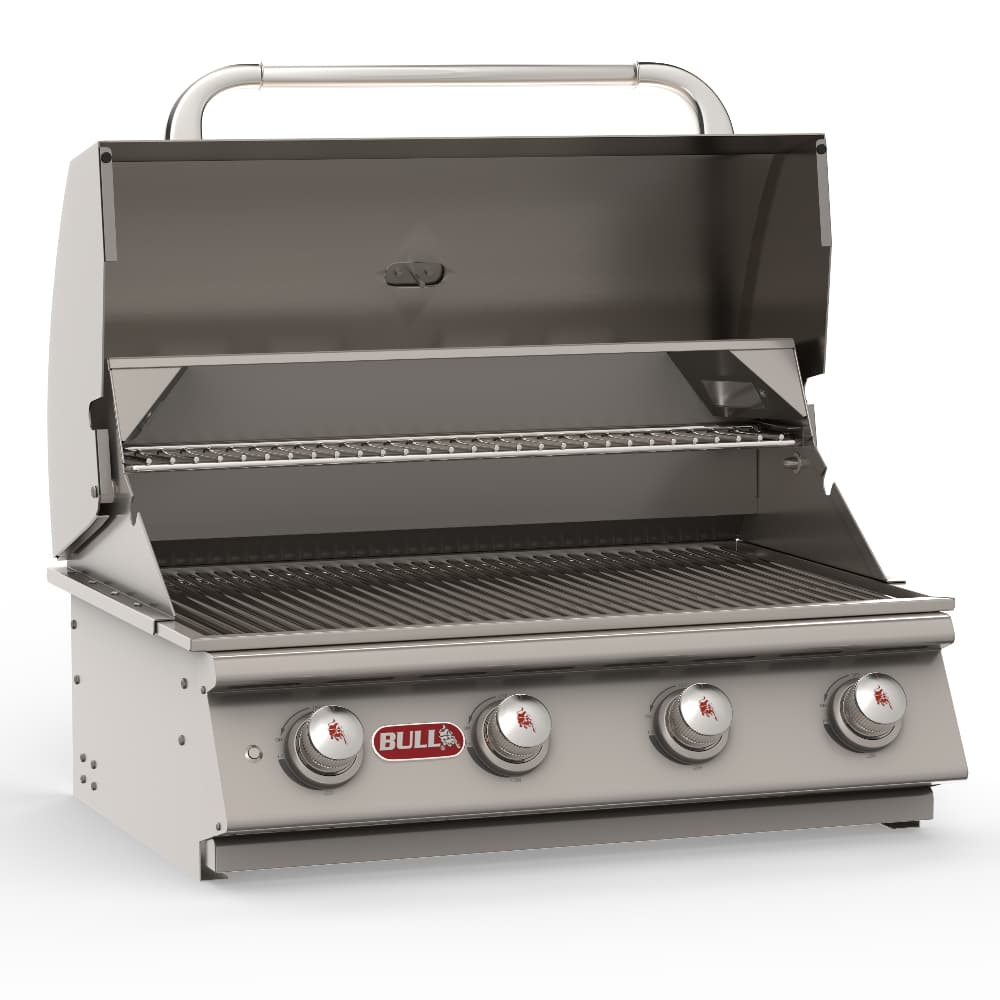
The Brahma steps up to 38 inches, 5 burners, roughly 90,000 BTU main, and adds all-infrared main burners rather than conventional tube burners. It runs approximately $1,000 more than the Angus. Worth the upcharge if you’re regularly cooking for 6-plus people or specifically want infrared searing under the food rather than just on the rotisserie. Not worth it for a family of four with occasional guests — the Angus footprint is more efficient for smaller cooks and the Brahma’s all-IR mains are overkill unless you’re truly running a steak-heavy program.
The other honest read: the Brahma’s all-infrared main burners are excellent for searing but require slightly more attention on lower-temp cooks — infrared runs hotter at the same knob position than conventional tube burners, so the learning curve on temperature management is real. If you’re coming from a standard gas grill, the Angus is the smoother transition. If you already run infrared regularly and want a full IR grill, the Brahma is the correct step up.
Bull Angus Install Requirements — What Contractors Actually Need
This section is written for the general contractor, mason, or outdoor-kitchen installer framing a chase for the Angus. Get these five spec points right and drop-in day is uneventful; miss one and you’ll be re-cutting stone.
Cutout dimensions. Standard 30-inch built-in cutout — 30.25″ wide by 22″ deep by 10″ tall for the head insertion. The head drops in from above and rests on the cutout lip. Frame the interior chase to at least 32″ wide by 24″ deep to give service clearance behind the manifold. Bull publishes exact millimeter dimensions in the current owner’s manual — always verify against the specific model year rather than trusting an older spec sheet.
Combustible clearances. Minimum 6″ clearance from the sides of the grill head to any combustible material (wood framing, composite decking, stained cedar cladding). Minimum 24″ vertical clearance from the top of the closed hood to any overhead combustible. If the island framing uses metal studs and non-combustible cement board, these clearances are easily met. Wood-framed islands with cedar cladding need careful spacing and often benefit from a heat-shield insert kit.
Gas line size. 3/4″ minimum black iron from the meter to the grill for the full 70,000 BTU load (60K main + 10K rear IR). Longer runs (over 25 ft) may warrant stepping up to 1″ to prevent pressure drop. Terminate with a shutoff valve inside the island cavity — accessible without disassembling the grill head — and use a stainless flex connector for the final connection to the manifold.
Electrical. Halogen interior lighting requires 120V power. Rough in a weatherproof GFCI receptacle inside the island cavity during framing — retrofitting through finished stone costs $300 to $500 and involves core-drilling. If skipping interior lighting entirely, no electrical is required.
Ventilation. Hood is optional for uncovered patio installs — no vent required if the grill sits under open sky. If the grill is enclosed under a solid roof, awning, or covered patio, an outdoor-rated vent hood sized to the grill footprint is required — 36″ minimum for a 30″ grill, roughly 900 CFM extraction, mounted 36″ to 42″ above the cooking surface. See our vent hoods sizing guide for full install specifics and the code language most jurisdictions enforce.
What It Costs (Really) — From $2,839 + Delivery + Cutout Modification
Grill price starts at $2,839. Freight to most of the country runs $150 to $350 curbside; inside delivery and placement into the island adds another $200 to $400 depending on the installer. If the mason built the cutout to spec, drop-in is essentially free. If the cutout needs modification (a concrete or stone cut to true it up), budget roughly $100 for concrete-cut labor.
Halogen interior lighting requires 120V power at the grill location — if you don’t have a receptacle in the island already, that’s a $300 to $500 electrician call to run a dedicated line with a weatherproof receptacle. Some installs skip the electrical entirely and simply don’t use the halogen lights; that’s a valid choice, particularly if the grill is under adequate ambient lighting.
Gas line install if you’re starting fresh: $200 to $800 depending on run length and whether the meter needs upgrading. Fitted Bull cover: $180 to $220 and non-negotiable in my recommendation — the freeze-thaw damage a cover prevents pays for the cover within two winters. Realistic all-in cost with cover, delivery, install, and any minor electrical: $3,200 to $3,800. That’s the honest number to budget for a Bull Angus in a new outdoor kitchen, and it’s the number worth quoting up front rather than discovering later. Ready to spec one? Browse the full built-in grill category to cross-shop the Angus against its siblings and competitors.
Frequently Asked Questions
Are Bull BBQ grills any good?+
Where are Bull grills made?+
Bull vs Weber Summit — which for a built-in?+
How long does a Bull grill last?+
What's the Bull warranty actually cover?+
Bull Angus vs Bull Brahma — which for a family of 4-6?+
Can I add rotisserie to the Angus later?+
Do I need a vent hood over a Bull built-in?+
Is the Bull Angus worth it vs the Lonestar Select?+
Is the Angus infrared rotisserie any good?+
Can you use the Angus in the rain?+
What size cutout does the Bull Angus need?+
Products & brands in this guide
Related reading
Reed — Reed writes the buying guides at BBQs.com — fifteen years selling and installing built-in grills means the picks here are what we'd actually put in our own outdoor kitchen.