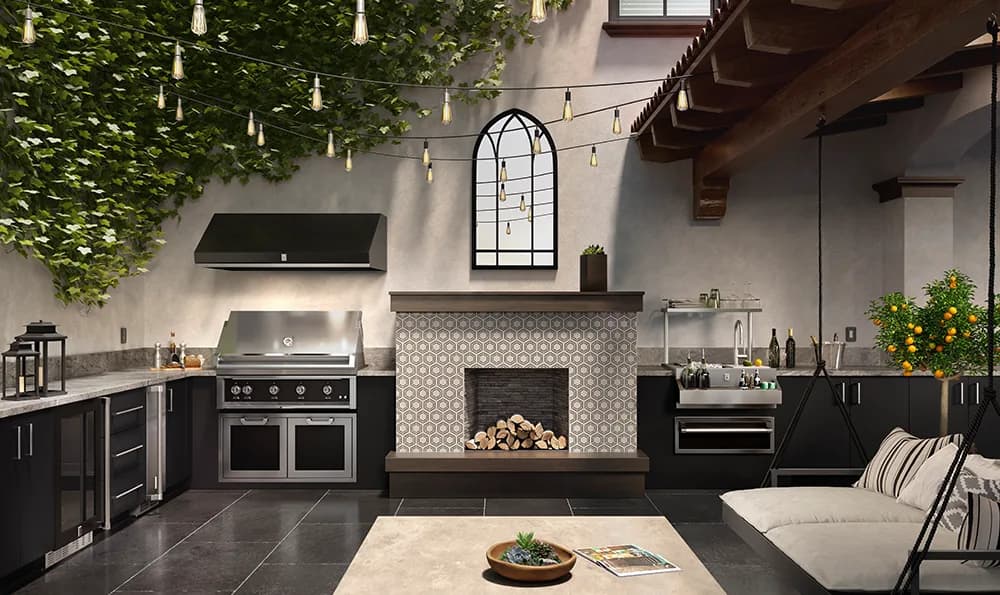
Vent Hoods for Built-In Grills: Sizing, Install, and What Nobody Tells You
By Reed · Published August 2026
Every year we get a call from a homeowner whose new built-in grill just stained the underside of their patio ceiling. The grease-vapor cloud built up under the covered structure for six months, condensed on the wood, and turned the framing into something a contractor now has to replace. All of it was preventable with a properly-sized vent hood — a component that's almost never in the initial outdoor kitchen budget until it's too late.
When a Hood Is Actually Required
Any built-in grill installed under permanent overhead structure needs a hood. Full stop. That includes covered patios, pergolas with solid roofing, breezeways, and any island installation with a ceiling within six feet of the grill grate.
Local mechanical codes vary, but the underlying principle doesn’t: combustion products and grease vapor need to leave the space, and they will not do so passively under a solid roof. Even an open-sided pergola with a solid top traps enough vapor to stain wood, corrode fasteners, and pose CO risk to anyone standing under it.
If the outdoor kitchen has a roof of any kind — including louvered pergolas set to closed and roll-out awnings — it needs a hood. The couple of feet of air gap between the grill hood and the structure above isn’t enough to move vapor at real cook rates.
The CO Risk Nobody Talks About
A 60,000-BTU grill under a covered patio consumes roughly 60 cubic feet of natural gas per hour. That combustion produces carbon monoxide, water vapor, and combustion byproducts that pool under any horizontal surface above the grill. In a fully-enclosed structure it’s a life-safety issue. In a partially-enclosed structure it’s a comfort and material-damage issue.
We’re not being alarmist — we’ve been in outdoor kitchens where ceiling temperature above an unhooded grill measured over 180F after 20 minutes of cooking. That’s structural damage territory, and CO is invisible until symptoms appear.
A properly-sized hood pulls that whole vapor plume up and out at the moment it forms. Without one, you’re relying on lateral airflow through gaps in the structure — and lateral airflow doesn’t beat hot air rising into a ceiling.
Sizing: The 100 CFM Per 10,000 BTU Rule
For outdoor cooking under a hood, the rule of thumb is 100 CFM of exhaust per 10,000 BTUs of total grill capacity, then add a safety margin. A 30-inch built-in publishing 75,000 total BTUs needs at least 750 CFM baseline — but for outdoor use where wind can back-pressure the hood and grease loads are higher than indoor cooking, we target 1,200 CFM minimum on that same grill.
For a 36-inch grill at roughly 90,000 BTUs, target 1,500 to 1,800 CFM. For a 48-inch grill or a grill-plus-side-burner setup at 120,000-plus BTUs total, target 2,000 CFM or higher. Undersized hoods don’t just fail to remove vapor — they get overwhelmed and start recirculating grease-laden air back into the cooking zone.
Round up on this calculation. A hood rated 200 CFM higher than you technically need is a rounding error in the total install cost, and it protects against wind conditions, duct losses, and grease-load surges that undersized hoods can’t handle.
Makeup Air
Any hood over 400 CFM needs a makeup air source. In an indoor kitchen this is code and it’s non-negotiable. Outdoors, the physics is the same — if you’re pulling 1,500 CFM of air out of a semi-enclosed space, that air has to come from somewhere or you’re depressurizing the structure.
In practice, most outdoor kitchens have enough natural infiltration through open sides to feed the hood. But if the outdoor kitchen is tightly enclosed (three solid walls plus a solid roof plus a partial fourth wall) or shares HVAC with the house through a passthrough, plan for a dedicated makeup air path from the start.
Ignoring makeup air is why some outdoor hoods ’don’t work’ after install — they’re actually working fine but can’t pull air against the pressure gradient the enclosed structure creates. The fan spins, no vapor moves. Fix the makeup air path and the same hood suddenly performs at spec.
Insert vs Canopy vs Island Hood
Insert hoods slide into a custom-built hood shell, typically stucco or stone. They’re the highest-end look, the most expensive to install, and the best match for island installations with a full masonry chase built to receive them. Plan the insert dimensions before the mason lays a single block.
Canopy hoods hang under an existing overhead structure — the ceiling of a covered patio. They install faster and require less structural work. For most retrofits, canopy is the right pick because it doesn’t require reconfiguring the outdoor kitchen chase.
Island hoods drop from a ceiling over a freestanding cooking island; they need robust ducting up through the ceiling to an exterior termination, which is where island installs get expensive. Match hood style to the outdoor kitchen architecture before you shop the hood, not after.
Brand Comparison
Zephyr Tempest II is our most common recommendation for premium outdoor installs. It publishes 1,200 to 2,000 CFM depending on model, uses 304 stainless throughout, and Zephyr’s outdoor line is UL-listed for exterior installation — an important detail because indoor hoods installed outdoors are not warranted and generally void insurance in the event of a fire.
Vent-A-Hood’s outdoor Magic Lung technology handles grease loads better than most competitors and comes in exterior-rated finishes. Trade Wind builds heavier-gauge stainless than most peers and is popular with builders because their outdoor sizing charts are conservative — they oversize rather than undersize as a matter of design policy.
Any of these three are defensible picks. The differentiator is CFM at your specific grill size and installation type, plus finish match to the rest of the outdoor kitchen. Zephyr wins on quiet operation; Vent-A-Hood wins on grease handling; Trade Wind wins on sizing headroom.
Install Requirements
An outdoor hood is a permitted, electrical, and often gas-adjacent install. Plan for a dedicated 20-amp GFCI circuit, ducted (never recirculating) exhaust with a stainless duct rated for exterior use, and a code-compliant roof or wall termination with a backdraft damper.
Duct runs matter more than most buyers realize — every 90-degree elbow reduces effective CFM by roughly 10 percent, and every 10 feet of straight duct reduces CFM by roughly 5 percent. A hood rated 1,500 CFM through a 25-foot duct with three elbows may deliver only 1,050 CFM at the hood face.
Size up for real-world duct routing, not the nameplate CFM. The published CFM on the box assumes an ideal duct run that doesn’t exist in most outdoor kitchens. Your installer should be doing this math before ordering the hood.
Maintenance
Grease filters need washing every four to six weeks during grilling season — put them in the dishwasher on a hot cycle with a degreaser tab. The baffle behind the filter needs annual cleaning; grease buildup there is a fire hazard, not just an efficiency issue.
Duct interiors need professional cleaning every two to three years for a residential outdoor kitchen. Commercial kitchens do this every three months by law — residential outdoor installs get away with less frequency because usage is lower, but ’never cleaned in 15 years’ is how grease-fire callbacks happen.
Budget $200 to $400 for a professional duct clean, once every two or three years. That’s cheaper than a grease fire, cheaper than a warranty claim on a scorched duct, and cheaper than a homeowner’s insurance claim if the fire spreads to the structure.
What to Skip
Skip recirculating hoods for outdoor installs. They exist, they’re marketed to homeowners who don’t want to run ductwork, and they don’t actually remove combustion products — they filter grease and blow the CO and moisture back into the space. If your outdoor kitchen can’t be ducted to an exterior termination, it probably shouldn’t have a permanent grill under a solid roof.
Skip ’universal’ hoods that don’t publish outdoor UL listing. Skip any hood without variable-speed control — you want the ability to run at 30 percent for smoke-free grilling and 100 percent for a full sear session, and single-speed hoods only offer one of those.
Skip anything under 900 CFM for a 30-inch built-in regardless of what the marketing claims. The math doesn’t lie. If the hood is undersized, the outdoor kitchen won’t work the way you expect and the ceiling above will pay the price over time.
Frequently Asked Questions
Do I actually need a vent hood over my outdoor grill?+
How many CFM does my outdoor grill need?+
Can I use an indoor vent hood outdoors?+
Should I get a canopy hood or an insert hood?+
Do outdoor vent hoods need makeup air?+
How often do I need to clean an outdoor vent hood?+
Products & brands in this guide
Related reading
Reed — Reed writes the buying guides at BBQs.com — fifteen years selling and installing built-in grills means the picks here are what we'd actually put in our own outdoor kitchen.