Where Are Bull BBQ Grills Made? American Factory Facts (2026)
By Reed · Published October 2026
Bull BBQ grills are manufactured in the United States across three company-owned facilities — Athens, Tennessee (also corporate HQ since 2025), Rialto, California, and Ontario, California. Founded in 1992 by Mark Nureddine, Bull welds, casts, and assembles every grill head on American soil, which puts it on a very short list of premium outdoor grill brands that can honestly use the FTC's 'Made in USA' designation. Updated October 2026.
The Short Answer: Three American Factories
Bull Outdoor Products operates three US manufacturing facilities, which is more domestic fabrication footprint than any other dealer-tier grill brand we carry on bbqs.com. The breakdown, per Bull’s own company history and verified against our warranty-parts fulfillment records:
Athens, Tennessee — 40,000 square feet. Acquired by Bull in 2008 from an island manufacturer and expanded to the current footprint by 2010. In 2025, Bull relocated its corporate headquarters from California to this facility, consolidating executive functions, warranty operations, and parts fulfillment in Tennessee. Grill head fabrication, polishing, and final assembly all happen here. If you’ve filed a warranty claim on a Bull grill in the last twelve months, the replacement part shipped from Athens.
Rialto, California — 35,000 square feet. Opened in 2009 to add West Coast fabrication capacity as outdoor-kitchen demand grew. Rialto is roughly an hour east of downtown Los Angeles in San Bernardino County. This plant handles stainless steel cutting, welding, and polishing for a significant portion of the production that eventually ships to Western dealers.
Ontario, California — 20,000 square feet. The oldest of the current facilities, opened in 2000 and expanded in 2003. Ontario sits in the Inland Empire about ten miles from the Rialto plant and handles production of smaller components and sub-assemblies that feed into both grill-head fabrication lines.
Combined US manufacturing footprint: roughly 95,000 square feet across three sites. For comparison, most competing “US-made” grill brands run a single plant under 25,000 square feet, which is part of why Bull can hold warranty parts in stock across the full product line rather than running out and backordering common service items.
Why Most “American” Grill Brands Aren’t Actually Made Here
Out of the roughly 20 brands marketed as 'American' in the premium outdoor-grill category, only four — Bull, Hestan, American Outdoor Grill, and Fire Magic — fully pass the FTC's unqualified 'Made in USA' standard.
The FTC’s Made in USA Standard is stricter than most buyers realize. To claim “Made in USA” without qualification, a product must be “all or virtually all” of US origin — meaning final assembly happens here, significant processing happens here, and all or virtually all components originate here. That’s the legal test the FTC has fined companies over, and it’s what separates the real American grill brands from the marketing-American brands.
“Assembled in USA” is a weaker, more honest claim that only requires final assembly to happen domestically. The components underneath — burners, valves, castings, electronics — can be entirely imported. Several brands use this qualified language precisely to stay compliant while sourcing production offshore. If the box says “assembled in USA” rather than “Made in USA,” the castings and burners probably came from Asia.
The third tier is companies that say nothing about country of origin at all and let the American-sounding brand name do the implying. This is where the majority of “patriotic” grill brands live. If the box doesn’t claim domestic manufacturing plainly, it isn’t domestic manufacturing. For a deeper breakdown of the brands that pass versus fail, see our full guide to grills actually made in the USA.
Where Every Top BBQ Brand Is Really Made
Here’s the honest country-of-origin table for the five brands most of our buyers cross-shop on bbqs.com. Facts verified against each brand’s own corporate materials, FTC filings where available, and our warranty-parts fulfillment addresses. Nobody else publishes this in one place because most retailers don’t want to admit how much of the “premium American” category is actually produced offshore.
| Brand | Where made | FTC claim | Founded |
|---|---|---|---|
| Bull BBQ | Athens TN, Rialto CA, Ontario CA (US) | Made in USA | 1992 |
| Hestan Outdoor | Anaheim, CA (US) — 70K sq ft | Made in USA | 2015 (outdoor line) |
| American Outdoor Grill (AOG) | City of Industry, CA (US) via RH Peterson | Made in USA | 1949 (RH Peterson) |
| Coyote Outdoor | Engineered Carrollton TX / manufactured Asia | Designed in USA (not Made in USA) | 2008 |
| Weber (Spirit) | Assembled in China | Not claimed | 1952 (parent) |
| Weber (Genesis / Summit) | Palatine & Huntley, IL assembly / mixed-origin components | Not claimed (unqualified) | 1952 (parent) |
Two surprises for most buyers in that table. First, Coyote markets heavily as a Texas-based premium American brand, and the engineering and design genuinely happen in Carrollton — but the actual grill fabrication happens through overseas manufacturing partners in Asia. Coyote never claims unqualified “Made in USA” because they can’t under FTC rules, and the carefully-chosen “engineered in the USA” language is legally honest. We still carry Coyote and recommend it — the engineering is good and the stainless specification is legitimate — but if domestic manufacturing is a hard requirement for you, Coyote is not the answer. Second, Weber Spirit, which many buyers assume is American because Weber’s Palatine headquarters is well known, is in fact assembled in China. Weber is clear about this on their own site; the perception gap is a buyer assumption, not Weber hiding anything.
What’s Made Where Inside a Bull Grill
“Made in USA” on a grill box can mean the hood was welded here while the burners came from a Chinese supplier. On Bull, it’s more thorough than that. Here’s what’s actually fabricated in Bull’s own US plants versus sourced through domestic suppliers, based on a facility tour and years of warranty parts verification:
Stainless steel fabrication (hood, body, structural panels): 100 percent US. 304-grade stainless sheet is cut, formed, welded, and polished in Athens or Rialto. No pre-formed hood assemblies shipped in.
Main burners: Cast in-house on Bull’s own equipment at the Rialto facility. This is unusual at this price point — most “US-made” grill brands buy stamped or cast burners from a shared supplier pool. In-house casting is why Bull can offer a true lifetime warranty on main burners that they’ll honor without argument.
Rear infrared burners (Angus, Brahma): US-sourced ceramic infrared assemblies from a California supplier, integrated at Bull’s fabrication facility.
Valves and manifolds: US-sourced from an industrial gas-valve supplier Bull has worked with since the mid-1990s.
Cooking grates (8mm round, 304): US-fabricated for the dealer-tier line (Angus, Brahma). The entry Lonestar Select ships with rod grates sourced through a mixed-origin supply chain, which is one of several reasons the Lonestar sits at a lower price tier.
Ignition electronics (piezo modules, wiring): Mixed-origin. The piezo units themselves are typically from a Taiwanese or Mexican supplier, assembled into the grill harness domestically. This is the one component area where Bull is genuinely international, and it’s also the component area with the shortest warranty (1 year) — the two things are related.
Final assembly, QC, pack-out: 100 percent US, in Athens or Rialto.
Why American Manufacturing Actually Matters on a Grill
The patriotic framing of “buy American” is one thing. The practical operational benefits are a different thing, and they’re what we actually tell buyers who ask whether domestic manufacturing is worth paying for on a grill. Three real differences that show up in ownership:
“A failed burner on a Bull ships from Tennessee in 3 to 5 business days. On an overseas-manufactured “American brand” grill, the same warranty claim can take 6 to 8 weeks and sometimes you’re the one paying to ship the broken part back.”
Warranty parts turnaround. When a burner fails under warranty on a Bull, replacement ships from the Athens parts warehouse in 3 to 5 business days. On overseas-manufactured brands marketed as American, the same claim can take 6 to 8 weeks and sometimes requires you to pay return shipping on the failed component. We’ve run both experiences through our warranty desk — the operational difference is real and shows up at exactly the moment you don’t want it to, which is when your grill isn’t working.
Material gauge consistency. US-manufactured grills in the Bull / Hestan / American Outdoor Grill tier tend to specify heavier gauge 304 stainless because labor cost is already the dominant line item — spending another dollar per pound on thicker steel doesn’t move the retail price much. Overseas plants optimize for sheet thickness to keep landed cost low. On a built-in that’s going to live outside for 15-plus years, gauge matters more than almost any other spec. For the full metallurgy argument, see our 304 vs 430 stainless breakdown.
Supply chain visibility on recalls or defects. When a burner batch has a defect, a US manufacturer can trace the serial numbers, isolate the affected production run, and ship replacements proactively. Overseas-manufactured brands under “American” labels typically can’t do this because the supplier is a step removed from the brand’s customer records. We’ve seen Bull run a proactive burner replacement program on a specific 2018 production batch three years after sale, without the customer asking — that happens because the serial record and the fabrication record live in the same company.
Which Bull Grill Is Right for Your Setup
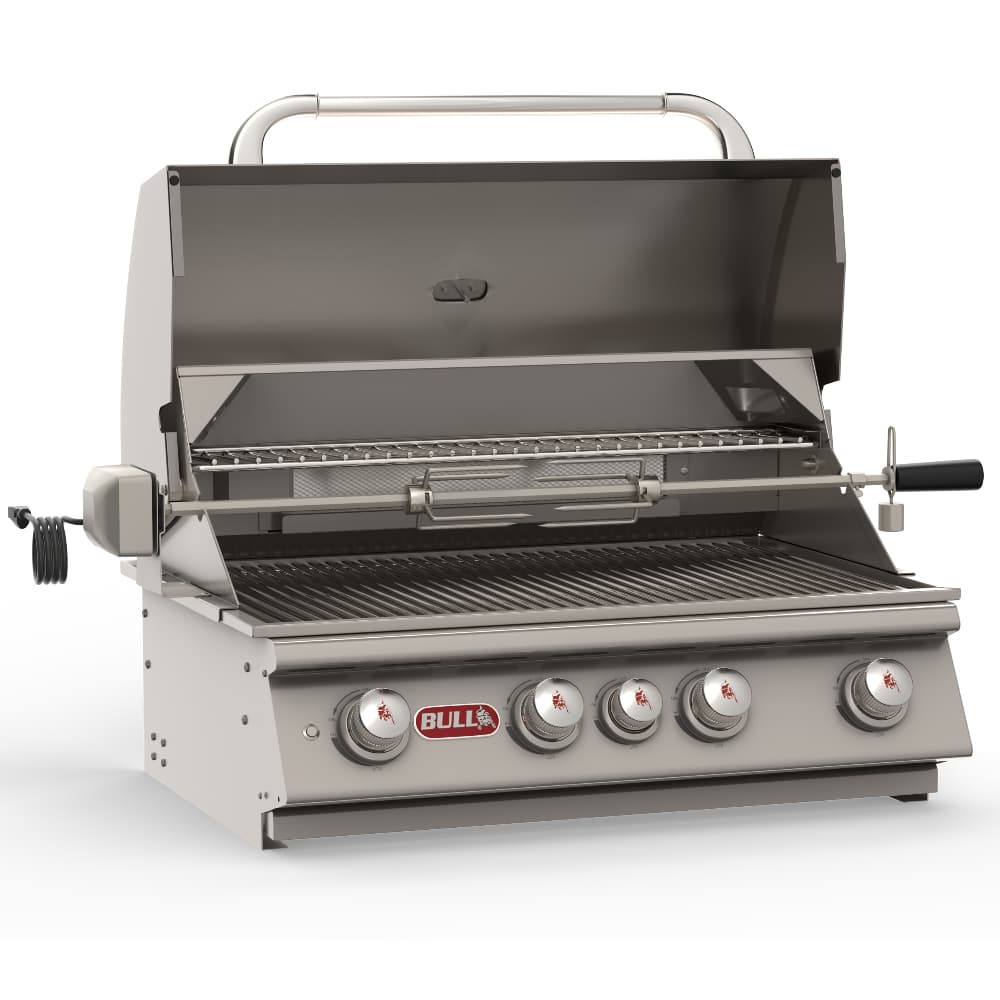
- 60,000 BTU main across 4 burners + 10K rear IR
- 304 stainless throughout, 8mm round grates
- Lifetime burner warranty, US-cast
- Our default built-in recommendation
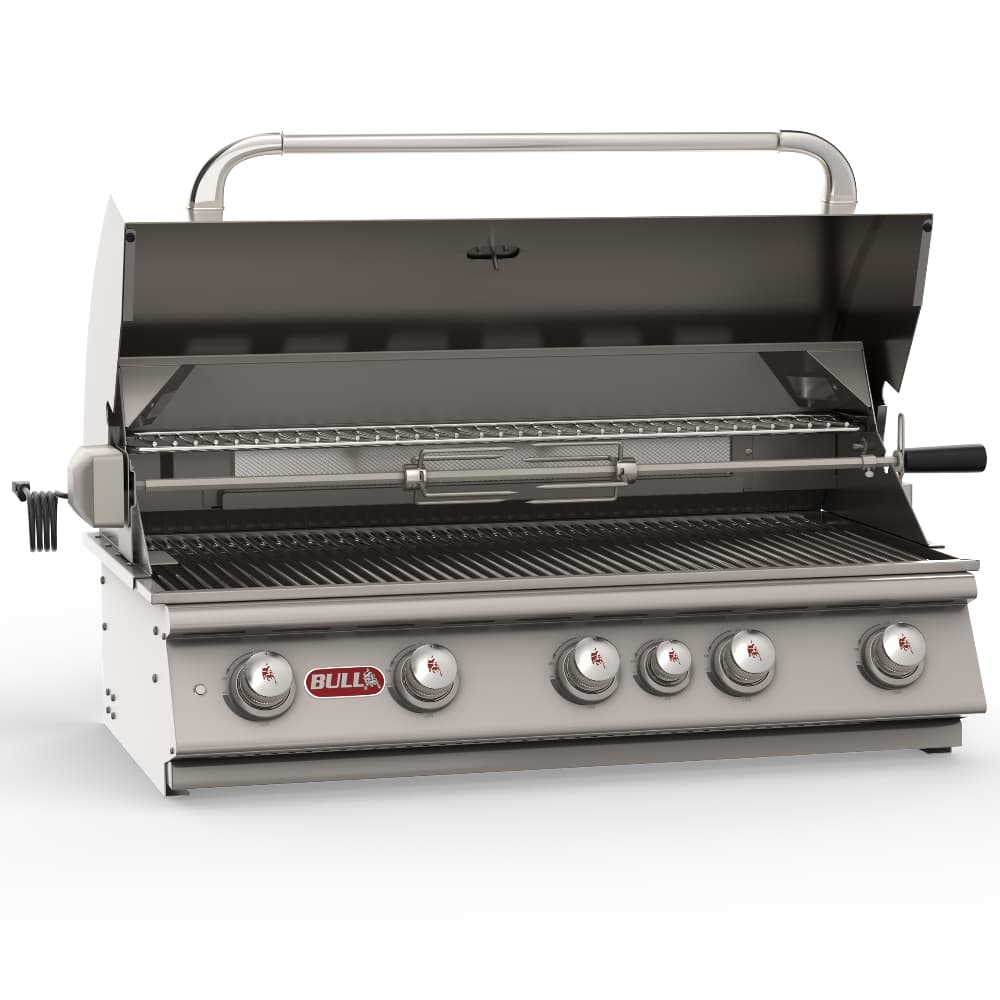
The Bull lineup ladder runs five residential tiers, all US-made, with real spec differentiation at each step. For a 30-inch, four-burner footprint, the Bull Angus at $2,839 is our default built-in recommendation — 304 stainless throughout, 8mm round grates, rear infrared rotisserie included, lifetime burner warranty. For families cooking regularly for six-plus, the Bull Brahma steps up to 38 inches, five burners, and 75,000 BTU main for $3,789. Full dealer review of the Brahma is in our Brahma deep-dive.
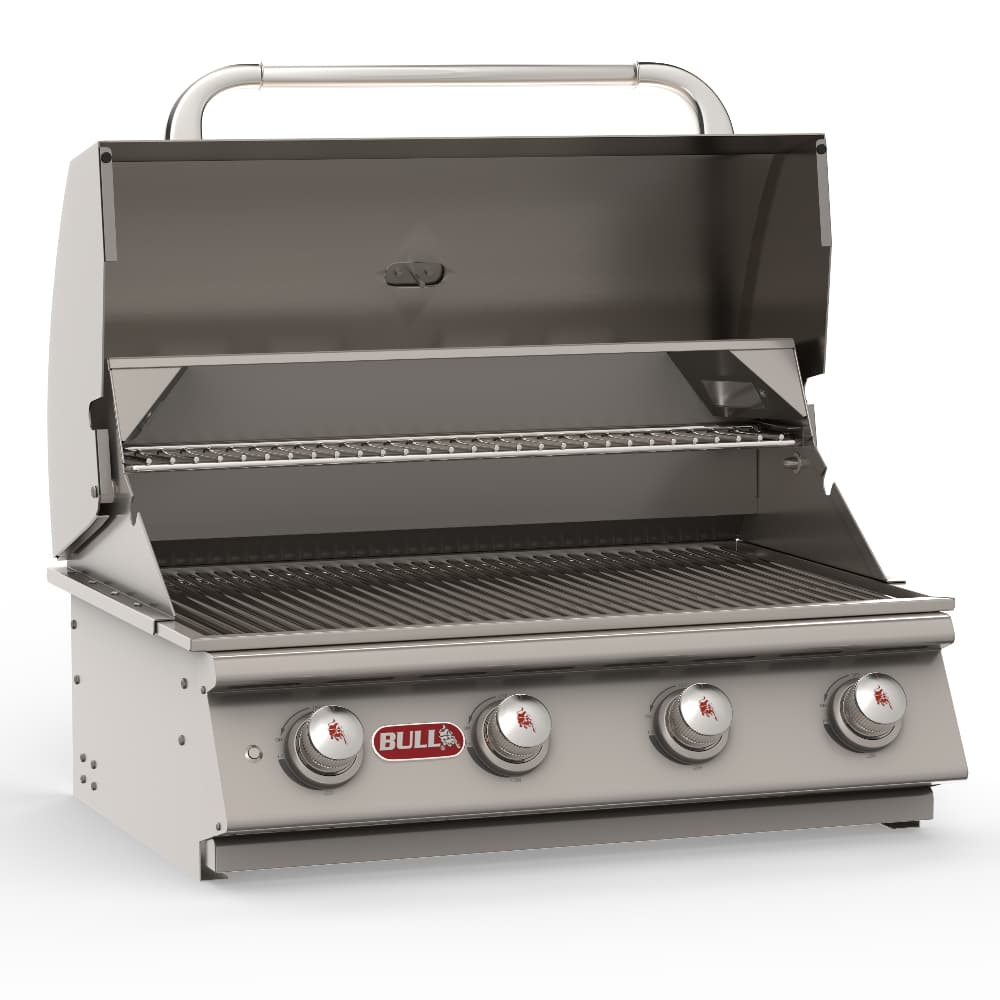
At the entry tier, the Bull Lonestar Select at $1,899 is the budget 4-burner — stainless-rod rather than 8mm round grates, limited-lifetime rather than full lifetime warranty, no rear IR. Still US-made in the same plants, still a legitimate built-in, just scaled back on the spec sheet to hit the sub-$2,000 price point. The Bull Outlaw at $2,199 sits between the Lonestar and the Angus — upgraded warranty over Lonestar, still no rear IR, legitimate value-tier buy.
Three Bull tiers compared — same California + Tennessee fabrication, same 304 stainless shell, scaled by burner count, grate construction, and warranty term.
Bull vs the Other American-Made Options
If domestic manufacturing is the hard requirement and Bull is the baseline, the two legitimate cross-shops on bbqs.com are American Outdoor Grill and Hestan Outdoor. Both pass the FTC Made in USA standard. The differences are warranty philosophy, build-weight class, and price band.
AOG, made by RH Peterson in the City of Industry, California, is the closest apples-to-apples cross-shop to Bull on price and footprint. The AOG L-Series 30-inch built-in runs roughly $2,400 — within $500 of the Bull Angus — and ships with the same 304 stainless shell and interior lighting. Where AOG wins: the double side burner accessory lineup and the T-Series lower-tier value play. Where Bull wins: in-house burner casting (AOG’s burners come from the RH Peterson supplier pool) and the simpler warranty-claim path. Full AOG breakdown in our AOG brand guide.
Hestan sits a tier above both on build weight — welded (not stamped) corners, 304 stainless at a heavier gauge, trellis infrared searing bar — and the price reflects it, roughly doubling Bull at equivalent sizes. If budget isn’t a constraint and you want the heaviest residential grill made in America, Hestan is the answer. If you want 90 percent of that build quality at half the price, Bull is the answer. The full Hestan context is in the Hestan Outdoor brand guide.
Bottom Line
Bull BBQ grills are genuinely manufactured in the United States, across three company-owned facilities totaling roughly 95,000 square feet of fabrication capacity — Athens TN, Rialto CA, and Ontario CA. Founded by Mark Nureddine in 1992, the company has stayed family-owned through three decades, moved HQ to Tennessee in 2025 without offshoring any production, and casts its own burners in-house rather than buying from the shared supplier pool most “US-made” competitors rely on. If “made in America” is a real spec rather than a marketing checkbox for you, Bull belongs on the short list — alongside Hestan and AOG, and ahead of Coyote and Weber Spirit, which fail or hedge the claim. Browse the full line on the Bull BBQ brand page, or jump to the built-in grill category to cross-shop against the other American-made options.
Frequently Asked Questions
Where are Bull BBQ grills manufactured?+
Is Bull BBQ actually an American company?+
When was Bull BBQ founded?+
Are Bull grills really made in the USA or just assembled here?+
Where are Coyote grills made?+
Where are Weber grills made?+
Where is American Outdoor Grill (AOG) made?+
Where are Hestan grills made?+
Does it matter if a grill is made in the USA?+
How long has Bull BBQ been in business?+
What makes Bull different from other American-made grills?+
Did Bull move its headquarters?+
Products & brands in this guide
Related reading
Reed — Reed writes the buying guides at BBQs.com — fifteen years selling and installing built-in grills means the picks here are what we'd actually put in our own outdoor kitchen.