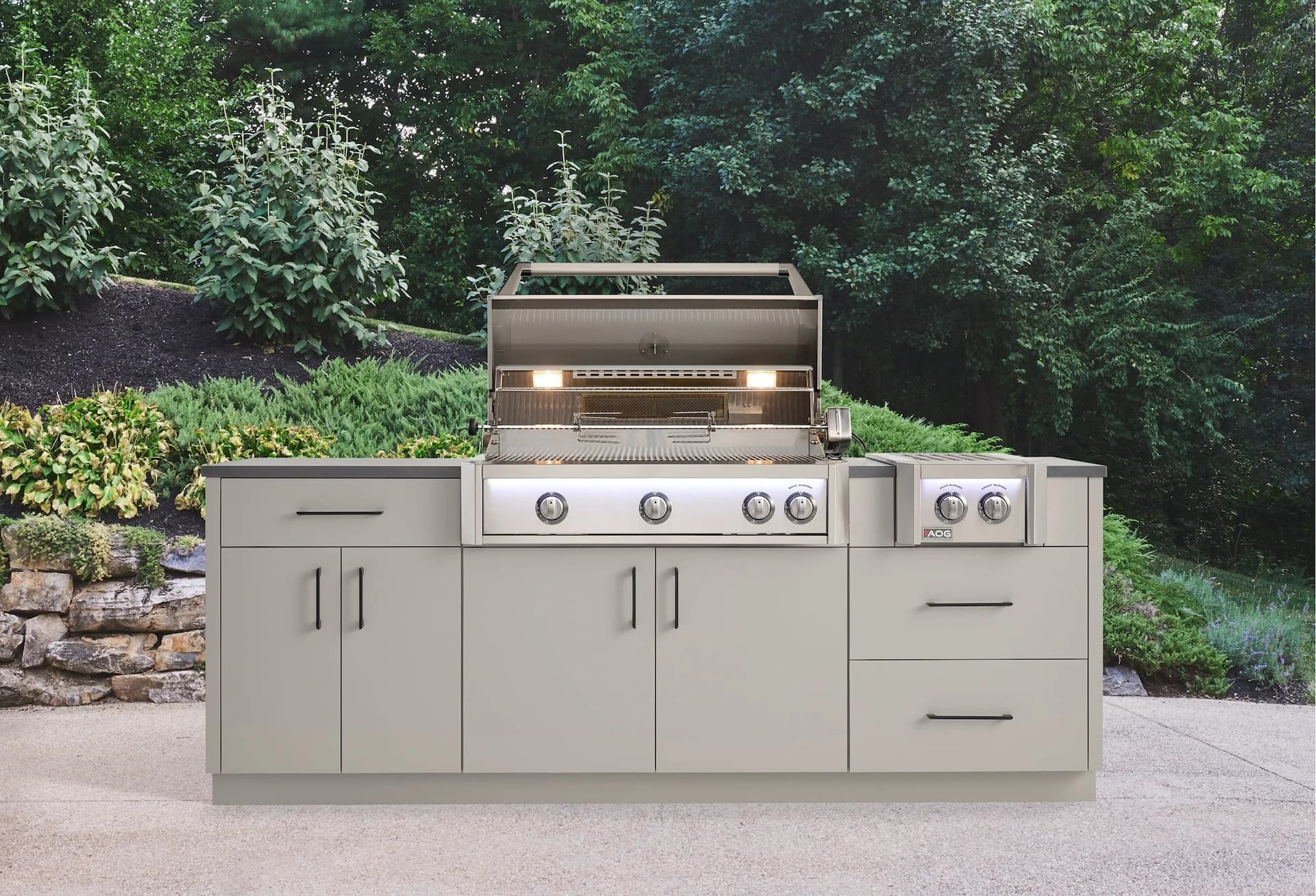
American Outdoor Grill — AOG — is the value line from R.H. Peterson Co., the California manufacturer that has built Fire Magic grills since 1937. Same factory, same 304 stainless firebox construction, same lifetime burner warranty. The AOG line launched to bring R.H. Peterson build quality to buyers whose outdoor kitchen budget doesn't stretch to Fire Magic pricing — and the result is the best value proposition in American-made built-in grills.
Who AOG Is For
AOG sits in the $1,400-to-$2,800 built-in grill tier and competes with Blaze Prelude, Bull Steer, Napoleon Prestige built-in, and the lower end of Lion Premium. Fire Magic sits above AOG in the same company’s own catalog, starting around $3,500 for an entry-tier 30-inch Aurora.
If you want American-made built-in quality with a lifetime burner warranty but can’t justify Fire Magic pricing, AOG is the clearest value in the category. For buyers who care about country-of-origin and parts-pipeline sustainability, this is also one of the few sub-$3,000 built-ins actually welded and assembled in the US — not assembled stateside from imported components.
The Lineup — Deliberately Simple
AOG’s catalog is designed to be shoppable without a decision fatigue tax. Two series (T Series and L Series), three sizes (24, 30, 36 inches), both natural gas and liquid propane. Six built-in SKUs total. No confusing sub-lines, no “discontinued next quarter” models, no annual spec revisions that strand parts.
T Series is the base grill — Diamond Sear cooking grids, tubular stainless burners, Flame Thrower piezo ignition, analog thermometer, single-wall hood. L Series adds interior halogen lights (one per burner — makes a real difference after dark), integrated rotisserie kit hardware with infrared rear burner, and backlit control knobs. Everything else between the two series is identical.
The 24-inch 2-burner is the compact option — fits in a tight patio corner or a secondary cook station. The 30-inch 3-burner is the volume seller and the right pick for most families. The 36-inch 4-burner is the entertainer’s choice — enough grate area to run a two-zone cook with a sear station on one side.
What Makes AOG Different Inside the R.H. Peterson Catalog
Three things separate AOG from Fire Magic in the same factory. First, AOG uses single-wall hoods where Fire Magic Aurora and Echelon are double-wall. The double-wall holds temperature better in cold weather and under heavy wind — a real advantage if you grill year-round in a cold climate, less of one if you cook summer-primarily.
Second, AOG’s illuminated control knobs are standard-lit (visible, not fancy) where Fire Magic uses backlit knobs with multi-color options. Cosmetic difference, not a cooking difference.
Third, warming racks on AOG are narrower than Fire Magic. On a 30-inch grill you lose maybe 30 square inches of secondary rack area. Rarely a decision factor for most buyers.
Everything else — the firebox, the burners, the Diamond Sear grids, the piezo ignition — is identical construction between the two lines. The lifetime burner warranty is the same tier. The parts pipeline runs from the same R.H. Peterson stocking warehouse.
AOG vs Blaze Prelude vs Bull Steer
At the sub-$2,500 built-in tier, AOG’s primary competitors are Blaze Prelude and Bull Steer. All three run 304 stainless; the differentiators are warranty terms, country of origin, and parts support.
Blaze Prelude is a Chinese-assembled grill with a US distributor; the stainless gauge is lighter and the lifetime burner warranty requires product registration + proof of purchase (strict compared to AOG’s relaxed registration process). Blaze’s price point is competitive but the long-term support story is weaker.
Bull Steer is Mexican-manufactured for a California-based family-owned brand. Build quality is solid and the price-per-BTU is strong. Bull’s stocking depth at dealers is excellent so lead times are usually days-not-weeks. Bull Steer trades a bit of grid weight for a lower price than AOG at the same size.
AOG’s edge: US manufacture, lifetime warranty with no registration gymnastics, and R.H. Peterson parts support through 2026 for grills that shipped in the mid-2000s. If you care about longevity and warranty reliability, AOG wins the sub-$2,500 category. If you care about immediate stocking and lowest-dollar price, Bull Steer wins.
When to Step Up to Fire Magic
Stay with AOG if you prioritize value, grill primarily in warm weather, and want the R.H. Peterson build without the Fire Magic premium. For 80 percent of outdoor kitchen builds, AOG is the right call at the grill line and the saved $1,500-plus funds a better side burner, nicer refrigeration, or stone countertops.
Step up to Fire Magic if you grill through winter in a cold climate (the double-wall hood matters), if you want backlit multi-color control knobs and the fully illuminated interior experience, or if you’re doing a $20,000-plus outdoor kitchen where the grill brand needs to match the aesthetic ambition of the install. The build-quality step-up is modest; the cosmetic + weather-tolerance step-up is real.
Side Burners, Doors, and Accessories
AOG’s double side burner (AOG2SBL for the L Series with lights, AOG2SBT for the T Series) matches the main grill finish and uses the same R.H. Peterson weld quality. Side burners mount into standard 12-inch module cutouts and are compatible with Fire Magic cabinetry if you’re mixing tiers in the island.
Access doors, double doors, and utility drawers run the full width range from 14 inches up to 36 inches, in horizontal and vertical orientations. The hinge quality is noticeably better than price-tier competitors — continuous stainless piano hinges rather than friction hinges that work loose in year 3.
The in-ground and patio post bases let you convert any AOG built-in head into a pedestal-mounted freestanding grill. Useful for patios without an outdoor kitchen chase, or for building a grill station adjacent to an existing kitchen rather than inside it.
Honest Downsides
The single-wall hood is a real cold-weather disadvantage. If you grill through winter in a climate that routinely drops below 20°F, the heat loss on an open-hood operation is noticeable. Either plan to grill with the hood closed (good practice anyway) or step up to Fire Magic for the double-wall thermal mass.
No infrared sear burner option on the T Series. The L Series has the infrared rear rotisserie burner but neither series offers a dedicated infrared sear zone like Hestan or Coyote. If you want restaurant-grade steak sear performance, AOG is not the pick — look at Coyote C-Series or Hestan Aspire.
Base-model T Series knobs are not backlit — you can see them in direct light but not in the dark. The L Series lights solve this but the T Series doesn’t. If you cook primarily after dark and the T Series is your budget pick, step up to L Series.
What to Ask Before You Order
Confirm the T vs L decision up front. The $400 L Series upcharge gets you interior lights (big quality-of-life win for evening cooking) and the rotisserie infrared burner (useful even if you don’t rotisserie every weekend). Retrofitting lights or the rotisserie burner after installation is more expensive than ordering it from the factory.
Confirm fuel type at order (natural gas vs liquid propane). Factory conversion is clean; field conversion requires the AOG conversion kit and a qualified gas technician. Both are supported but ordering the right fuel upfront avoids the service call.
Register the warranty within 60 days of delivery. The lifetime burner-and-housing coverage locks in on registration — a small step with meaningful long-term consequence.
Order a fitted vinyl cover (AOB-cover for built-in heads). A cover is the single highest-ROI accessory for grill longevity. In our service experience, uncovered built-ins see failures 2 to 3 years earlier than covered ones; the cover pays for itself in extended service life.
Frequently Asked Questions
Is American Outdoor Grill the same as Fire Magic?+
What's the difference between AOG T Series and L Series?+
What size AOG grill should I buy?+
Are AOG grills made in the USA?+
How long do AOG grills last?+
Does AOG make natural gas and propane versions?+
Products & brands in this guide
Related reading
Reed — Reed writes the buying guides at BBQs.com — fifteen years selling and installing built-in grills means the picks here are what we'd actually put in our own outdoor kitchen.