Updated October 2026. The pellet smoker category grew up this decade — PID temperature control, Wi-Fi that actually works, warranties that outlast the first owner. Weber's Searwood 600 at $999 and Searwood XL 600 at $1,299 are the two we stock and the two we hand to buyers who ask for a straight answer. This guide covers both, explains where the Pit Boss and Traeger tiers fit (we don't carry them, and we'll tell you why), and lays out the serious-cook Memphis and Yoder options that live at the top of the market.
The 60-Second Answer
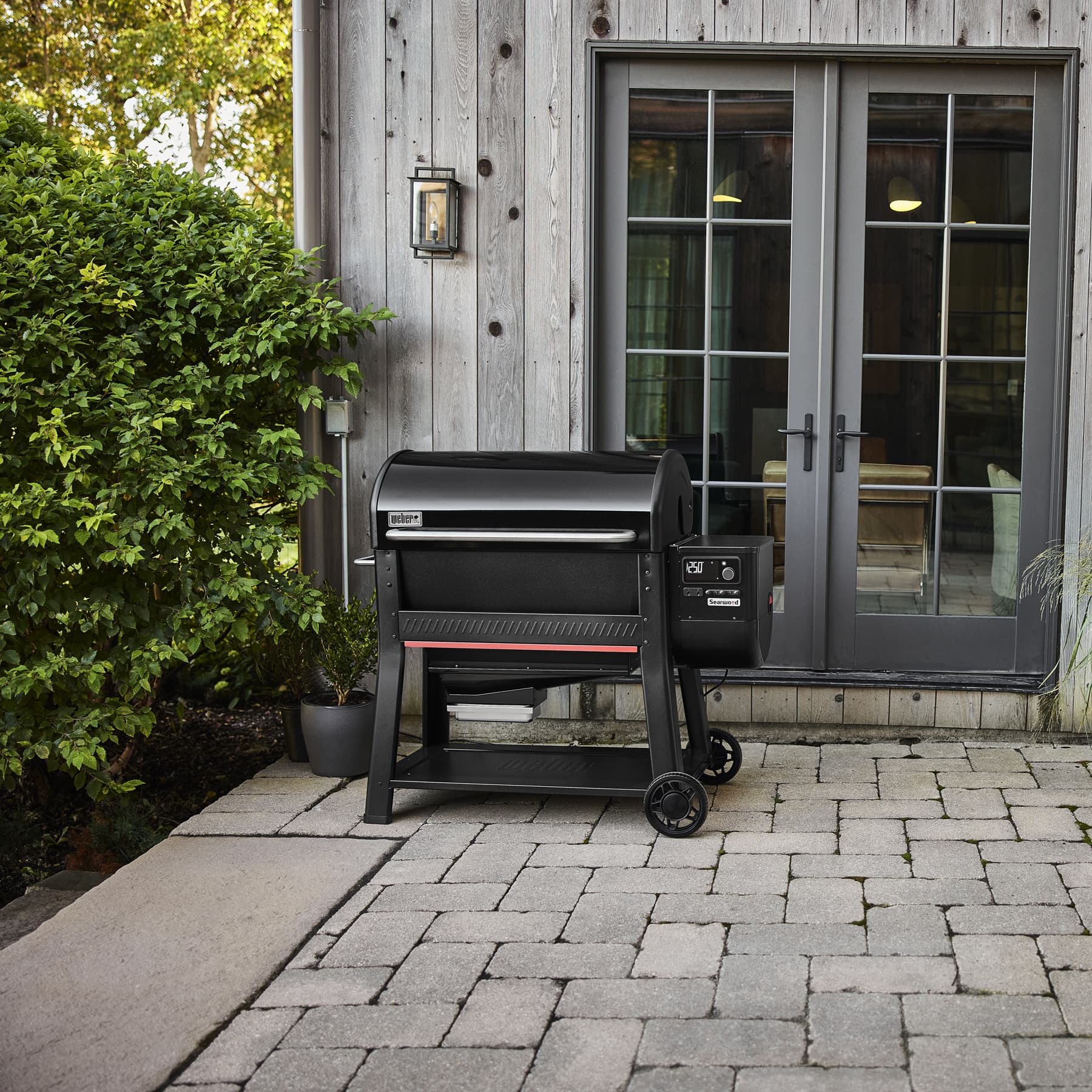
The Weber Searwood 600 at $999 is the pellet smoker we recommend for most households in 2026.It's a 24-inch Wi-Fi-controlled pellet grill with a 20 lb hopper, PID control that holds temperature within ±5°F, 572 square inches of cook area, and Weber's 10-year warranty on the cook box. Step up to the Searwood XL 600 at $1,299 if you smoke two pork shoulders at a time or host big.
How to Pick a Pellet Smoker in Three Steps
Before you compare models, settle three questions: what are you cooking most (brisket and pork shoulder, or weeknight chicken and burgers), how much cook area do you need (24-inch for a family, 36-inch for an entertainer, built-in only for outdoor-kitchen specs), and what's the budget (under $500 is big-box pellet, $900 to $1,500 is the Weber Searwood bracket, $2,500 plus is the serious-cook tier). Every other spec — hopper size, Wi-Fi app quality, searing capability — stops mattering once those three are set.
One thing that doesn't matter as much as the marketing suggests: total BTU. Pellet smokers are convection appliances, not direct-heat grills. A Searwood 600 and a $2,500 Yoder YS640s both hold 225°F for a 14-hour brisket just fine. The spread shows up in build quality, chamber insulation (which affects pellet consumption in winter), and warranty length, not in peak heat output on a July afternoon.
A word on brand coverage. The organic SERP for "best pellet smoker 2026" is dominated by roundups that put a $400 Pit Boss, a $600 Traeger Pro, and a $900 Camp Chef in the same list — because those are the brands that pay for affiliate commissions. We don't carry any of them. What we do carry is Weber's Searwood line, which hits the exact same mainstream price point ($999 to $1,299) with a significantly longer warranty and a build we actually trust to be under a cover on a Baton Rouge patio for a decade. Everything below is the honest version.
Our Picks: The Weber Searwood Line
Weber Searwood 600 (24-inch) — $999.Our mainstream pick. The Searwood 600 is a 572-square-inch cook area pellet grill with a 20 lb hopper, PID temperature control that holds within ±5°F across its 180°F to 600°F range, Wi-Fi connectivity through the Weber Connect app, two meat probe ports, a stainless steel burn pot, and the SmokeBoost function that drops to 180°F for maximum smoke output during the first hour of a cook. It fits a 14 lb brisket or six racks of spare ribs. Weber's 10-year warranty on the cook box and barrel is the longest in the mainstream pellet tier, and the 3-year electronics warranty covers the single component most likely to fail — the controller.
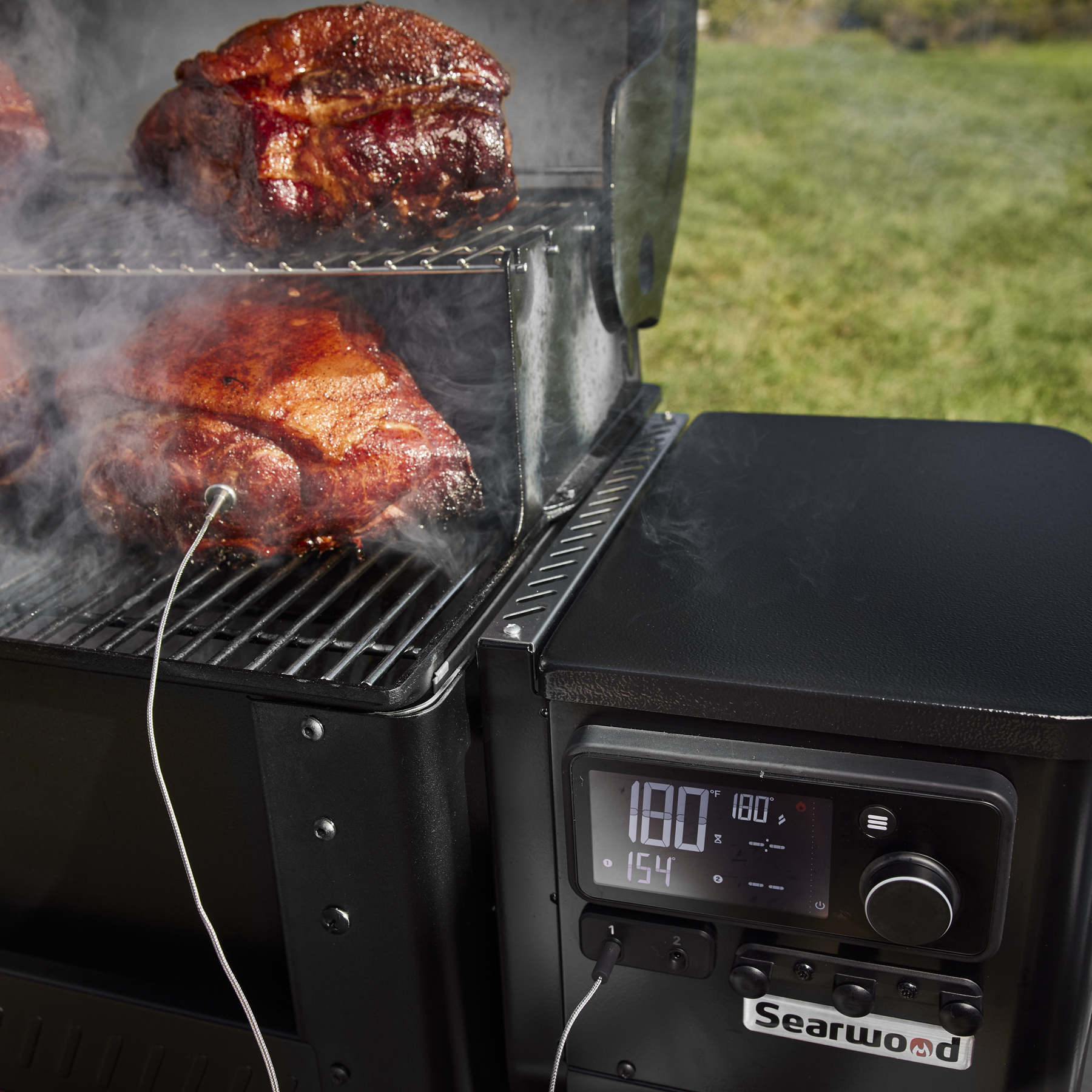
Weber Searwood XL 600 (36-inch) — $1,299. The entertainer upgrade. The XL steps cook area up to 1,008 square inches — enough for two whole packer briskets side-by-side, four pork shoulders, or ten racks of ribs. Hopper grows to 32 lb (good for 20+ hour unattended cooks), everything else matches the 600: same PID controller, same Wi-Fi app, same 10-year cook box warranty, same SmokeBoost mode. If you cater, host more than six people regularly, or want to run a brisket plus a pork butt on the same cook, buy the XL. The $300 upgrade over the standard 600 pays off the first time you stop running the smoker twice to feed a Super Bowl party.
Pellet Grill vs Pellet Smoker: The Honest Definition
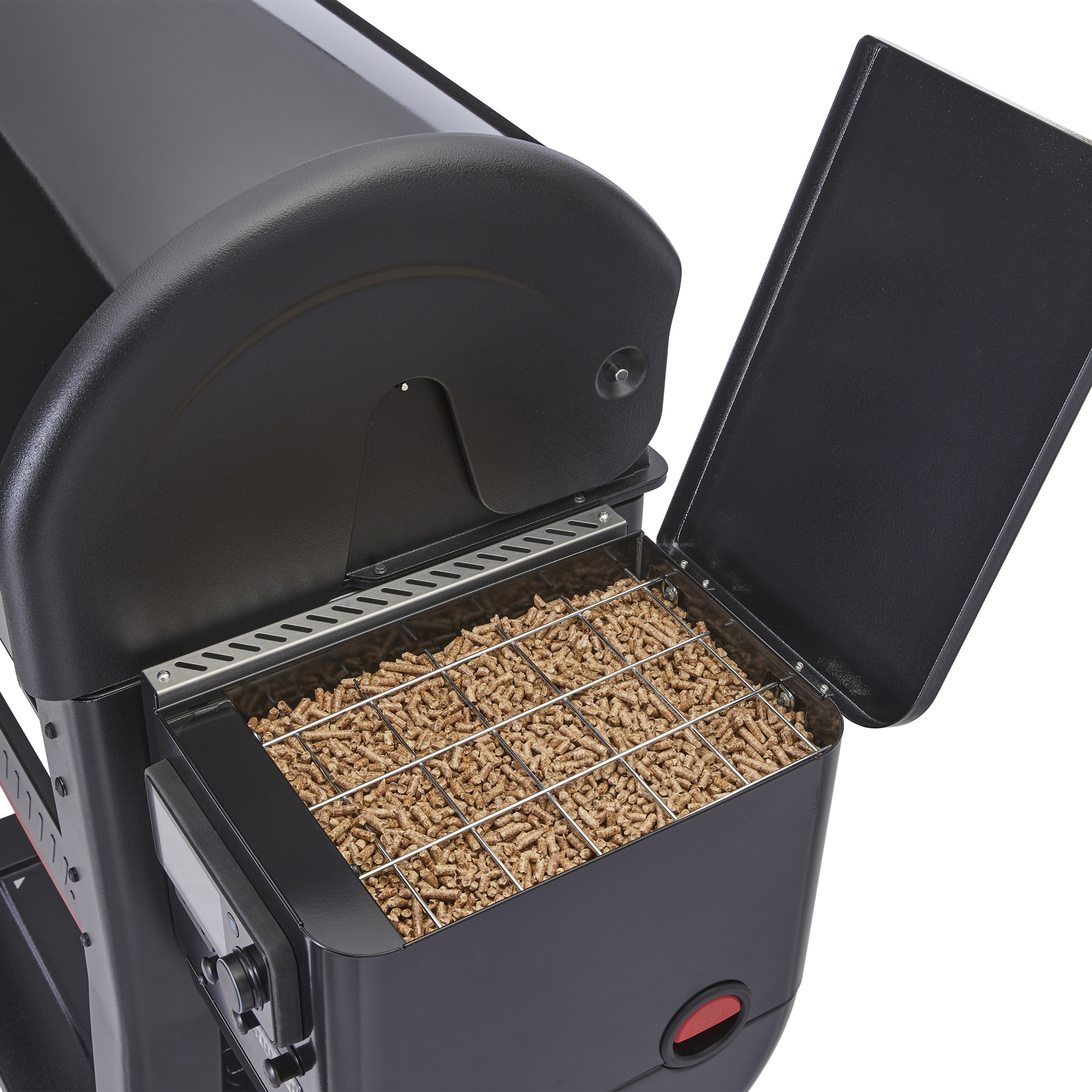
A "pellet grill" and a "pellet smoker" are the same appliance with different marketing. Both run compressed hardwood pellets through an auger into a burn pot where a hot rod ignites them. A convection fan circulates heat and smoke around a sealed chamber. The controller modulates auger speed and fan speed to hit a target temperature. Low setting is 180°F to 225°F for smoke; high setting is 500°F to 600°F for grilling. Every modern pellet unit — Weber, Traeger, Pit Boss, Yoder, Memphis — works this way.
Where brands diverge is howthey modulate the auger. Cheap pellet controllers run a fixed on-off cycle: pellets dump in, temperature overshoots, auger stops, temp drops, pellets dump in. The result is a 40°F sawtooth that averages to the target but actually swings dramatically. PID controllers (what Weber Searwood, Yoder, and Memphis all use) read the current temperature every second and modulate the auger continuously, holding ±5°F. Brisket doesn't care if the swing averages to 225°F. It cares what the actual meat-surface temperature is doing at hour 11 of a long cook. PID matters.
The Brands We Don't Carry (And Where They Fit)
We're a specialty-grill dealer, which means we skip anything with mandatory big-box distribution. If you're cross-shopping and these brands come up, here's the honest cross-reference.
Pit Bossowns the sub-$500 pellet tier. The Pit Boss Pro Series 850 at around $499 at Home Depot is the direct comp to a 24-inch Weber Searwood. Build is noticeably lighter — 14 gauge steel versus Weber's 10 gauge barrel — and the controller is a bang-bang design rather than full PID. Warranty is 5 years cook box and 1 year electronics. If budget is the dominant constraint and you're OK replacing in 5 to 7 years, Pit Boss is a legitimate buy. Just buy it direct, not from us.
Traegeris the mainstream brand that built the category. Traeger Pro 575 at $700, Ironwood XL at $1,699, Timberline XL at $3,299. The Traeger WiFire app ecosystem is the best in the category — recipe integration, step-by-step guided cooks. Build is competent, warranty is 10 years cook box and 3 years electronics (matches Weber Searwood). Traeger's premium models (Timberline) go head-to-head with Yoder and we think Yoder wins. The mid-tier Ironwood goes head-to-head with the Searwood XL and we think the Searwood XL wins on price-per-square-inch at $1,299 vs $1,699.
Camp Chefplays in the $600 to $1,100 bracket with a side-firebox option — the Woodwind SG lets you add a propane sear box to the right side. It's a legitimate feature if you want one appliance that smokes and sears at 1,000°F plus. We don't carry them because the warranty is 3 years on everything and we've seen enough controller failures at year four to make us uncomfortable selling the units.
Recteqis Georgia-made and runs some of the best PID control in the category — their RT-700 at $1,299 is a real competitor to the Searwood XL 600. Build is 14 gauge stainless and the warranty is 6 years on the full unit. If you want American-made and don't need Weber's dealer-support network, Recteq is a strong buy direct. We don't carry them because they sell exclusively DTC.
Memphis Pro, Yoder YS640s, Twin Eaglesare the serious-cook tier. Memphis Pro at $5,999 is 304 stainless everywhere, 40,000 BTU peak output, 180°F to 700°F range, built-in rotisserie, 20+ year hardware. Yoder YS640s at $2,999 is American-made 10 gauge steel, the pick for competition BBQ cooks who want set-it-and-forget-it with real metal. We don't carry Memphis or Yoder because our outdoor-kitchen tier is dominated by Bull BBQ, Hestan, and Coyote on the grill side — we haven't built a pellet-smoker specialty program yet, and we'd rather send a serious buyer to a pellet-focused specialist than half-carry the tier. That's an honest answer, not a sales pitch.
Information Gain: Real Cook Times on the Searwood
Published cook times for pellet smokers run short because they're written against ideal conditions — 70°F ambient, no wind, dry pellets, lid shut. Here's what we actually see in Baton Rouge, where the ambient is 92°F in July and 38°F in January, running real packer briskets and pork shoulders through the Searwood 600.
14 lb packer brisket, 225°F: 12 to 14 hours in summer, 15 to 17 hours in winter. The stall between 155°F and 170°F internal is where the time variance lives — wrap in butcher paper at 170°F to shorten it by 90 minutes, or let it ride for maximum bark. Pull at 203°F internal when a probe slides in like warm butter.
8 lb pork shoulder, 225°F: 11 to 13 hours. Pork shoulders stall harder than brisket because they carry more connective tissue. Wrap at 165°F internal if you want the cook under 12 hours. Pull at 203°F internal for shredding, 190°F for slicing. Rest for a minimum of 1 hour in a cooler before pulling.
Spare ribs, 225°F: 5 hours total using the 3-2-1 method (3 hours unwrapped on the grate, 2 hours wrapped in foil with apple juice, 1 hour unwrapped with sauce). Baby back ribs run the same method at 2-2-1, so 5 hours total also but shorter wrap.
Whole chicken, 275°F: 2 to 2.5 hours. Spatchcock and run breast-up for even cook. Pull at 165°F in the breast and 175°F in the thigh.
1-inch ribeye, reverse sear:45 minutes at 225°F to internal 115°F, then crank the Searwood to 600°F for 90 seconds per side on the grate. The pellet-grate sear won't match a 1,500°F infrared burner, but it will put a legitimate crust on a steak that's taken a full hour of oak-smoke.
Pellet Smoker vs Charcoal vs Gas: When NOT to Buy a Pellet
Pellet smokers are not the best tool for every outdoor cook, and the most common mistake we see is a buyer who really wanted a gas grill buying a pellet because the YouTube influencer sold it as "the one grill to own." Here's the honest decision matrix.
Buy a pellet smoker if you cook brisket or pork shoulder more than four times a year, you host low-and-slow BBQ parties, you want Wi-Fi monitoring on an overnight cook, or you want set-it-and-forget-it reliability. Pellet is the easiest smoker a first-time smoker can learn on — no fire-tending, no vent management, no pellet-feed guesswork. The controller does the hard parts.
Buy a charcoal grill or kamado (Weber Master Touch, Weber Summit Kamado, Big Green Egg) if you want the strongest smoke flavor possible, you grill steaks and burgers more than you smoke, or you want a 15-year hardware investment with no electronics to fail. Charcoal is cheaper to feed than pellet (a 20 lb bag of lump charcoal is $25 and runs five long cooks). The tradeoff is active fire management — you tend coals every 2 hours on an overnight brisket, not every 8 hours like a pellet.
Buy a gas grill (Weber Genesis, Bull BBQ Angus) if you grill 80% of the time and smoke 20% — burgers Tuesday, chicken thighs Wednesday, steaks Friday, maybe a pork shoulder on Saturday. A gas grill with a smoker box gives you enough smoke for weekend BBQ without compromising the weeknight quick-cook workflow. See our best natural gas grills 2026 rundown for the full gas lineup, or the Weber Genesis vs Spirit vs Summit comparison for the Weber gas tier that pairs best with a Searwood.
Accessories That Actually Earn a Spot
Pellet grills ship with everything they need to cook, but three accessories pay off the first season. We sell all three for the Searwood line and we hand them to every buyer who asks.
Stainless Steel Wet Smoke Pan ($29.99). Drops onto the heat deflector and holds water, apple juice, or beer. Raises chamber humidity through the cook — brisket bark comes out thicker and the stall shortens by 60 to 90 minutes. The one accessory we recommend every single Searwood buyer add to the cart.
Premium grill cover ($94.99 for 600, $125 for XL). A pellet smoker's single enemy is moisture reaching the pellets in the hopper. The Weber cover is heavy-gauge polyester with a fleece inner liner, dedicated vents to prevent condensation, and a 5-year warranty. Non-negotiable if the grill lives outside year-round.
Rotisserie kit ($149.99 for XL).The XL 600's barrel-shaped chamber takes a 30-inch spit cleanly. Whole chickens, rotisserie prime rib, pork loin — the pellet-smoke-plus-rotation combination is the single best way to run poultry on a Searwood. Skin crisps because of the sear-level airflow, meat stays juicy because the rotation self-bastes.
Our Final Ranking
If you're buying one pellet smoker and you want the best price-per-square-inch: Weber Searwood 600 at $999. Enough cook area for a family of four or six, PID control, 10-year warranty, Wi-Fi that works. Our default recommendation.
If you host more than six people or smoke two large cuts at once: Weber Searwood XL 600 at $1,299. $300 more for 73% more cook area and 60% more hopper. The buyer who hesitates and sizes down regrets it the first time they try to fit two briskets on the standard 600.
If budget caps you at $500:Pit Boss Pro Series 850 or Traeger Pro 22. Buy direct — we don't stock them and we're telling you honestly where to go. Expect to replace in 5 to 7 years as electronics age.
If you're building a serious outdoor kitchen and pellet is the central cooker:Memphis Pro at $5,999 or Yoder YS640s at $2,999. Neither one is in our catalog — we're deep in the gas-grill and built-in tier and haven't built a pellet specialty program yet. A pellet-focused dealer like Memphis Direct or BBQ Guys is where that spend belongs.
If you're not sure whether you want a pellet at all: read our best gas smokers and Green Mountain Grills brand review before committing. The honest truth is that most buyers who think they want a pellet are better served by a Weber Genesis with a smoker box plus a Weber Smokey Mountain charcoal smoker — $1,100 combined, two tools that each do one job well, instead of one tool that compromises. For buyers who want a single all-in-one appliance and value convenience over ultimate flavor, the pellet still wins.
Frequently Asked Questions
What is the best pellet smoker to buy in 2026?+
Pellet grill vs pellet smoker — are they the same thing?+
Why doesn't BBQs.com carry Pit Boss or Traeger?+
How much should I spend on a pellet smoker?+
How long does a pellet smoker take to smoke a brisket?+
Can a pellet smoker sear a steak?+
How many pellets does a pellet smoker use?+
What's the warranty reality on a pellet smoker?+
Products & brands in this guide
Related reading
Reed — Reed writes the buying guides at BBQs.com — fifteen years selling and installing built-in grills means the picks here are what we'd actually put in our own outdoor kitchen.