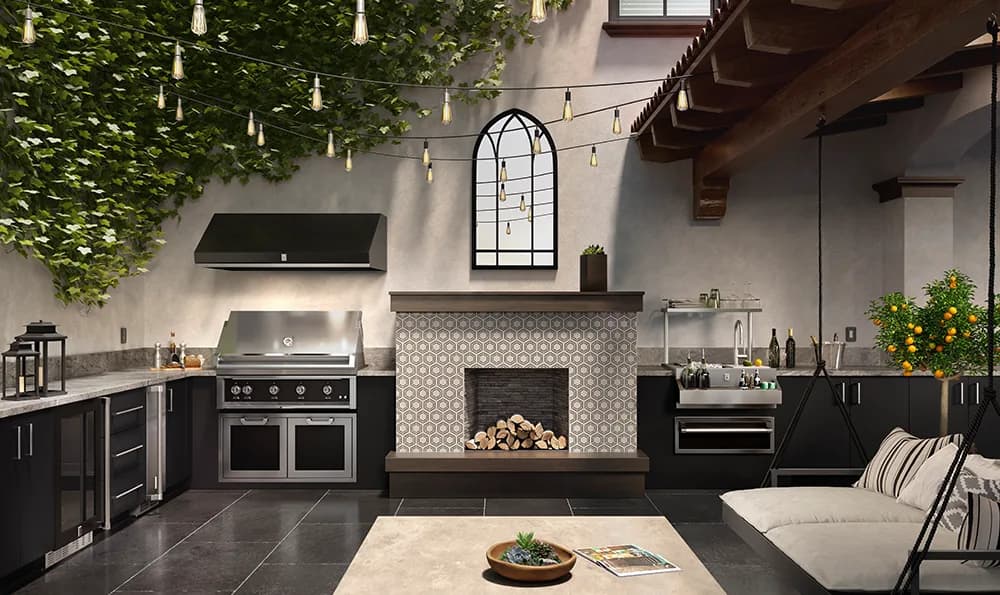
Updated October 2026. Before you fall for a specific grill, decide one thing: natural gas or propane. We sell both configurations of every major built-in grill brand at BBQs.com — Hestan, Coyote, Bull, Summerset, AOG — and the fuel choice drives install cost, long-term operating cost, placement, and (on some models) sear performance.
TL;DR —Natural gas wins on fuel cost and “never runs out” convenience if your home already has a gas line within 40 feet of the grill location. Propane wins on portability, zero install cost, and (on some grills) slightly faster high-temperature sear. For most permanent outdoor kitchen builds, natural gas is the right answer. For patios, rentals, and anyone who’d rather spend the install money on the grill itself, propane still makes sense.
How the Two Fuels Actually Differ
Natural gas is methane piped from the municipal utility, arriving at the grill at about 7 inches water column of pressure (roughly 0.25 PSI) after passing through your meter’s regulator. Propane is a liquefied hydrocarbon stored in a tank — a 20-pound cylinder for a freestanding grill, or a 100-pound stationary tank for a dedicated built-in. A tank-top regulator steps the pressure down to about 11 inches water column (0.4 PSI) before it reaches the grill.
Two numbers matter for performance: pressure and BTU density. Propane delivers at higher pressure (0.4 vs 0.25 PSI) and holds more energy per cubic foot (about 2,500 BTU/cu ft versus 1,030 for NG). To hit the same rated BTU output on both fuels, a grill manufacturer uses a larger orifice on the natural gas burner — the wider opening passes enough extra volume to make up for the lower pressure and lower energy density. That’s why you cannot simply hook a propane grill to a natural gas line without a conversion kit. The orifice is wrong, the regulator is wrong, and the flame will either starve or sputter.
Fuel Cost: The Real Math
Natural gas runs about $1.20 per therm at the US residential meter (national average, late 2026). One therm is 100,000 BTU. A 60,000 BTU four-burner grill at full flame burns 0.60 therms per hour — $0.72 an hour. A larger 90,000 BTU grill like the Bull Brahma runs about $1.08 an hour at full flame. In the real world, you’re rarely at full flame the entire cook, so cut those numbers roughly in half for a typical two-zone session.
Propane costs about $22 for a 20-lb tank exchange at Blue Rhino or $16 for a refill at a local propane depot. One 20-lb tank holds about 430,000 usable BTUs. A 60,000 BTU grill at full flame drains the tank in 7.2 hours — $3.07 an hour on exchangeor $2.22 an hour on refill. A 100-lb stationary tank runs cheaper per BTU (roughly $2.80 to $3.20 a gallon on delivery), but you’re still looking at 3 to 4 times the per-hour fuel cost of natural gas.
At 50 cook sessions a year, two hours per session, 60,000 BTU average load — natural gas comes out to about $36 a year. Propane on tank exchange runs about $154 a year. The $118 annual delta is where NG amortizes its install.
Install Cost: The One-Time Hit
Running a gas line for a grill isn’t cheap, and it’s the single biggest reason propane still sells heavily on premium-grill orders. Three cost ranges based on what we see quoted:
Short, easy run ($400 to $900): grill sits within 15 feet of the meter or an existing manifold, lawn trenching only, no slab penetration. Plumber work plus permit.
Standard patio run ($900 to $1,800): 25 to 40 feet, one obstacle (step, planter, pet fence), lawn plus a short bore under a walkway. Covers 70% of the quotes we see on residential outdoor-kitchen builds.
Long or hard run ($1,800 to $3,500+): over 50 feet, cutting through a concrete slab, boring under a driveway, or upsizing the house meter because the grill plus a pool heater exceeds the existing capacity. The upsize alone can be $600 to $1,500 before any line work.
Propane’s install cost is zero on a cart grill. For a built-in LP installation feeding from a 100-lb stationary tank, budget $300 to $600 for a tank cradle, the regulator and the flexible stainless line — still a fraction of an NG trench run.
Hookup Requirements, Side by Side
Natural gas needs:a dedicated branch line sized for the grill’s BTU draw (typically ½" black-iron pipe or yellow CSST for 60,000 to 90,000 BTU grills), a quick-disconnect shutoff valve at the appliance, a licensed plumber or gas fitter to run and pressure-test the line, a permit from the local building department, and the correct NG regulator at the grill itself. Most premium grills ship with the regulator installed and configured for the ordered fuel.
Propane needs: a tank (20-lb for carts, 100-lb for built-ins), the correct LP regulator at the tank, a flexible stainless line to the grill, and an open-air location for the tank. No permit, no plumber, no inspection. On a built-in installation, factor in the tank enclosure — most outdoor-kitchen designs hide the 100-lb tank in an insulated cabinet with vents at the base.
Both fuels run on the same gas-flex connector on the grill side. Swapping an existing propane grill to natural gas means replacing the orifices, the regulator, and sometimes the valve bodies — thirty to sixty minutes of work with a kit from the manufacturer. Bull, Hestan, Coyote, Summerset, and AOG all sell the kit directly; we stock them for anything we carry.
Convenience, Aesthetics, and the Day-to-Day
Natural gas is set-it-and-forget-it. There’s no tank to swap, no cold Sunday afternoon where you realize mid-cook that you’re out of fuel. The grill is permanently connected and permanently fed. That’s the single biggest reason buyers with an existing line almost always choose NG.
Propane trades that convenience for mobility. A cart grill can move to the far end of the patio for a party, into the garage for winter storage, over to a rental property for a weekend. The tank goes with it. On a built-in, LP is less flexible — the 100-lb tank is heavy and permanent — but still a fallback for yards where no gas line exists.
On aesthetics, NG wins the built-in look. There’s no visible tank in the cabinet, no cutout vent for an LP tank enclosure, no reminder of fuel supply. The outdoor kitchen reads as cleanly integrated as an indoor one. On a freestanding cart, the fuel source is roughly a wash — most carts hide the LP tank in a side compartment that looks identical to the pipe-fed version from a few feet away.
Sear Performance: The Honest Comparison
This is where internet opinion diverges most. Here’s what we’ve measured across the brands we carry at BBQs.com:
Premium tier (Hestan, Coyote, Bull, Summerset):the delta is tiny. Hestan over-sizes NG orifices to a point where the rated BTU output and the real grate-level sear temperature match the LP version within about 15°F. On a Hestan 3-burner we clocked LP at 755°F peak and NG at 740°F peak after a 10-minute preheat with hood down. Not a cooking-visible difference.
Mid tier (Bull Angus, Summerset Sizzler): a slightly larger gap of 25 to 50°F favoring propane. On a Bull Angus 30-inch we saw LP at 710°F and NG at 665°F. Still well past steakhouse sear temperature (650°F is the usual bar). The difference is noticeable in time-to-first-sear by about 20 seconds.
Budget tier (anything under $1,000):propane pulls ahead by 50 to 75°F in some cases, because manufacturers don’t re-engineer the orifices for NG — they ship a conversion kit and leave it to the customer. If high-heat steakhouse sears are your primary use case and you’re shopping below $1,000, LP is the safer bet.
The infrared sear zone changes the math. Grills with a ceramic or stainless infrared burner (Coyote C-Series, Hestan GSBR, Bull’s rear rotisserie burner) hit 900°F+ at the sear station on both fuels, because infrared burners are engineered around their heat radiator rather than raw flame temperature. For serious steak searers, the infrared burner matters far more than the fuel choice.
A Decision Framework
Choose natural gas if:you own the home, you have an existing gas line within 40 feet of the grill location, the grill is going into a permanent outdoor kitchen or hardscape, you grill more than once a week, and you’re willing to invest once in a permitted line install that pays back in 3 to 4 years.
Choose propane if:you rent, your yard has no existing gas service, you need the grill to be portable, you grill occasionally rather than regularly, you need the grill operational the same week it arrives, or your dream grill is going somewhere a plumber can’t easily run a line.
Still torn? Buy a dual-fuel-ready premium grill from Hestan, Bull, Coyote, Summerset, or AOG. Every one of them is factory-convertible with a kit. Start on propane this season, run the gas line next year when the budget clears, and swap the orifices in an hour. See our Bull Angus 30-inch built-in or the Hestan 3-burner built-in for the two most-common dual-fuel paths we ship. If you’re leaning Coyote, start with the Coyote C-Series 3-burner built-in — same conversion path, lower price point, built-in infrared sear burner included.
What We’d Buy
Nine out of ten outdoor kitchen builds we spec at BBQs.com end up on natural gas, because the line install is a one-time cost baked into the overall project and the long-term fuel savings plus zero-fuss convenience compound every weekend. The one in ten that goes propane is almost always a budget call, a rental, or a yard where no gas service exists within a reasonable run.
For a free-standing cart grill that lives on a patio and might move with you, propane is still the better buy — the install economics never work out on a cart.
Full brand breakdown lives in our Bull BBQ brand hub, Hestan Outdoor brand hub, and Coyote brand hub. If you’re still shopping for the grill itself (not just the fuel), start with our Best Natural Gas Grills of 2026 guide and our How Many BTUs Do You Need sizing piece — those two cover the next decision after fuel choice.
Frequently Asked Questions
Is a natural gas or propane grill better?+
Do natural gas grills cook as hot as propane grills?+
What does it cost to run a natural gas line to a grill?+
Can I convert a propane grill to natural gas?+
How long does a 20-pound propane tank last on a grill?+
Do I need a permit to run a gas line for my grill?+
Does a natural gas grill lose resale value compared to propane?+
Does natural gas burn cleaner than propane?+
Products & brands in this guide
Related reading
Reed — Reed writes the buying guides at BBQs.com — fifteen years selling and installing built-in grills means the picks here are what we'd actually put in our own outdoor kitchen.