How to Plan an Outdoor Kitchen: Zones, Budget, and the 5 Decisions That Matter
By Reed · Published November 2026
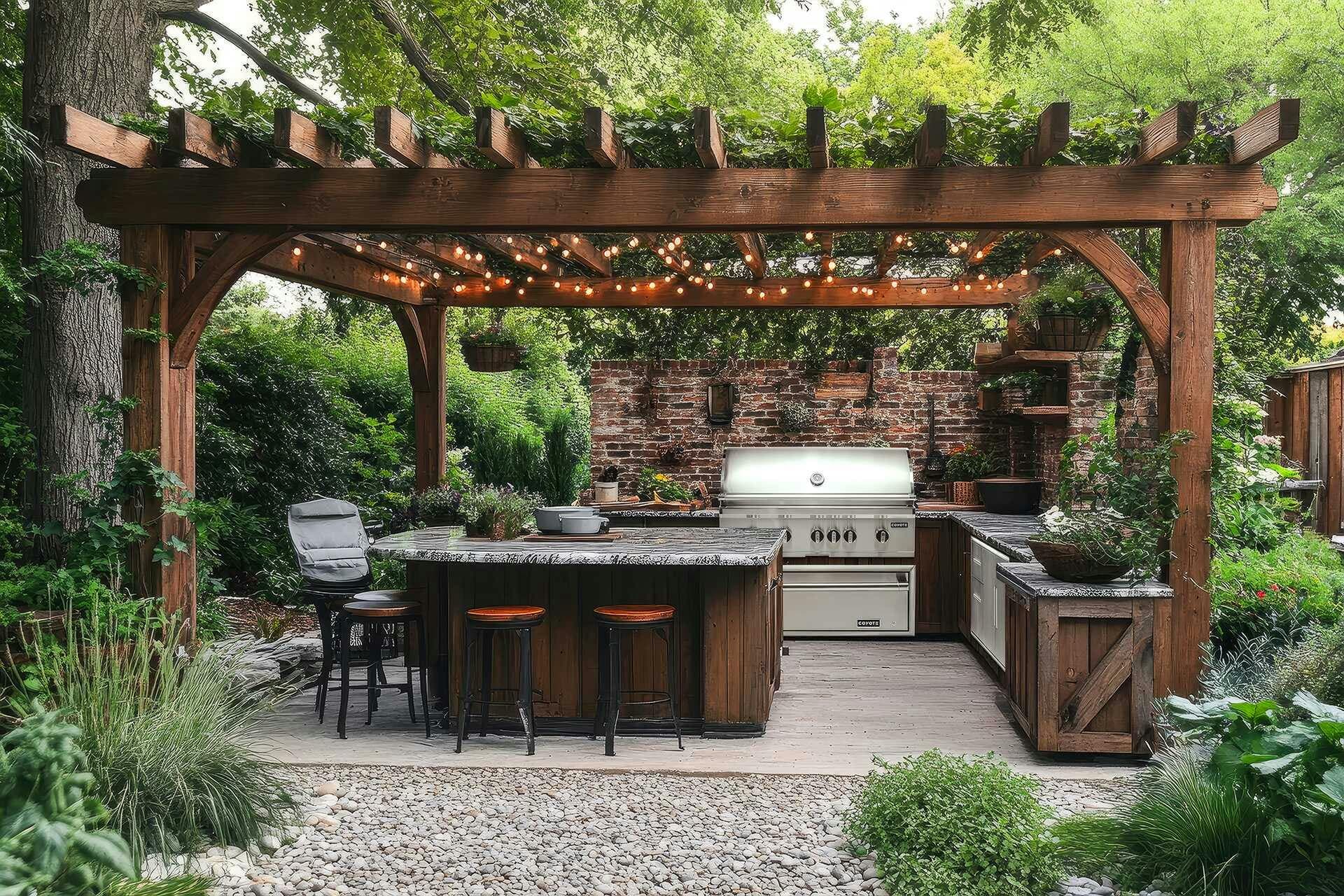
Updated November 2026. An outdoor kitchen is five decisions stacked on top of each other — fuel type, built-in vs freestanding, counter material, weather protection, and zone layout. Get those five right and a $15K build outperforms a $40K build that got the zones wrong. This is the planning framework we walk every BBQs.com customer through before we quote a single grill head: what each zone is for, how much space it takes in actual inches, what it costs in 2026 dollars, and which decisions you can defer to later without re-cutting stone.
The 5 decisions, in order
These stack. Each one constrains the next. Try to pick a counter material before you’ve settled on fuel type and you’ll over-spec the surround for a build that never happens. Lock the layout before you’ve decided built-in vs freestanding and you’ll either waste 18 inches of wall or realize at install day that the cutout won’t fit.
| # | Decision | What it locks in | When to decide |
|---|---|---|---|
| 1 | Fuel type | Gas line routing, propane tank storage, utility bring-up cost | Before any island construction |
| 2 | Built-in vs freestanding | Island size, cutout dimensions, whether you need matching cart accessories | Before ordering the grill head |
| 3 | Counter material | Surround budget (30-50% of total build), freeze-thaw survival | Before island framing — some materials need structural reinforcement |
| 4 | Weather protection | Pergola / roof / cover strategy; vent hood yes/no | Before stone goes in — roof posts anchor into the slab |
| 5 | Zone layout | Linear feet, L vs U vs straight run, cook flow | Last — depends on all four above |
Decision 1: fuel type
Natural gas is the default when the house has a gas meter with any reasonable path to the kitchen location. A 1/2-inch gas line can push 100,000 BTU of appliance load 30 feet from the manifold without an upsized regulator. Beyond 30 feet, or with more than 150,000 BTU of combined appliances (grill plus side burner plus power burner plus pizza oven), the installer will spec a 3/4-inch run and a secondary regulator. Natural gas drops roughly 60% of the long-term cost vs propane because the tank refills are gone, the BTU output is more consistent in cold weather, and you never run out mid-cook.
Propane is the right answer when the gas run is impractical, when the kitchen location might move within 5 years, or when the climate makes natural gas pressure unreliable (very cold mountain installs). A buried propane tank with a dedicated line runs the same as natural gas at a fraction of the install cost in a rural build. Above-ground tanks work but require a storage drawer like the Bull 16-inch roll-out propane drawer if the island is finished — nobody wants a 20-pound bottle visible next to the grill.
Charcoal and pellet almost never run as the only fuel in an outdoor kitchen. They go in as a second cooking station — a Kamado-style charcoal kettle beside the gas built-in, or a pellet smoker on a side cart. The ash management and lid behavior don’t integrate with the prep-counter workflow the way gas does.
Decision 2: built-in vs freestanding
Built-in means a welded grill head drops into a cutout in a masonry or metal island. The hood is double-wall insulated, the control panel finishes flush, and there’s no cart — the island is the furniture. Freestanding means the grill lives on a cart with wheels or legs, with the hood and control panel engineered for a standalone look. Same brand, often same burner architecture — different trim.
Built-in costs 20-30% more at the grill-head level than the same brand’s freestanding equivalent. A Hestan GMBR36 built-in lands in the $11-13K band; the Hestan 36 freestanding on the Deluxe cart with a double side burner lands in the $12-14K band — actually higher once you include the cart. The real cost delta is the island itself. A built-in NEEDS an island at $4K-$15K. A freestanding doesn’t. If the yard budget is $8K total, freestanding wins by default — pour a flat patio pad, roll the grill in, call it done.
We walk the full built-in sizing math in our built-in sizing guide, and if the brand decision is between Hestan Outdoor and the value-tier Aspire line, we did the full line comparison here. For buyers landing on Bull at the entry built-in tier, the Bull Angus vs Bull Diablo breakdown covers the 30-inch 4-burner vs 46-inch 6-burner decision.
Decision 3: counter material
Three materials survive year five in an outdoor kitchen without replacement: honed granite, quartz-concrete composites, and thick-slab porcelain. Everything else — polished marble, butcher block, tile over mortar, concrete DIY pours — looks great at install and shows wear by season two.
| Material | Installed cost / sq ft | Freeze-thaw survival | UV survival | Hot-pan tolerance |
|---|---|---|---|---|
| Honed granite | $60–$120 | Excellent | Excellent | Excellent |
| Quartz-concrete composite | $80–$160 | Very good | Check manufacturer UV rating (some yellow) | Excellent |
| Thick-slab porcelain (12mm+) | $120–$220 | Excellent | Excellent | Excellent |
| Polished marble (DO NOT) | $80–$140 | Poor (etches) | Good | Fair |
| Butcher block (DO NOT) | $30–$60 | Poor (warps) | Poor | Poor |
| Tile over mortar (DO NOT) | $15–$35 | Poor (grout fails) | Good | Fair |
Decision 4: weather protection
Protection is three layers that stack. Skip any one and you cut the kitchen’s lifespan in half.
Roof coverage. A louvered aluminum pergola, a solid-roofed outdoor room, or even a well-anchored shade sail doubles the lifespan of the grill, extends the fridge compressor’s life by 3-5 years, and is the single biggest reliability factor in the whole build. If the budget forces a pick-one decision between a $5K upgrade to the grill head and a $5K pergola, the pergola wins. The $3K Bull grill under a roof outlasts the $8K Hestan sitting in full sun.
Appliance covers. Factory-fit covers for every grill, side burner, fridge, and vent hood, pulled on when the forecast calls for weather. Generic covers don’t seal. Spend the $100-$200 per appliance and get the model-fit version.
Surround drainage. Any stone or concrete island needs a slight pitch — about 1/8 inch per linear foot — off the top edge so water sheds away from the grill cutout. In cold climates, drain weep holes at the base of the island so trapped water doesn’t freeze and crack the stone. Grill cutouts should be sealed with a high-temp silicone bead around the hood lip.
Vent hoods belong under solid roofing or enclosed pergolas where smoke gets trapped. Open-air pergolas don’t need a hood. Covered outdoor rooms, porch soffits, and sunroom-style enclosures do — a 1,200 CFM hood like the Bull 42-inch twin-fan or the Coyote equivalent handles a typical 36-inch built-in grill under that proximity. Check local code on make-up air — over 600 CFM triggers it in many jurisdictions.
Decision 5: zone layout
Zones go last because they depend on every decision above. There are five zones in a full outdoor kitchen. You don’t need all five — a complete grill-plus-refrigeration build hits three of them. Each zone has a real linear-foot requirement and a workflow logic.
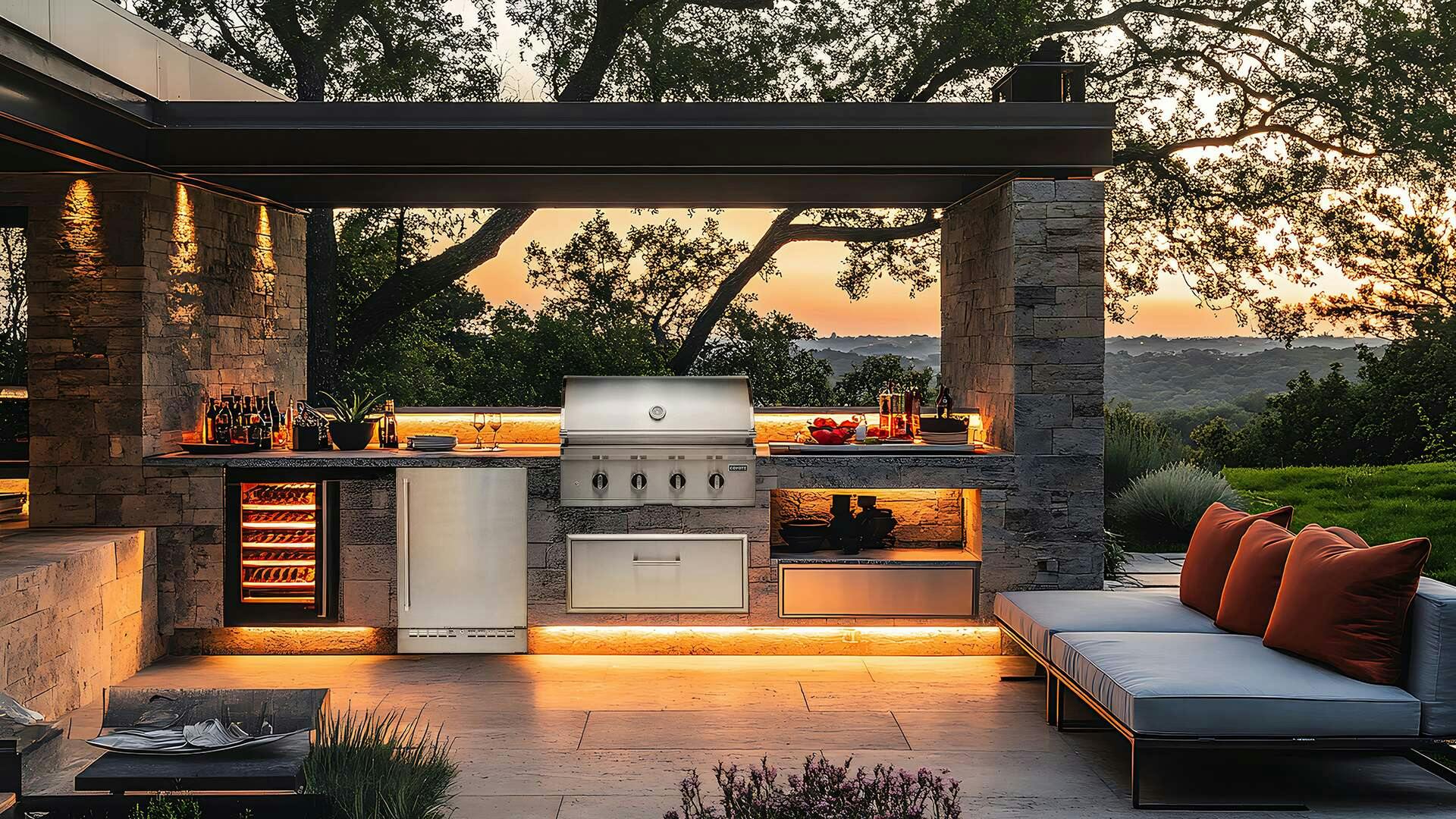
Zone 1: the cook
The grill head itself plus 24 inches of landing counter on both sides. Minimum 72 inches of linear island for a 30-inch built-in; 96 inches for a 36-inch; 108+ inches for a 42-inch or a grill-plus-side-burner combo. Landing counter on both sides is non-negotiable — the only alternative is carrying a 500-degree platter to a counter 8 feet away, which is where hot grease ends up on the paver.
Zone 2: the side station
A 25,000 BTU side burner, a 66,000 BTU power burner for wok cooking, or a secondary cooking station (charcoal kettle, pellet smoker). Takes 15-24 inches of linear island on top of the grill zone. A side burner handles sauces, sautés, the corn pot, the crab boil — everything a stovetop handles indoors. A power burner with a wok ring handles stir-fry and large-vessel outdoor cooking that would smoke out an indoor kitchen.
Zone 3: refrigeration
An outdoor-rated compact refrigerator — the Bull 24-inch, the Aspire outdoor-rated compact, or equivalent — takes 24 inches of base cabinet. Adding a kegerator or a wine cooler takes another 24 inches each. Position the fridge away from the grill — direct radiant heat from a grill 18 inches away shortens the compressor life measurably. 36 inches of separation is the comfortable target.
Zone 4: storage
Access doors and drawers below the counter surround — single or double access doors, utensil drawers, a trash pull-out, and (for propane builds) a tank storage drawer. Budget 48 inches of storage for a 10-person-party kitchen, 72 inches for 20-person. Vented doors are required anywhere a propane tank or an ignition-source appliance lives — un-vented stores cold combustible vapor at floor level.
Zone 5: bar / prep counter
A 24-inch prep counter at a minimum, a 36-48 inch bar counter with stools if the social center of the backyard is going to live here. The bar counter needs to be 42 inches off the ground vs the 36-inch standard counter height so stool-seated guests face the cook at eye level instead of looking up at a chin.
Sizing by party count
| Regular party size | Minimum linear feet | Shape | Zones to include | Realistic build range |
|---|---|---|---|---|
| Family of 4 + occasional guests | 8 ft | Straight run | Cook, refrigeration, storage | $12K–$18K |
| 10 person dinner | 12 ft | Straight or L | Cook, side station, refrigeration, storage | $18K–$28K |
| 20 person party regularly | 16 ft | L or U | All 5 zones | $28K–$45K |
| 30+ person entertaining | 20 ft+ or dual stations | U shape with two cook stations | All 5 + pizza oven OR second grill | $45K–$80K+ |
What to spec first if the budget is phased
Not every kitchen gets built all at once. The common phased path is grill-plus-island year one, refrigeration year two, pergola year three. The order matters because some upgrades are harder to retrofit.
Phase 1 must-haves: gas line routing (the trench is cheap now, murder later), slab with weep holes and the right pitch, the grill head itself, 48 inches of counter surround minimum, two access doors below the grill.
Phase 2 adds: outdoor-rated refrigerator (needs a dedicated 20-amp outdoor circuit — pull it in phase 1 even if you don’t install the fridge yet), side burner, kegerator.
Phase 3 adds: pergola or roof (anchor bolts should already be in the slab from phase 1), vent hood if the roof is solid, pizza oven or second cook station, bar counter upgrade.
The single biggest phased-build mistake we see is skipping the electrical trench in phase 1. Adding a 20-amp outdoor circuit after the stone goes in means breaking the patio to run conduit — thousand-dollar problem solved by a $200 trench on install day.
Where to start
Pick the grill head first because it anchors every other decision. The size of the built-in cutout determines the island linear feet. The brand determines which accessories (side burner, storage, vent hood) are available in matching finishes. The fuel type is set with the grill.
For buyers landing on the three brand lines we see most often at BBQs.com, the brand-specific comparisons go deep: Hestan Outdoor vs Aspire by Hestan at the premium tier, Bull Angus vs Diablo at the mid tier, and Blackstone 36 vs 28 griddle sizing for the flat-top crowd. For the value calculus on the whole build, outdoor kitchen cost per linear foot breaks down every line item.
The short version
Five decisions, in order: fuel, built-in vs freestanding, counter material, weather protection, zone layout. Pick the grill head first because it anchors the rest. Build in phases if the budget isn’t all there now, but pull the gas line and the electrical trench in phase one — both are impossible to retrofit cleanly once the stone is in. Spend the pergola money before the grill upgrade money. And size by the party you actually throw, not by the yard footprint. Get these right and a $15K kitchen outperforms a $40K build that got the zones wrong.
Frequently Asked Questions
What does a basic outdoor kitchen actually cost in 2026?+
What size should an outdoor kitchen be?+
Built-in grill or freestanding — which is right for my build?+
Do I need a vent hood over an outdoor grill?+
Gas, propane, or charcoal — what’s the right fuel for an outdoor kitchen?+
What counter material actually survives an outdoor kitchen?+
How do I protect an outdoor kitchen from weather?+
Products & brands in this guide
This Season
Shop the season
Black Friday 2026
Black Friday Grills
Deepest markdowns of the year on built-ins, carts, and high-BTU gassers.
Shop Black Friday →Holiday 2026
Holiday Grill Deals
Gift-ready grills and accessories that still beat Christmas.
Shop Holiday Deals →Thanksgiving 2026
Thanksgiving Grilling
Ideas to keep the turkey outside and the oven free for pies.
Read the Guide →Related reading
Reed — Reed writes the buying guides at BBQs.com — fifteen years selling and installing built-in grills means the picks here are what we'd actually put in our own outdoor kitchen.