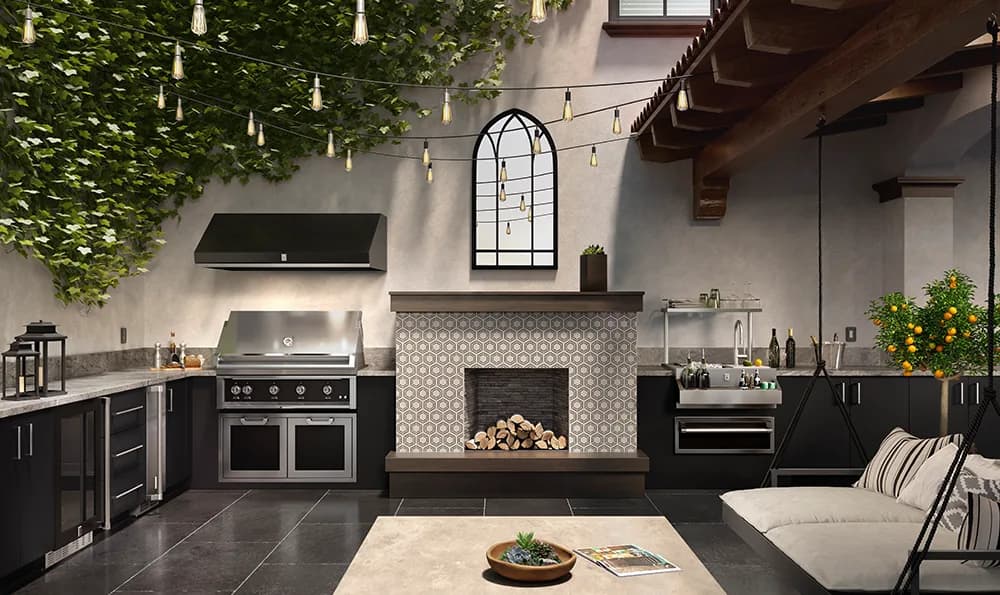
Updated October 2026. Sizing a built-in grill is where most outdoor kitchens go wrong — not the burner count, not the brand, the width. Pick 30 inches and you'll outgrow it the first time you host 10 people. Pick 48 inches and you'll heat half an empty grate for every weeknight burger. The right size is a function of three things most buying guides skip: how many people you actually cook for, how deep your counter run is, and what the countertop cutout math forces on your mason. In fifteen years of specifying built-in grills across every tier from Aspire by Hestan to full Hestan Deluxe, here's the sizing framework I give every client.
The Real Sizing Question Isn’t “How Big”
Most sizing guides open with a table that maps grill width to the number of guests. That table is directionally right and specifically wrong. Width alone doesn’t tell you how a grill cooks. Burner count, primary-grate square inches, and BTU per square inch do.
A 30-inch Bull Angus publishes 540 square inches of primary grate across four 15,000-BTU burners. A 30-inch head from a cheaper brand might run two 20,000-BTU burners across 480 square inches. Same nominal width. Different grills. The Angus delivers 111 BTU per square inch across a four-zone cooking surface; the two-burner version delivers 83 BTU per square inch across two zones and cooks nothing like it.
So before width, settle these three numbers: how many burners, how many primary square inches, and what BTU rating per burner. Width follows from those. Width alone is a cabinet-shop number, not a cooking number.
Width by How Many You Actually Cook For
Here’s the framework I use with buyers after fifteen years of installs. Start with real cook-load data, not aspirational entertaining data.
| Width | Burners | Primary grate | People / cook | Right for |
|---|---|---|---|---|
| 30" | 2-4 | 500-600 sq in | 4-6 | Couples, small families, patio kitchens |
| 36" | 3-4 | 650-750 sq in | 6-10 | Most outdoor kitchens — the sweet spot |
| 42" | 4-5 | 800-950 sq in | 10-14 | Regular entertaining, two-zone cooking |
| 48"+ | 5-6 | 1000+ sq in | 15+ | Luxury kitchens, dual-purpose builds |
Note the overlap. A 36-inch head can cook for 10 people — it’ll just run close to full capacity. A 42-inch can cook for 6 people — it’ll just leave two burners cold. The sizing question is really about where you want your typical cook to land: comfortably in the middle of the grate’s capacity, or hugging either end.
30-Inch: The Patio Kitchen Workhorse
The 30-inch tier is the right pick for most patio-scale outdoor kitchens. You get four burners from the premium brands, a dedicated infrared sear zone on most tiers, 500 to 600 square inches of primary grate, and total cost that lands between $2,000 and $3,500 for the grill head alone. The Bull Angus 30-inch and the Aspire by Hestan 30-inch are the two we move most of in this slot.
- Trellis ceramic infrared burner — true 650°F sears
- DiamondCut 304 stainless grates
- Hestan engineering at the Aspire price point
- Cutout: 29-3/16" W x 22-1/2" D x 9-9/16" T
Where 30 inches breaks down: the first time you host 12 people. You’ll run two cook cycles instead of one. If that’s acceptable because it’s rare, 30 is fine. If you’re the house that hosts a lot, step up to 36.
36-Inch: The Sweet Spot
If I had to pick one size for the majority of outdoor-kitchen clients, it’s 36 inches. Four burners (or three big ones plus a dedicated infrared), 650 to 750 square inches of primary grate, enough space for a brisket plus full sides on the same cook, and the width still fits a standard 7-foot outdoor-kitchen chase with room on either side for a sink and a refrigerator.
36-inch premium built-ins land in the 100-112 BTU-per-square-inch band — comfortably past the 90-BTU threshold where searing starts to work.
The three 36-inch heads I quote most: Coyote C-Series CL 36, Aspire by Hestan 36, and Hestan GSBR36. Each represents a different price-and-finish tier within the same width class.
36-inch tier — three honest options at three price points.
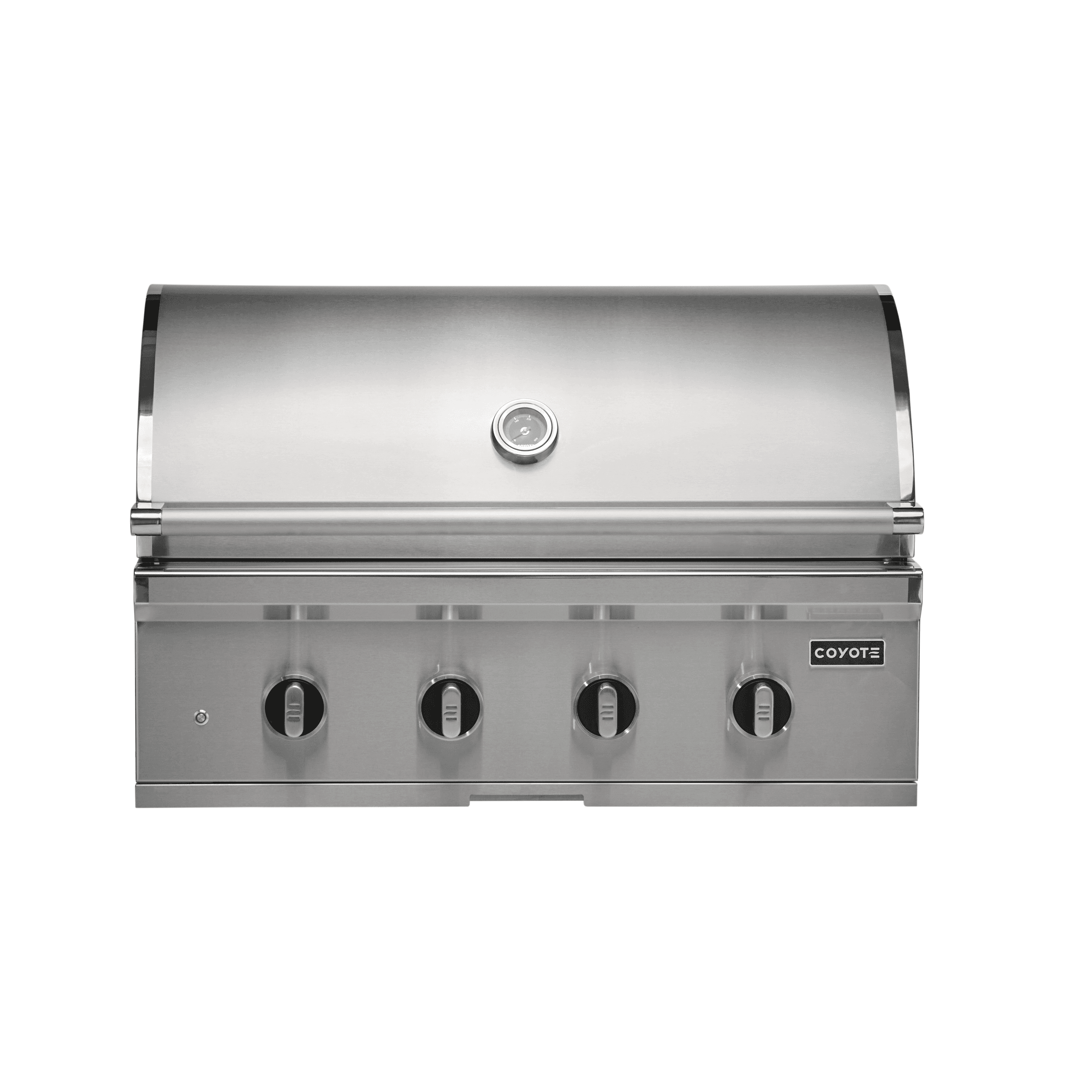
Coyote CL at $2,599 is the value play — cast brass burners, ceramic radiants, lift-assist hood, 15-year warranty. Aspire eb36 at $3,895 is the Hestan-engineering-at-Aspire-pricing play — DiamondCut grates, Trellis infrared, same build team as full Hestan with a less-premium finish. Hestan GSBR36 at $6,495 is the no-compromises luxury play — welded (not fastened) 304 stainless, 12-year all-inclusive warranty, and the cleanest build quality in the category.
42-Inch: When Two Zones Matter
Step up to 42 inches only if you have an honest answer to one question: do you cook with two simultaneously different heat zones? A dedicated sear zone running 700°F next to a stable 325°F indirect zone, both running on the same cook. If yes, the extra 6 inches of width buys you real separation between zones that a 36-inch head would compromise. If no — if you cook direct, close the lid, flip, serve — the extra width is wasted counter.
42-inch tier — the dual-zone size class.
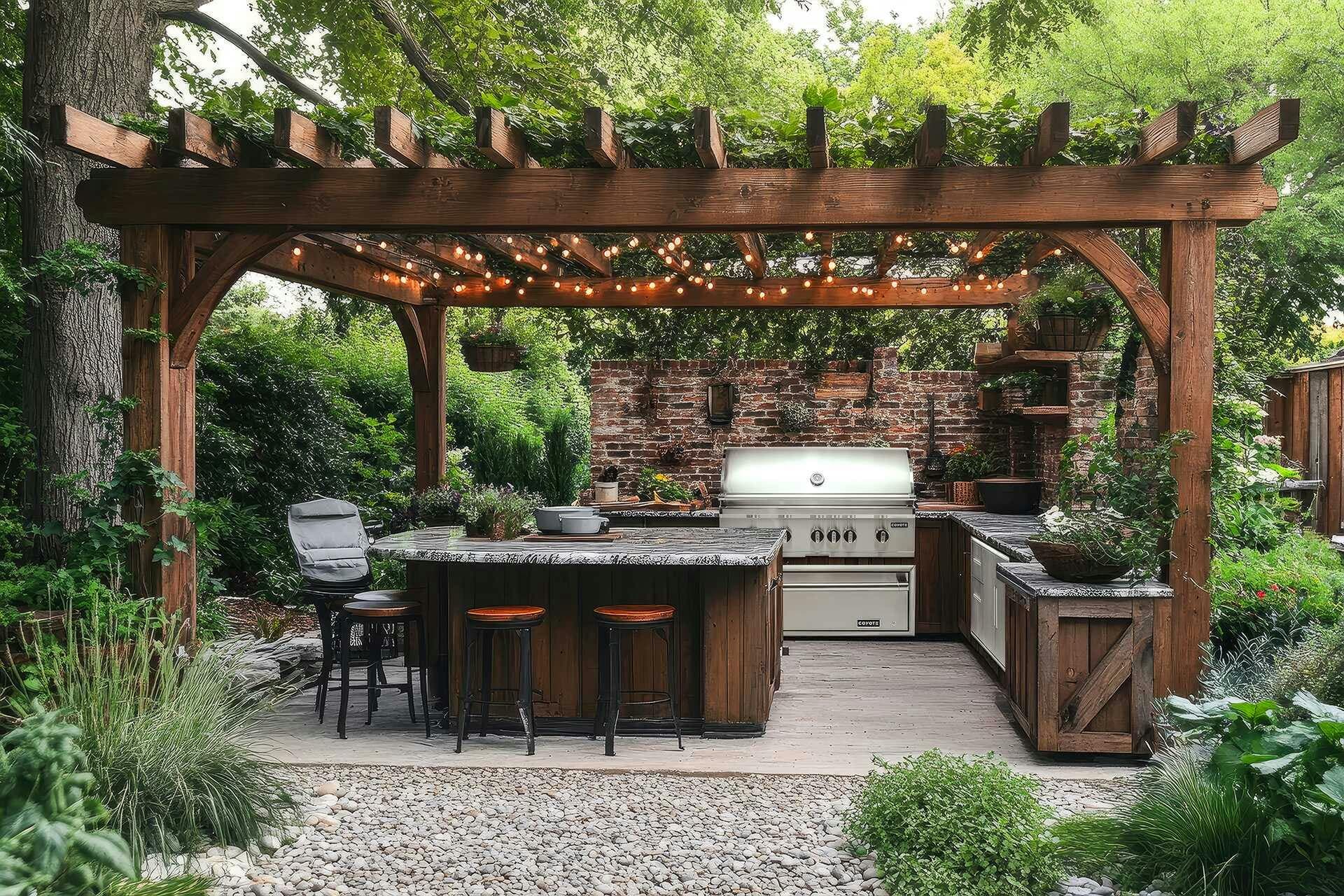
The 42-inch Hestan GSBR42 is the single most-specified grill in luxury Baton Rouge and Houston outdoor kitchens I’ve walked through in the last three years. It’s not because it’s the biggest — Hestan sells a 48-inch — it’s because 42 inches hits the sweet spot where two cooking zones get real breathing room without pushing the surround past the width where a mason can run a single countertop slab.
48 Inches and Up: Luxury Entertainers Only
Past 42 inches, you’re in dedicated-entertainer territory. A 48-inch head with five or six burners can cook for 15 to 20 people on a single cycle, run three independent heat zones, and cost $8,000 to $15,000 depending on tier. We spec them when the client genuinely hosts crowds of that size on a recurring basis, or when the build is a side-by-side dual-grill design where one head is dedicated to searing and the other to low-and-slow.
Honest take: in a decade of specifying outdoor kitchens, I’ve put in roughly one 48-inch head for every eight 36-inch heads. The 48-inch tier is a legitimate product, and the people who need it love it. Most buyers don’t need it.
Countertop Cutout — the Math That Burns Masons
Here’s where sizing goes from spec-sheet to physical build. Cutout dimensions are brand-specific and model-year-specific. A “36-inch” grill from one brand needs a different rough opening than a “36-inch” grill from another. The marketing width is the hood width; the cutout is the firebox-plus-flange width, and it’s always smaller than the hood.
| Grill | Nominal | Cutout W x D x T |
|---|---|---|
| Aspire eb30 | 30" | 29-3/16" x 22-1/2" x 9-9/16" |
| Bull Angus 30 | 30" | 29-1/2" x 22-1/4" x 10" |
| Coyote C-Series 30 | 30" | 28-3/8" x 20-1/2" x 9-7/8" |
| Aspire eb36 | 36" | 34-3/16" x 22-1/2" x 9-9/16" |
| Coyote CL 36 | 36" | 34-1/2" x 22-3/4" x 10-3/8" |
| Hestan GSBR36 | 36" | 36" x 23" x 10" |
| Aspire eb42 | 42" | 40-3/16" x 22-1/2" x 9-9/16" |
| Coyote CL 42 | 42" | 40-1/2" x 22-3/4" x 10-3/8" |
| Hestan GSBR42 | 42" | 42" x 23" x 10" |
“A 1/4-inch cutout error means re-cutting an entire slab of countertop. Measure the grill, not the marketing material.”
Depth is the number that catches most masons. Hestan runs 23 inches deep. Coyote CL runs 22-3/4 inches. Aspire eb runs 22-1/2 inches. A 24-inch-deep counter is standard; a 23-inch grill drops into it with 1/2 inch of overhang in back for ventilation. Specify a 22-inch counter and the grill either hangs over the back or doesn’t fit flush — both are failure modes.
Clearance Code — What You Actually Have to Follow
Clearance requirements are the second place outdoor kitchens fail inspection. Three dimensions matter: side, rear, and overhead.
Rear clearance
ANSI Z21.58 and most jurisdictions require a minimum of 6 inches from the back of the grill firebox to a non-combustible wall or combustible-with-listed-insulation surround. Jump to 10 inches minimum when the rear surround is combustible (wood, vinyl, composite) and you’re not using a listed insulation jacket. Most premium brands — Hestan, Coyote, Aspire by Hestan — publish their own rear clearance in the install manual, and it overrides generic code when it’s more conservative.
Side clearance
Minimum 2 inches of clearance from the firebox to combustible surround material (cabinet frame, wood trim). Non-combustible stone or stucco surround can go flush to the flange. Common failure: a wood cabinet frame built flush to a grill that doesn’t have an insulation jacket — the frame chars over time and fails inspection.
Overhead clearance
If you have a roof, soffit, pergola with ceiling material, or vent hood above the grill, minimum 24 inches of clearance from the grill grate surface to the overhead non-combustible material, 36 inches to combustible material. A vent hood ships with its own install-height spec that’s usually in that range and should be followed over generic code.
Insulation Jackets — The $500 Line Item Nobody Budgets For
If your outdoor kitchen surround is combustible material — wood framing, HardiePlank, vinyl, composite stone over wood framing — you need a listed insulation jacket (sometimes called a grill liner or insulation sleeve). The jacket wraps the firebox in a thermal barrier that drops the required clearance-to-combustibles from 10 inches down to roughly 1 inch on sides and back.
Hestan, Coyote, Aspire by Hestan, and Bull BBQ each sell jackets specifically fitted to their grill heads. They run $400 to $700 depending on size. Factor this cost into the build budget — it’s not optional on combustible builds, and it’s the single most-skipped line item in homeowner-planned outdoor kitchens.
BTU Per Square Inch — The Rule That Actually Predicts Cooking
Of all the specs on a grill sheet, BTU per square inch of primary grate is the one that actually predicts how the grill cooks. The working band for premium built-in grills is 90 to 110 BTU per square inch. Below 80 and sears stall out past 500 degrees. Above 120 and you’re pushing more flame than the grate can usefully deliver to food — you get hot-spotting and wasted fuel.
| Grill | Primary BTU | Primary sq-in | BTU / sq-in |
|---|---|---|---|
| Aspire eb30 | 50,000 | 548 | 91 |
| Bull Angus 30 | 60,000 | 540 | 111 |
| Coyote C-Series 30 | 50,000 | 550 | 91 |
| Aspire eb36 | 60,000 | 705 | 85 |
| Coyote CL 36 | 64,000 | 572 | 112 |
| Hestan GSBR36 | 75,000 | 792 | 95 |
| Aspire eb42 | 80,000 | 860 | 93 |
| Hestan GSBR42 | 100,000 | 1056 | 95 |
Note what’s not on this table: total BTU. Marketing material loves big total-BTU numbers that include rear infrared burners, side burners, and warming racks. That number is useful for comparing grill-head capacity in general, but it doesn’t predict primary-cooking performance. Primary-grate BTU-per-sq-in does.
What Size Grill Fits My Outdoor Kitchen? — A Practical Flow
Here’s the decision flow I run buyers through when the hypothetical gets concrete:
1. Count honest guests. Not party guests. Weekly dinner guests. If that number is 4-6, you’re a 30-inch. If 6-10, 36-inch. If 10-14, 42-inch. If 15 plus with real regularity, 48-inch or dual-head.
2. Measure the counter run. A 30-inch grill needs a 7-foot minimum counter run to leave room for sink + refrigerator + prep. A 36-inch wants 8 feet. A 42-inch wants 9. A 48-inch wants 10 feet minimum, often with a side-by-side design that pushes the kitchen footprint to 11 or 12 feet.
3. Pull the actual cutout spec. Not the marketing width. The current install manual from the brand, dated within the model year you’re buying. Hand it to the mason or cabinet shop before anything gets cut.
4. Spec the insulation jacket if the surround is combustible. Don’t find out at inspection.
5. Verify BTU-per-sq-in lands in the 90-110 band on primary grate. If it doesn’t, you’re either underpowered (searing stalls) or spec-sheet-flexed (hot-spotting).
“The right-sized grill is the one that lets you cook on half the burners most nights and still have headroom for the one big cook. Not the biggest grill you can fit.”
What I’d Build Today
If I were building my own outdoor kitchen tomorrow, with my own cook load (6-8 people most weekends, 15+ twice a year), on a 9-foot counter run, in a stone surround: 36-inch Coyote CL 4-burner, sized to the 100 BTU-per-sq-in band, dropped into a stone chase with 2-inch side clearance and 8 inches of rear clearance to a non-combustible wall. $2,599 for the head, $500 for the jacket (even though stone is non-combustible, the jacket adds thermal mass and quietly extends grate life). Total built-in-grill line item: $3,100.
If budget doubled and I was building a luxury kitchen with matching Hestan refrigeration and cabinetry: 42-inch Hestan GSBR42, same clearance math, matching Hestan vent hood. The GSBR42 is the single best 42-inch built-in on the market right now, and the Hestan ecosystem of refrigeration, side burners, and cabinetry delivers a visual coherence no other brand can match.
If budget was constrained and I had to deliver a working outdoor kitchen under $4,000 total: 30-inch Bull Angus 30, 7-foot counter run, utility sink only, no built-in refrigeration (freestanding beverage cooler on wheels instead). The Angus at $2,839 with a lifetime burner warranty delivers 85 percent of a premium 36-inch build at 50 percent of the cost, and you can upgrade later without rebuilding the surround.
Frequently Asked Questions
What size built-in grill do I need?+
What is the cutout size for a 36-inch built-in grill?+
How much clearance do I need behind a built-in grill?+
What is the BTU per square inch rule for a built-in grill?+
Is a 36 or 42 inch built-in grill better?+
Can I install a built-in grill in a combustible-material outdoor kitchen?+
Products & brands in this guide
Related reading
Reed — Reed writes the buying guides at BBQs.com — fifteen years selling and installing built-in grills means the picks here are what we'd actually put in our own outdoor kitchen.