Coyote sits in an interesting spot in the premium built-in category. It's not Bull — which owns the value-per-BTU conversation in the $2,500-to-$3,000 window — and it's not Hestan, which owns the top of the market at $6,000-plus. It lives in the middle, and that middle is a legitimately hard place to build a grill. After a decade of selling and installing them, I still think the C-Series — specifically the CL 'Loaded' tier reviewed here — is one of the smartest picks in premium built-in outdoor cooking. That said, it has real tradeoffs against Bull Angus that most reviews won't tell you about, and I'll get into those honestly.
What Coyote Actually Is
Coyote Outdoor Living is a Dallas, Texas company founded in 2010 by veterans of the outdoor cooking industry — a group that included alumni of Viking’s outdoor division and other commercial-grade appliance backgrounds. The whole thesis of the brand was to bring restaurant-grade specs to the premium-residential price point, and to distribute exclusively through outdoor-kitchen dealers rather than big-box retail.
You will not find Coyote at Home Depot, Lowe’s, or Costco. That’s deliberate — the brand’s whole positioning depends on being sold by dealers who install outdoor kitchens rather than by floor reps who move whatever’s on the pallet. It also keeps pricing honest; Coyote doesn’t discount promotionally, and the dealer margins support the kind of white-glove delivery and installation support that a $2,600 built-in should carry.
Final assembly happens in the United States with a mix of domestic and imported components — the 304 stainless is sourced globally, but the head is built and burn-tested stateside. For a lot of our clients, that’s a real differentiator against the mostly-offshore competition at the same price point.
C vs S vs CL vs SL — Coyote’s Lineup
Coyote sells four tiers of C-Series built-in and it’s worth understanding the difference before you pick one. The base C is entry-tier: 304 stainless, tubular main burners, no ceramic radiants, standard hood without lift-assist. It’s a solid grill and priced accordingly, but it doesn’t showcase what Coyote does uniquely well.
The S adds a dedicated infrared sear zone to the base C configuration — one of the burners is swapped for a ceramic infrared sear burner. That’s the right choice if you cook a lot of steak and don’t need the full Loaded feature set.
The CL — Loaded — is where the brand really shows up. Cast brass main burners replace stainless tubular. Ceramic radiants sit under every burner. The hood gains spring-assisted lift, the gas connection gets a safety valve for flame-out shutoff, and interior halogen lights turn on with the hood. This is the tier reviewed here and the one we recommend for most premium builds under $3,500.
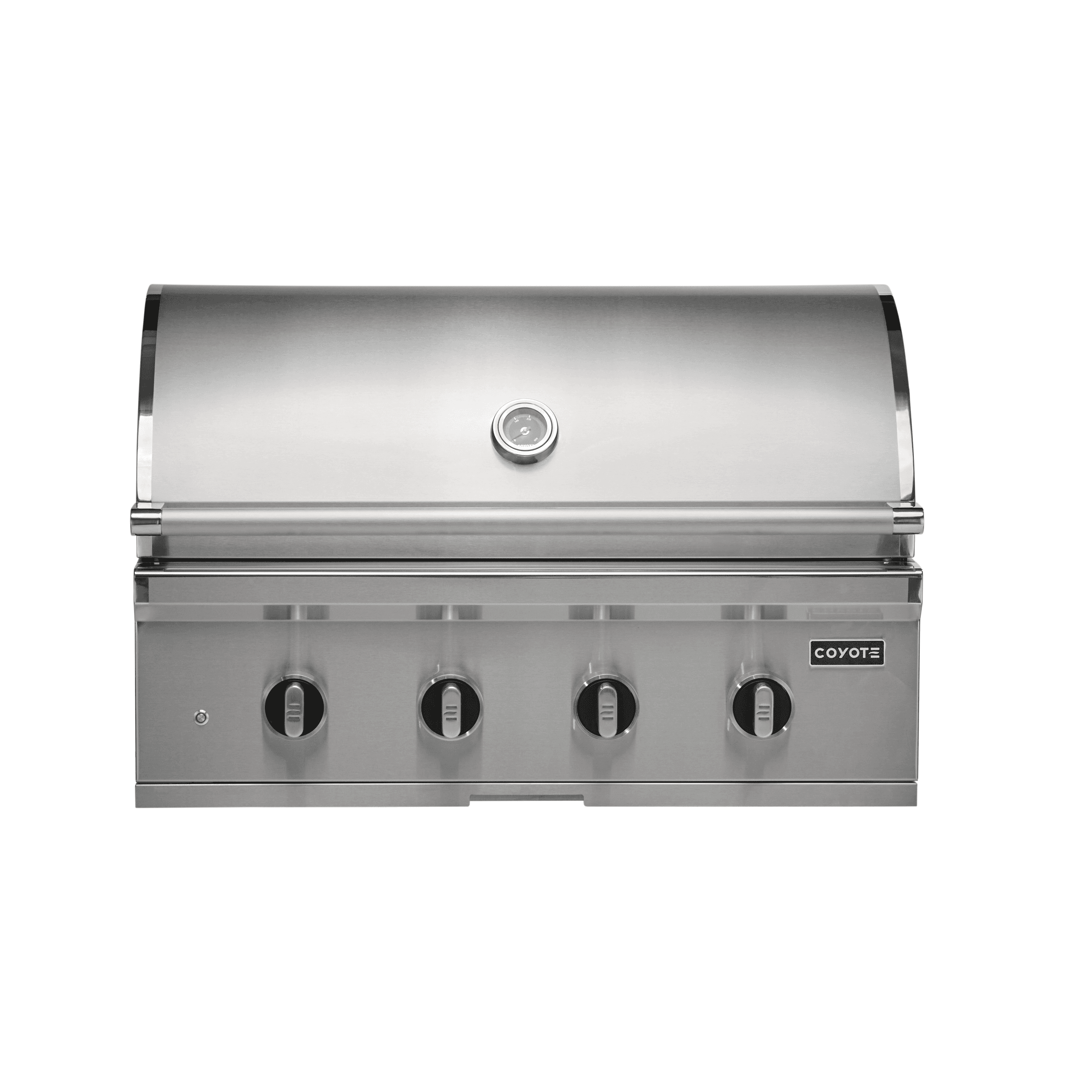
- 64,000 BTU cast brass burners across 4 zones
- Lift-assist hood — one-hand open with a plate in the other
- Ceramic radiants + 3/8" stainless grates
- 15-year warranty, US-assembled in Dallas
The SL — the luxury Loaded flagship — adds premium finish options and slightly heavier structural stainless on top of everything CL has. It runs a meaningful upcharge for what’s ultimately a finish and refinement upgrade. Worth it in luxury kitchens; overkill in most.
Cast Brass Burners — the Underrated Difference
Nearly every competitor in Coyote’s price range uses cast or tubular stainless burners. Coyote CL uses cast brass, and it’s the single spec on the CL sheet that most buyers don’t understand the significance of. Brass conducts heat differently — at the same rated BTU, brass burners run roughly 15 percent hotter at the flame tip than stainless because brass carries heat away from the burner body more efficiently and pushes it up into the flame.
Brass also doesn’t oxidize the way cast iron does — you don’t get the rust-and-flake failure mode that eats cast iron burners on coastal installs. And it doesn’t warp under repeated thermal cycling the way stainless can when it’s cast to the wall thickness needed for a residential price point.
The tradeoff — and this is the important part — is that brass concentrates heat right at the burner tip. Without a diffusion layer, that would translate to hot-and-cold zones across the grate. Coyote solves it with ceramic radiants sitting directly over each burner (more on those in a minute) that absorb the concentrated heat and re-radiate it evenly across the full cooking width. Brass burners without ceramic radiants would hot-spot badly; ceramic radiants without cast brass would be underfed. The two components are engineered together, and it’s the combination that makes the CL cook the way it does.
16,000 BTU x 4 = 64K Total — What That Actually Cooks
Coyote CL primary zone — cast brass burners hit target temp about 30% faster than stainless at the same rating.
The CL 4-burner publishes 16,000 BTUs per main burner across four burners for 64,000 BTUs total on the primary cooking grid. Divide by the roughly 572 square inches of primary grate and you get 112 BTU per square inch — comfortably above the 100 BTU-per-square-inch target we spec grills to on this site, and higher than most competitors at the same size.
What that translates to in real cooking: hard-sear temperatures of 600 to 700 degrees Fahrenheit at the grate with all four burners on high, stable 350-degree low-and-slow performance with two burners on for indirect cooking, and enough recovery power to hold temperature when you open the lid on a 50-degree fall evening. The brass burners hit target temperature roughly 30 percent faster than the equivalent stainless burner — you’re at working temp in 8 to 10 minutes instead of 12 to 15.
The 875 square inches of total cooking surface (primary plus warming rack) is enough to feed 12 to 15 people comfortably without crowding, or to run a full brisket-and-sides cook without shuffling. This is a serious grill for cooking-forward homeowners, not a spec-sheet flex.
The Lift-Assist Hood
The CL hood weighs approximately 35 pounds. That’s heavier than the entry C-Series hood by design — the added mass keeps temperatures stable when you open the lid and it protects against warping under sustained high-BTU cooking. But 35 pounds of stainless is a real lift, especially with one hand while the other is holding a plate of raw meat.
Coyote solved that with spring-assisted hood pivots on the CL and SL tiers. The hood still weighs 35 pounds — the spring doesn’t change the mass — but the effort at the handle is reduced to what feels like 10 or 12 pounds. You lift it with one hand while the other is occupied. You close it with a gentle push instead of dropping it. It stays up at any angle you leave it at instead of slamming to full-open.
This is the kind of feature that reads as marketing on a spec sheet and reveals itself as a real usability win the first time you cook on the grill. Standard heavy hoods take two hands and a shoulder to open cleanly. The lift-assist hood doesn’t. It sounds small; it isn’t.
Ceramic Radiants vs Stainless Heat Tents
Here’s the honest tradeoff most Coyote reviews skip. Ceramic radiants — the plates that sit between burner and grate to distribute heat — deliver measurably more even heat than stainless heat tents. They absorb the concentrated flame from the brass burners and re-radiate it as broader, softer heat across the full grate width. You get fewer hot spots, cleaner sears across the whole cooking surface, and better performance on delicate items like fish.
But ceramic cracks. Not immediately, and not from cooking — from thermal shock when a cold rain hits a hot grill, or from a heavy grate dropped on the radiant during cleaning. In our warranty experience, ceramic radiants on Coyote CL heads typically need replacement every 5 to 7 years at roughly $80 to $120 per set. That’s a real ownership cost, and it’s the accurate honest tradeoff versus stainless heat tents that last 20-plus years but hot-spot the grates in the direct-flame zones.
“The ceramics distribute heat more evenly but cost you $80–120 in replacement parts every 5–7 years.”
The choice comes down to what you value: more-even heat with a periodic $100 wear-part replacement, or slightly less-even heat with a component that outlasts the grill. Both answers are defensible. Coyote made the ceramic call; Bull made the stainless call. Neither is wrong.
Compared to Bull Angus
| Spec | Bull Angus | Coyote CL | Hestan Aspire 30" |
|---|---|---|---|
| Burners | 4 x 15K stainless tubular | 4 x 16K cast brass | 4 x 15K stainless tubular |
| Main BTU | 60,000 | 64,000 | 60,000 |
| IR sear | Rear only | Rear + optional | Trellis IR primary |
| Grate | 8mm 304 rod | 3/8" stainless | DiamondCut 304 |
| Hood | Manual | Lift-assist | Manual |
| Radiants | None — heat tents | Ceramic | Ceramic |
| Warranty | Lifetime burners | 15-yr primary | 12-yr all-inclusive |
| From | $2,839 | $2,599 | $4,500+ |
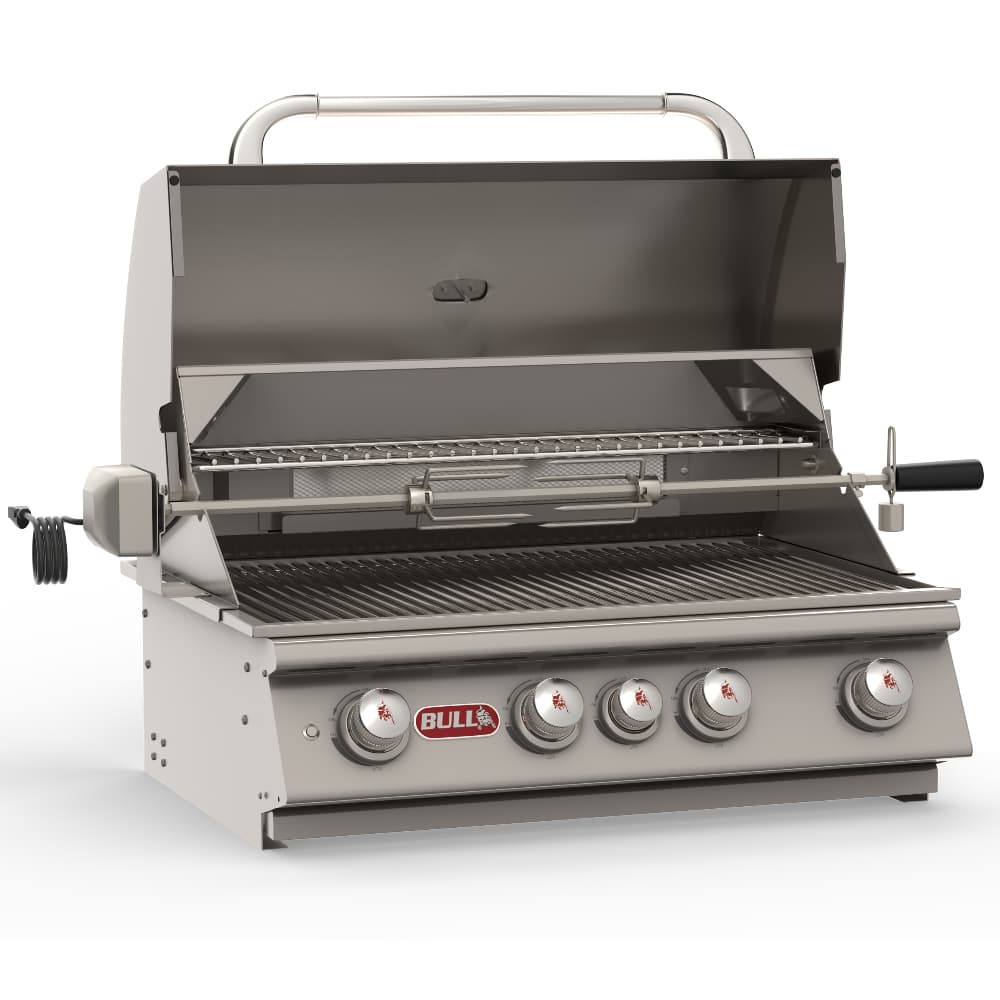
The Bull Angus 30-inch built-in is Coyote CL’s single most direct competitor — same premium built-in category, same $2,600-to-$2,900 price window, both aimed at the outdoor-kitchen buyer who wants a real grill without stepping up to Hestan. Head-to-head, they’re different philosophies.
Bull Angus publishes approximately 60,000 BTUs on main burners across four cast stainless tubular burners, uses stainless heat tents (not ceramic radiants), 8mm rod cooking grates, a standard hood without lift-assist, and carries a lifetime warranty on stainless and burners. It’s the simpler, more durable, longer-warranty grill.
Coyote CL publishes 64,000 BTUs across four cast brass burners, uses ceramic radiants, 3/8-inch heavier stainless grates, a spring-assisted lift-assist hood, safety valve, interior halogen lights, and a 15-year warranty on primary components. It’s the more feature-rich, better-cooking grill on the day of the cook.
How I frame it for buyers: choose Bull Angus if you value warranty simplicity, lower long-term ownership cost, and the peace of mind of a lifetime burner claim. Choose Coyote CL if you value the lift-assist hood, more-even heat from the brass-plus-ceramic system, and better night visibility from the interior lights. Both are grills we’ll happily sell. Neither is a mistake.
The head-to-head cross-shop — same price window, different philosophies.
Compared to Hestan Deluxe
Hestan Deluxe at 30 inches lands between $6,000 and $9,000 depending on finish and configuration. That’s roughly double what Coyote CL costs, and the honest question is whether the upcharge delivers double the grill.
It doesn’t. It delivers roughly 15 percent more grill — heavier stainless gauge, welded (not fastened) structural construction, the strongest warranty in the category at 12 years on everything including ignition, and a level of finish and design coherence that’s genuinely a step above Coyote. But the actual cooking performance gap between a Hestan Deluxe and a Coyote CL is small. Both hit 700 degrees on high, both hold 350 degrees stably, both deliver enough BTU to cook for a crowd.
My honest framing: if you can afford Hestan and you’re building a luxury outdoor kitchen with matching refrigeration and cabinetry, buy Hestan. The finish coherence and warranty are worth it. If you can’t justify $7,500 for a 30-inch head, Coyote CL is the best value premium built-in on the market at half the price with 85 percent of the performance. That’s the highest compliment I can give a grill in this category, and it’s the reason we sell as many CL heads as we do.
Frequently Asked Questions
Is Coyote a good grill brand?+
Where are Coyote grills made?+
What's the difference between Coyote C, S, CL, and SL?+
How long does a Coyote grill last?+
Is Coyote worth it vs Bull?+
Do Coyote grills come with a warranty?+
Products & brands in this guide
Related reading
Reed — Reed writes the buying guides at BBQs.com — fifteen years selling and installing built-in grills means the picks here are what we'd actually put in our own outdoor kitchen.