What Size Fire Pit Do I Need? The Honest 24 to 48 Inch Sizing Guide
By Reed · Published September 2026
Every fire pit sizing conversation we have at the counter follows the same shape. Somebody measured their patio, googled a diameter, and ended up between two sizes with no way to pick. Updated September 2026, right as fire pit season starts. This guide walks the real math for 24, 30, 36, 42, and 48-inch fire pits — how many people each size warms, the 36-inch clearance rule nobody teaches, the honest BTU targets per size, and the models from Ohio Flame, The Outdoor Plus, and Prism Hardscapes we actually stock at each dimension.
Start With the Clearance Rule, Not the Patio Size
Almost every wrong-size fire pit story starts the same way: somebody measured their patio, subtracted a rough furniture footprint, and picked a pit diameter that filled the leftover space. That is the wrong math. The right math starts from the code-required 36-inch clearance in every direction from the edge of the pit to any wood decking, patio umbrella, plant, fabric, or structure. That clearance is not a suggestion — it is what your homeowner's insurance and every warranty in the category assume.
Take the clearance ring and add it to the pit diameter. A 36-inch round pit needs a 108-inch (9-foot) diameter clear zone. A 48-inch round needs 120 inches (10 feet). Rectangular pits need the same clearance measured off the longest side. Now compare that clear zone to your patio. If your patio is 12 by 12, a 48-inch pit fits with seating on two full sides. If it is 10 by 10, a 36-inch fits with tight seating. Anything under 10 by 10, cap at 30 inches and accept that the pit is the focal point rather than a centerpiece with chairs around it. Local code often adds to the NFPA-54 default — check your jurisdiction before you buy, some California residential decks require 60 inches.
“Nobody measures the clearance ring first. Then they buy a 60-inch pit and their patio umbrella starts smoking in month three.”
How Many People Each Size Actually Warms
The other question people arrive with: how many people can this size warm. There is no honest answer without knowing the ambient temperature, but here is what we tell customers at the counter, calibrated to 45°F weather with chairs pulled 36 to 40 inches back from the edge (which is the correct clearance distance).
24-inch pit at 45,000 BTU: 2 to 4 people. Bistro-scale. A small deck. Warms hands and takes the chill off the immediate ring but does not carry past 4 feet. Fine for a couple who wants ambience on a small patio.
30-inch pit at 40,000 BTU: 3 to 5 people. The starter size for real backyard use. Warms a small ring of chairs without any thermal dead spots. Fits on a 10 by 10 patio.
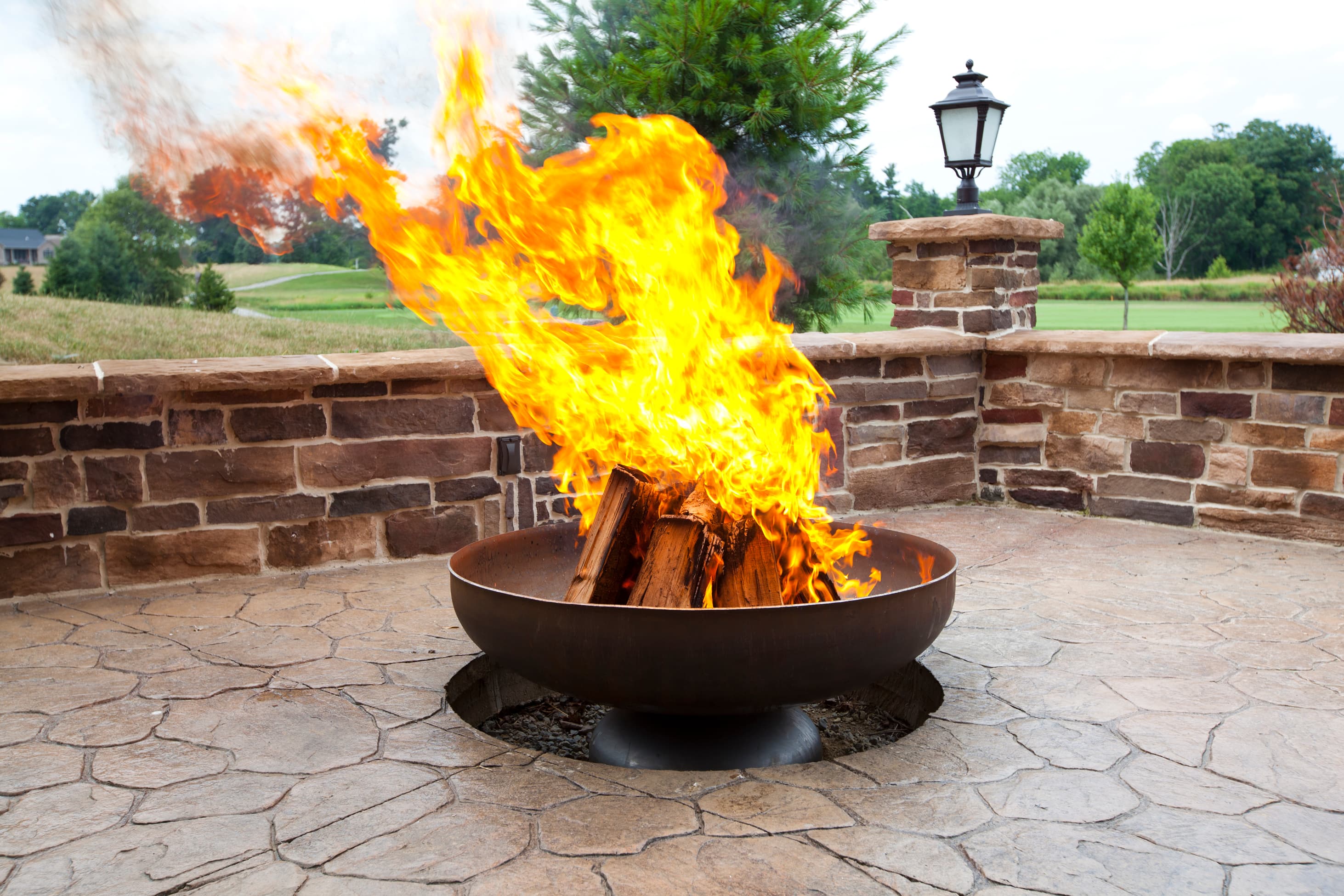
36-inch pit at 50,000 BTU: 4 to 6 people. This is our best-selling size for a reason — it hits the sweet spot between fits-anywhere and warms-a-real-group. The Ohio Flame Patriot at 36 inches is the wood-burning version of this size that most people end up with.
42-inch pit at 55,000 BTU: 5 to 7 people. A meaningful step up in useful heat radius over the 36. Good for regular hosts who don't need the full 48-inch commitment.
48-inch pit at 60,000 to 65,000 BTU: 6 to 9 people. Entertaining-forward. This is the pick for regular weekend hosts, pool parties, or a covered outdoor room. The full 48-inch decision has its own buying guide.
A 30-inch pit wants 35-40k BTU. A 36-inch wants 45-55k. A 48-inch wants 55-65k. Below the range the flame is sputtery; above it, you're burning fuel faster than the payoff justifies.
Which Brand Carries Which Size
Not every brand ships every size. If you have a hard sizing constraint (patio dimensions, HOA-required max footprint, need to match an existing fire table), knowing who ships what saves a lot of dead-end browsing.
Ohio Flame Patriot and Liberty (wood-burning, Corten steel): the deepest size range in the category. 24, 30, 36, 42, and 48 inches all in stock. Same silhouette across all five sizes so you can pick the size for your patio, not the size the brand happens to make.
The Outdoor Plus Cazo (gas, copper or steel bowls): 24, 30, 36, and 42 inches. Best value in the mid-range if you want a real gas bowl. 45,000 BTU on the 24 and 30 inch, 65,000 BTU on the 36 and up.
Prism Hardscapes (gas fire tables, concrete): the design-forward pick, ships primarily in 30, 40, 48, and larger table formats — not traditional round pits. Moderno at 30 inches and Tavola 4 at 66 inches are the two most-requested. If you want a fire table rather than a bowl, this is the line.
Round vs Rectangular — Shape Changes the Social Axis
The other decision people over-think. Round pits give equal visibility from every side, which matters if the pit sits as a centerpiece in a lawn or on a deck with chairs on all four sides. Rectangular pits give a natural social axis along the long edge that fits standard patio-furniture arrangements — a sectional along one long side, individual chairs on the other, low tables at the short ends. Most furnished residential patios end up rectangular because that is what the existing furniture wants.
The clearance math is the same for both. A 48-inch square pit and a 48-inch round pit both need 36 inches of clearance in every direction. The difference is just what looks and functions best given the surroundings.
Sizing for a Small Deck (Under 10x10)
Small deck rules are stricter because wood decking IS a combustible per code. If your deck is 8 by 10 or smaller, cap the pit at 24 or 30 inches and use a fire-safe pad underneath the pit itself. Even with a pad, keep 36 inches of clearance from railing, siding, and furniture. Do not put a 48-inch pit on a small deck under any circumstance — the burn radius plus the seating clearance means you have zero usable deck left.
For a small deck, the Ohio Flame Patriot 24-inch or 30-inch, or The Outdoor Plus Cazo 24-inch bowl, are the honest picks. Any larger and you are compromising either safety or use of the deck.
Sizing for a Large Yard or Poolside
Big yards flip the math. When clearance is not the constraint, the question becomes flame visibility and heat carry. A 24-inch pit in a 40 by 40 backyard reads as small — visually, the flame does not carry past 8 feet, so from across the yard it looks like a candle. Size up to at least 36 inches for a lawn setting, and 48 inches or a large fire table for poolside where guests approach from multiple directions.
Larger than 48 inches, you are into fire-table territory. The Prism Tavola 4 (66-inch rectangular, 65,000 BTU) and similar table-format pits are the pick for large-scale outdoor rooms. That's a different category and it has its own buyer's guide.
Fuel Choice by Size
Fuel choice interacts with size in one specific way: propane tank longevity. A 20-lb propane tank runs a 30-inch pit at 40,000 BTU for about 11 hours, a 36-inch at 50,000 BTU for about 9 hours, and a 48-inch at 65,000 BTU for about 6.5 hours. If you use the pit for a 3-hour session twice a week, the 48-inch will burn through a tank every three to four weeks in season.
That's the case for natural gas whenever the option exists. NG is about 30 percent the cost per BTU of propane, and once the line is plumbed you never think about tanks again. The install cost (usually $400 to $900 for a licensed plumber to run a dedicated 1/2-inch line) pays back inside two seasons on a regularly-used pit. We break down the full fuel math in the natural gas vs propane guide.
The Honest Recommendation by Patio Type
If you skip the rest of the article, this is the counter answer:
8 by 10 or smaller deck: 24 or 30 inches. Ohio Flame Patriot 24.
10 by 10 or 10 by 12 patio: 36 inches. Ohio Flame Patriot 36 or a Cazo 30 for gas.
12 by 12 or 12 by 14 patio: 42 or 48 inches. This is the sweet spot for regular entertainers.
Large yard or poolside: 48 inches minimum, or step into a fire table.
Covered outdoor room: 42 or 48 inches, gas-only, and confirm ventilation clearance from the ceiling (usually 8 feet minimum).
The pit that fits your patio is the pit that stays used. The one that's a size too big becomes a warning story on the next patio project.
Frequently Asked Questions
What size fire pit do I actually need for my patio?+
How many people will a 36-inch fire pit warm?+
What is the smallest fire pit that is still worth buying?+
Round or rectangular fire pit — does the shape change the size math?+
How much BTU do I need per inch of fire pit?+
Do bigger fire pits cost more to run?+
Can a fire pit be too big for the patio?+
What is the minimum clearance to combustibles?+
Products & brands in this guide
Related reading
Reed — Reed writes the buying guides at BBQs.com — fifteen years selling and installing built-in grills means the picks here are what we'd actually put in our own outdoor kitchen.