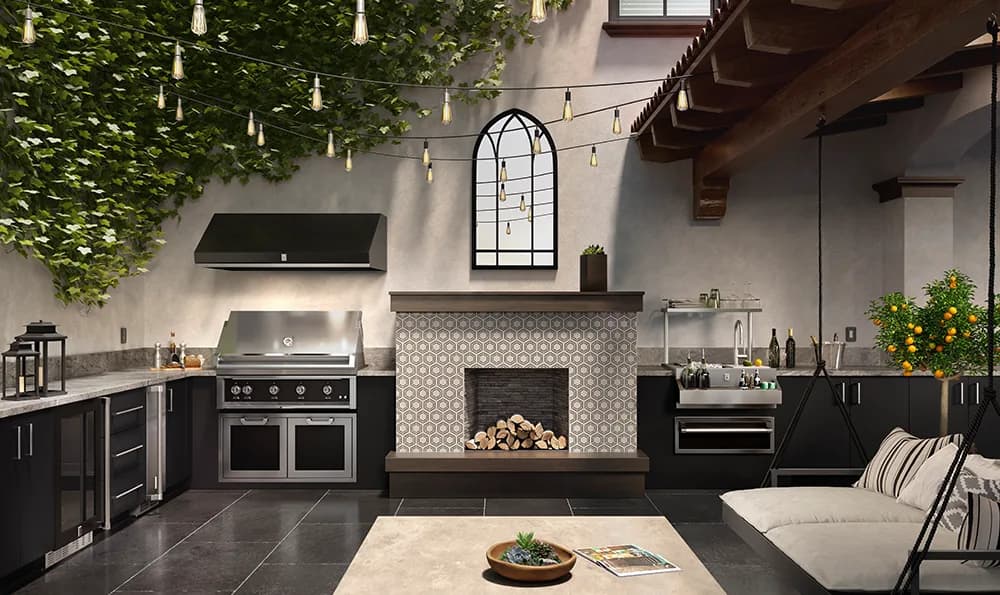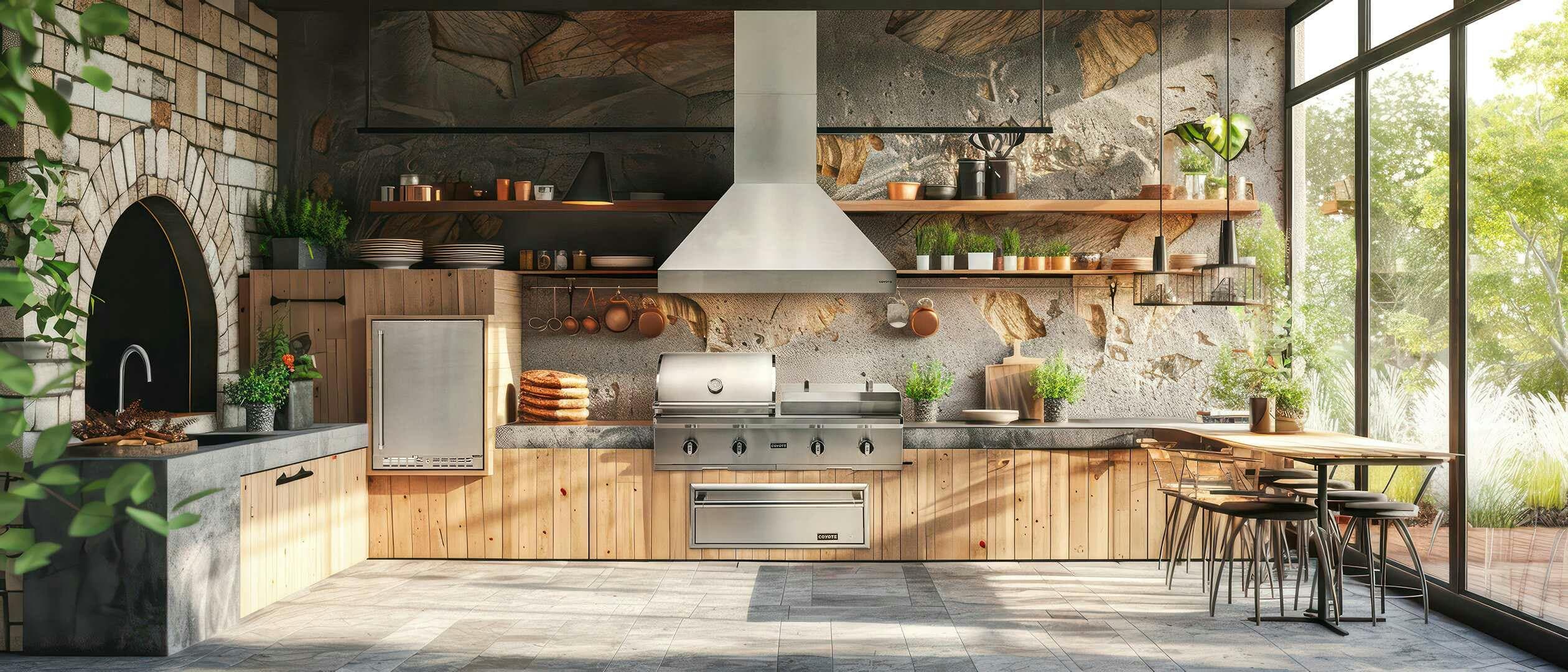
Updated October 2026. A built-in grill is worth the price premium over a freestanding when you plan to stay in the house ten years or longer and you want a permanent outdoor kitchen. The grill head itself is actually cheaper in built-in form — you skip the cart. The island build is where the real money goes. Below is the honest math on the same Coyote, Bull BBQ, and Hestan heads sold both ways, pulled from live BBQs.com inventory, plus the resale-value math nobody else publishes.
The honest answer in one paragraph
Built-in wins when the grill is going into a real outdoor kitchen you will cook on for a decade or more. Freestanding wins when you rent, when you might move, when the patio is small, or when you want to spend the kitchen-build money on the grill itself. The decision is not really grill versus grill. It is kitchen versus no kitchen, and the grill is the smallest line item in that spreadsheet.
Fifteen years of selling both from the showroom in Baton Rouge has taught us one pattern. Buyers who have already decided they want an outdoor kitchen almost never regret going built-in. Buyers who buy a built-in because it looks nicer in a magazine, then skip the island, end up with an expensive head on a plywood box. That is the regret pattern.
What a built-in grill actually costs vs the same freestanding head
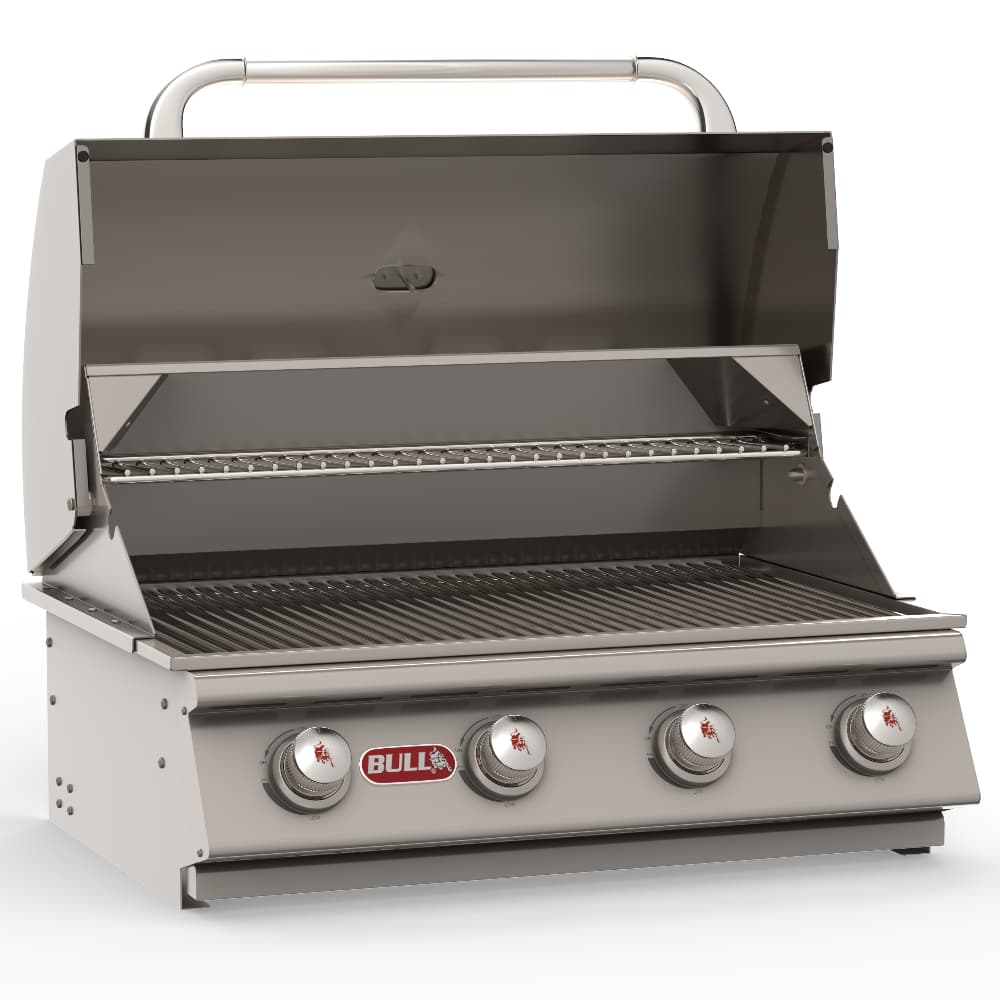
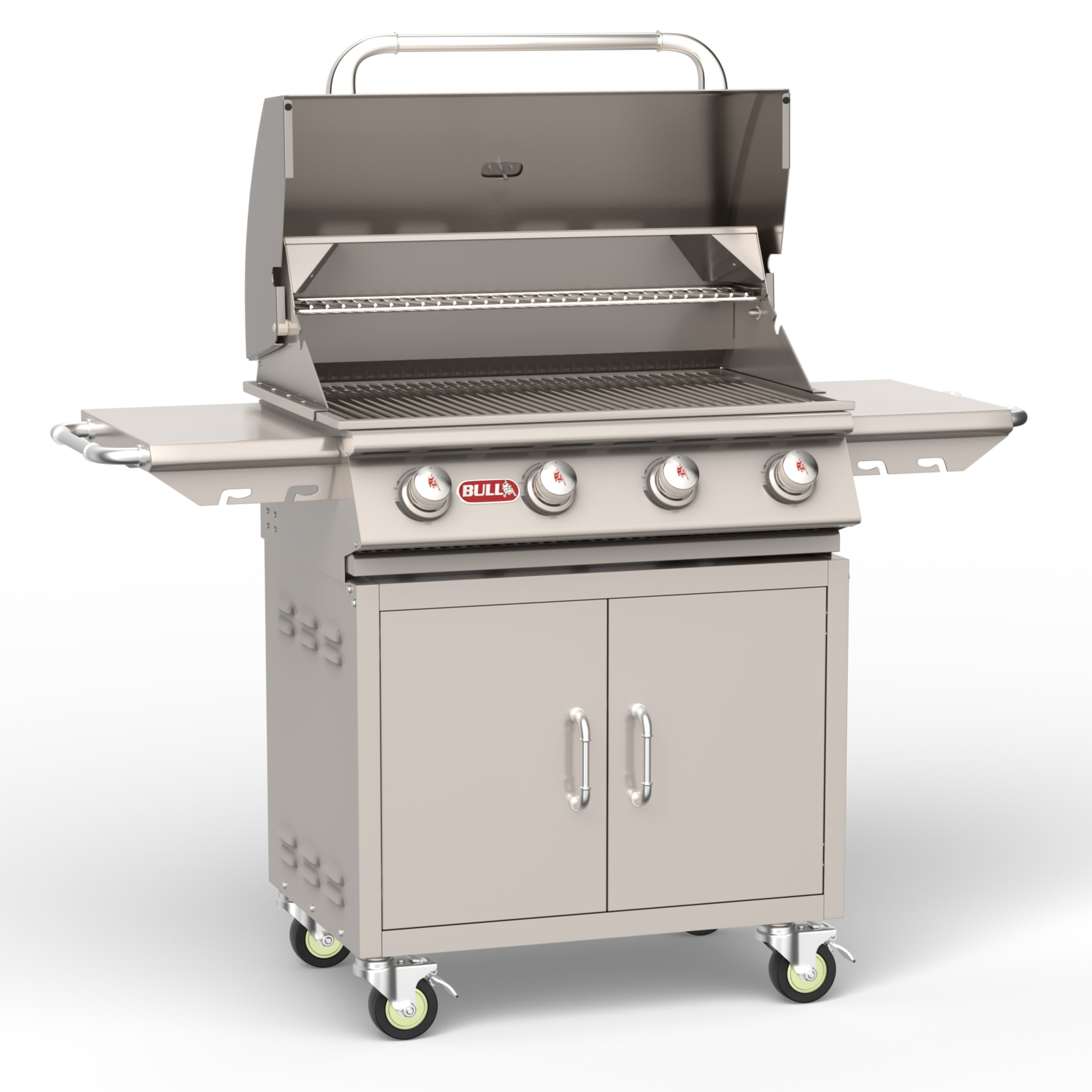
Every major premium brand we carry at BBQs.com — Coyote, Hestan, Bull BBQ, Aspire by Hestan, and Summerset — sells the same grill head two ways. The built-in version is a bare firebox with mounting flanges. The freestanding version is that exact same firebox dropped into a stainless cart with wheels, side shelves, and sometimes a side burner.
The head is identical. The warranty is identical. The BTU rating, grate material, burner count, and interior lighting are identical. What you are paying for in the freestanding uplift is the cart — a few hundred dollars of stainless steel on casters. Here is what that uplift actually looks like on the three brands we move the most of, pulled from live BBQs.com inventory the morning of October 13, 2026.
| Model | Built-In | Freestanding | Cart uplift |
|---|---|---|---|
| Bull BBQ Outlaw 30" 4-burner | $2,199 | ~$2,699 | ~$500 |
| Bull BBQ Angus 30" 4-burner (IR rear) | $2,839 | ~$3,299 | ~$460 |
| Coyote C-Series CL 36" 4-burner | $2,599 | ~$3,299 | ~$700 |
| Coyote C-Series CL 42" 5-burner | $3,299 | ~$4,099 | ~$800 |
| Hestan GSBR36 36" 3-burner | $6,495 | ~$8,195 | ~$1,700 |
| Hestan GSBR42 42" 4-burner | $7,495 | ~$9,295 | ~$1,800 |
Three things jump out. The cart uplift ranges from about 15 percent on a Bull Outlaw to 25 percent on a Hestan. The dollar amount scales with the grill price because the cart quality scales with it — a Hestan deluxe cart is a serious piece of furniture, not just wheels. And the premium brands charge more for the freestanding cart in both absolute and percentage terms because the stainless gauge, casters, and welds are all noticeably heavier.
So the headline is counterintuitive. If all you care about is the grill head, built-in is the cheaper purchase. The island is where the money goes.
“The built-in grill head is the cheaper purchase. The island build is the expensive part.”
What the island actually costs
Here is where people underestimate. A prefab stucco or faux-stone island sized for a 36-inch grill runs $1,800 to $3,500 delivered. A masonry block island with a poured concrete counter runs $4,000 to $7,000 if a mason builds it, closer to $2,500 if you build the block yourself and only hire out the counter pour. A full stone-veneer island with granite or quartzite counter and matching storage drawers runs $7,000 to $15,000.
Add the utilities. A permitted natural gas line from the meter to the island, run by a licensed plumber with a manometer leak test at the end, runs $400 to $1,200 depending on run length and whether a trench is needed. A 20-amp GFCI outlet for grill lights and accessories runs $300 to $600 for an electrician. If the island itself is combustible — any wood frame, any vinyl surround — you also need a listed insulation jacket from the grill manufacturer, which runs $400 to $700 and is non-optional per every manufacturer install manual we have read in the last decade.
The total built-in budget on a modest build is: $2,500 grill head plus $2,500 prefab island plus $900 utilities equals $5,900 all in. On a mid-range custom build it jumps to $3,000 plus $5,000 plus $1,500 equals $9,500. On a flagship Hestan or Alfresco build it climbs past $20,000 before you add refrigeration, sinks, or a vent hood.
The freestanding equivalent is the grill head plus the cart. That is the whole budget. On the Bull Outlaw it is $2,699 all in. You can roll it onto a concrete slab tomorrow.
The resale math nobody else publishes
Remodeling magazine’s annual Cost vs Value Report tracks how much homeowners actually recover at sale on common outdoor projects. For a mid-range outdoor kitchen with a built-in grill, counter, and storage, recovery sits at 55 to 70 percent of build cost in warm-climate markets (Southern California, Florida, Texas, the Gulf Coast). In colder markets it drops to 35 to 50 percent. Zillow and Realtor.com listing data from the last two years consistently show homes with permanent outdoor kitchens selling 2 to 7 percent faster than comparable homes without.
A freestanding grill returns exactly zero at resale because it is personal property, not a fixture. It leaves with you when you move, which is correct — you paid for it, it is yours.
Run the math on a 10-year ownership window. A $9,500 built-in installation that recovers $5,500 at sale costs you $4,000 net. A $2,700 freestanding grill that still works and sells for $400 on Facebook Marketplace at year 10 costs you $2,300 net. The built-in costs $1,700 more over that decade, which breaks down to $170 a year — the price of about three good steaks a month. For a lot of households that is a reasonable trade for a permanent kitchen you cook on five nights a week.
The math inverts at the five-year mark. If you move at year five, the built-in has barely finished amortizing while the freestanding is still worth $900 to $1,200 secondhand. Short ownership window, freestanding wins.
Resale recovery on a mid-range built-in outdoor kitchen in warm-climate markets per Remodeling magazine's Cost vs Value Report. Freestanding grills recover zero at home sale.
Where built-in wins outright
Permanence. A built-in is engineered to be part of the house for the life of the house. The firebox sits flush with the counter, the gas line is hard-plumbed instead of hose-connected, and the whole installation looks intentional rather than parked.
Thermal mass. A stone or block island absorbs and holds heat in a way a stainless cart cannot. On a 40-degree Louisiana evening the island surround stays warm around the grill, which is a small thing until you notice it is nice.
Storage and workflow. A built-in installation lets you add doors, drawers, a trash pullout, a sink, and refrigeration right next to the grill. We have fit a Bull BBQ built-in bar center with ice chest and sink next to a Coyote CL on a 10-foot island and the owner now runs a whole dinner service from one spot.
Resale and listing presence. A permanent outdoor kitchen photographs well, lists well, and appraises as part of the real estate. A grill on wheels does not.
Where freestanding wins outright
Mobility. You can roll it. You can sell it. You can take it to the new house. For renters, condo owners, military families, and anyone with a five-year horizon on their current patio, this is the whole argument and it is the correct argument.
Simplicity. One box lands on the porch, four bolts attach the cart to the head, you connect propane or natural gas, and you cook that night. No contractor. No permits. No weekend of island building.
Side burner included on most. The freestanding Bull Angus, Coyote SL, and Hestan 3-burner freestanding on the deluxe cart all come with a side burner integrated into the cart. On a built-in you buy the side burner separately as a drop-in unit — add $600 to $1,400 depending on brand.
Lower total spend. On a bare slab or deck, the freestanding grill IS the outdoor kitchen. Done. If you want to spend the island money on the grill itself, you can afford the Bull BBQ Brahma 38-inch freestanding instead of a basic Outlaw built-in, and you will cook better food on a bigger grill.
A head-to-head illustration — the exact same Bull Outlaw grill head, sold two ways. The built-in flange slides into a cutout; the freestanding version drops into a stainless cart. Pick the mounting that matches your situation, not the one that looks better in a magazine.
Our pick by scenario
You own the house, you cook outside twice a week or more
Built-in. Start the island planning before you pick the grill head. For most patios the Coyote C-Series CL 36-inch at $2,599 is the right head — it hits the BTU-per-square-inch sweet spot, lift-assist hood takes effort off daily opening, and the cutout dimensions have been constant for years so a replacement in 2040 will still fit. If budget allows, step up to the Hestan GSBR42.
You own the house, you cook outside less than once a week
Freestanding. A $2,000 freestanding Bull or Weber on wheels serves a casual griller better than a $9,500 island that gets used eight times a summer. Spend the saved money on better meat, a dual-fuel pizza oven, or a quality outdoor ice maker for cocktails on the deck.
You rent or you might move in the next five years
Freestanding. Non-negotiable. A built-in grill becomes the landlord’s property or the next homeowner’s property the moment it is installed. Keep your money mobile.
You already have an outdoor kitchen and you are replacing an old grill
Built-in, matched to the existing cutout. Measure the cutout to the sixteenth of an inch before you buy. Coyote, Hestan, and Bull BBQ have kept their cutouts constant across generations, so a 2010 Coyote cutout will accept a 2026 Coyote CL. Weber Spirit and Weber Genesis built-in cartridges are mostly cart-dependent and are harder to swap one-for-one.
You want the kitchen but the budget stops at $4,500 all-in
Prefab stucco island plus a Bull BBQ Outlaw 30-inch built-in. That combination lands around $4,700 before utilities. Add a dedicated gas line later when the budget allows. Half an outdoor kitchen that gets used every weekend beats a dream outdoor kitchen that stays on a Pinterest board for three years.
What breaks the “worth it” math
Three things kill the ROI on a built-in. First, buying the grill without a plan for the island. A $3,000 Coyote head sitting in a wood box with a vinyl surround looks exactly like what it is — expensive hardware wasted on cheap infrastructure. Second, picking a brand we do not have a cutout history on. Niche or imported brands sometimes change cutouts between model years, which means in year 12 you cannot replace the head without re-cutting the counter. Third, building the island in a spot the sun hits all afternoon with no shade. Stainless steel at 140 degrees air temperature is miserable to cook on, and the hood controls get too hot to touch.
The fix on all three is the same: plan the kitchen first, pick a brand with cutout continuity (Coyote, Hestan, Bull BBQ, Aspire by Hestan, Summerset all qualify), and site the grill where afternoon shade or a pergola covers it from May through September.
Our verdict
A built-in grill is worth it when the island is already in the plan and you intend to use the kitchen regularly for a decade or more. The grill head itself is the cheaper purchase in built-in form — it is the island that spends the money. Over 10 years, built-in costs roughly $170 a year more than freestanding and gives you a permanent cooking kitchen plus 55 to 70 percent resale recovery in warm markets.
A freestanding grill is worth it when you rent, when you might move, when the budget stops at the grill, or when you cook outside casually rather than habitually. You can always upgrade to a built-in later, and on brands like Coyote and Bull BBQ you can even reuse the exact head you already own by pulling it out of the cart.
Either answer is the right one for the person who answers honestly about which situation they are actually in.
Frequently Asked Questions
Is a built-in grill worth it over a freestanding?+
What is the actual price difference between a built-in and freestanding version of the same grill?+
Does a built-in grill add resale value to a home?+
Can I convert a freestanding grill into a built-in later?+
Do built-in grills last longer than freestanding grills?+
What are the hidden costs of a built-in grill?+
Should I buy a freestanding grill if I rent?+
Is a built-in grill harder to repair than a freestanding?+
Products & brands in this guide
Related reading
Reed — Reed writes the buying guides at BBQs.com — fifteen years selling and installing built-in grills means the picks here are what we'd actually put in our own outdoor kitchen.