Best 15-Inch Outdoor Ice Makers 2026: U-Line vs Bull BBQ, Head to Head
By Reed · Published September 2026
Most people building an outdoor kitchen skip the ice maker because they already own an indoor one. Then the first party rolls up in July, the freezer trays cannot keep up, and someone gets sent to the gas station for bagged ice. Updated September 2026. This guide is what we tell customers at the counter after selling roughly 90 built-in outdoor ice makers into real islands: when the ice maker earns its price back, why 15-inch is the only size that matters for a home build, and honest picks from U-Line and Bull BBQ — the only two brands worth serious consideration on the residential side.
Ice Maker vs Ice Bin — the Question People Ask Wrong
Half the calls we get on this category start with "I need an ice bin" when the person actually needs an ice maker, and vice versa. They are not substitutes. An ice maker is a plumbed compressor-driven appliance that pulls water from a supply line and produces fresh ice every 24 hours, unattended. An ice bin is a passive stainless well you dump 40 pounds of store-bought ice into an hour before guests arrive. Different budget, different install, different job.
The heuristic we use at the counter: if you take a drink from your outdoor kitchen more than twice a week, or you host a party more than once a month, the ice maker earns its price back inside one season on bagged-ice trips alone. Two 20-pound bags of ice a week at $4 a bag is $416 a year — a U-Line clear cube runs $4,259 and pays for itself against bagged ice in about ten years, but the reason to buy it is not the math. The reason is that at 8 pm on a Saturday, the ice is already there. Cold, clear, in the bin. You do not send someone to the gas station.
If you entertain in bursts (four to six times a year, holiday-heavy), the ice bin is the honest call. Cheaper, no plumbing, no compressor to service. We cover that side of the decision in the sister ice bin guide. Most well-designed outdoor kitchens end up with both — the ice maker produces daily, the bin holds the party surge.
“The ice maker justifies itself the first Saturday nobody has to leave the pool.”
Why 15 Inches Is the Only Size That Matters
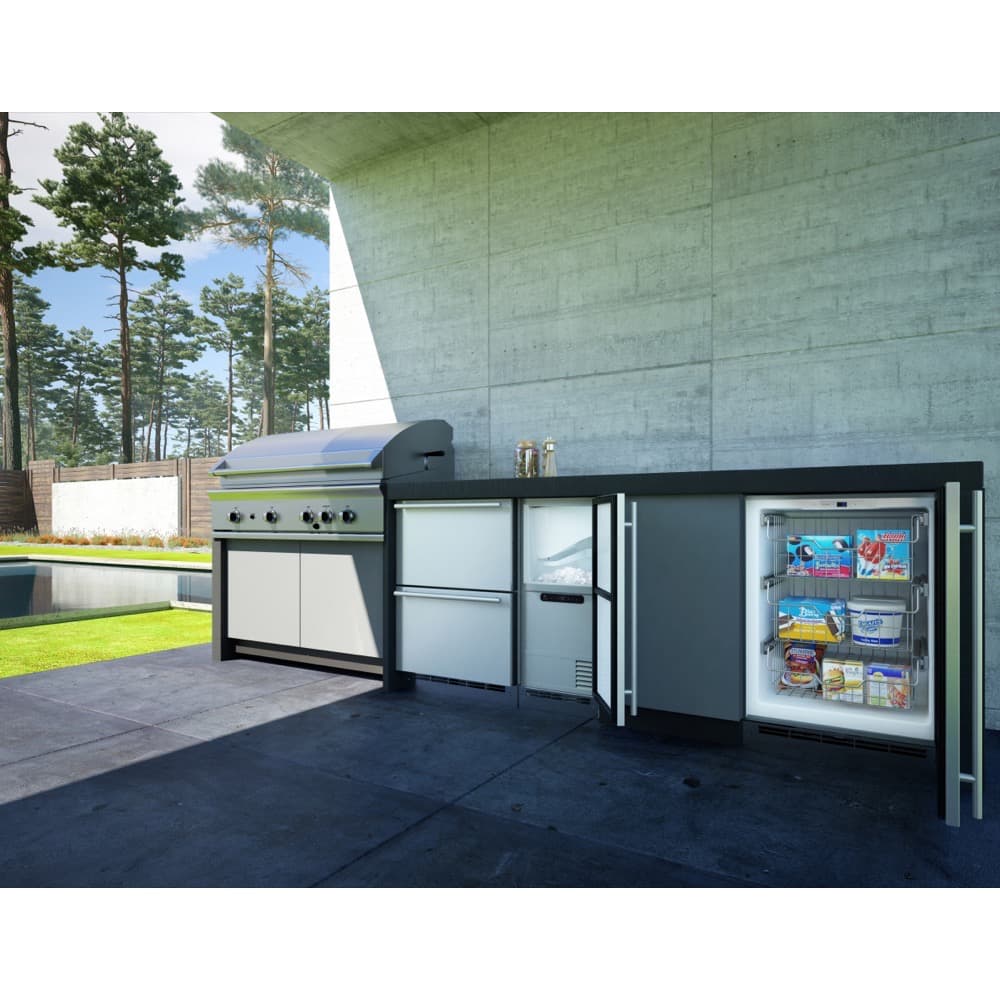
Every serious residential outdoor ice maker on the market ships in a 15-inch-wide chassis. That is not marketing — it is the width the outdoor-appliance industry settled on so that ice makers, compact refrigerators, kegerators, and warming drawers line up in a matched appliance run inside a standard island cutout. Your fabricator templates the whole run once, the fronts sit flush, and swap-outs down the line are painless.
The 24-inch ice makers you might see when you search — Manitowoc, Scotsman commercial units — are real, and they will produce 100+ pounds a day, but they cost $6,000 to $12,000, need a 30-amp dedicated circuit, and are engineered for restaurant service. For a home outdoor kitchen, the 15-inch class is the answer. Any smaller (undercounter 12-inch units) is a compromise — the reservoir is too small, the compressor cycles too often, and the ice-per-day drops below what you actually need.
The three units in this guide are all 15-inch, all outdoor-rated, and all drop into a 15-inch-wide by 34-inch-tall cutout with about a quarter inch of clearance on each side.
Clear Cube vs Crescent vs Gourmet Cube — the Ice Actually Matters
People fixate on the daily-production number and skip the ice-type spec, which is backwards. The ice type is what your guests taste. Three types matter for outdoor kitchens.
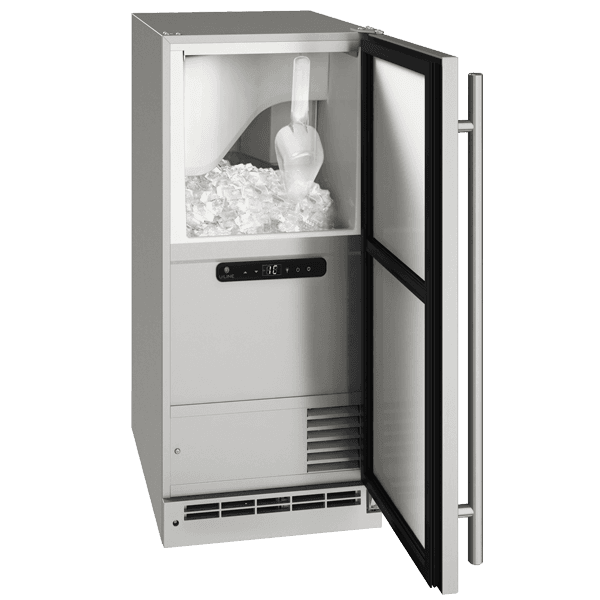
Clear cube is the near-transparent restaurant-style ice you get at a good hotel bar. Made by running water over a chilled plate in thin sheets, freezing it in stages, and cutting it into cubes. Melts slowly (no trapped air), does not cloud a whiskey, and looks premium in a rocks glass. This is what the U-Line UOC115-SS01B produces, and it is the pick if you drink brown spirits neat or serve cocktails.
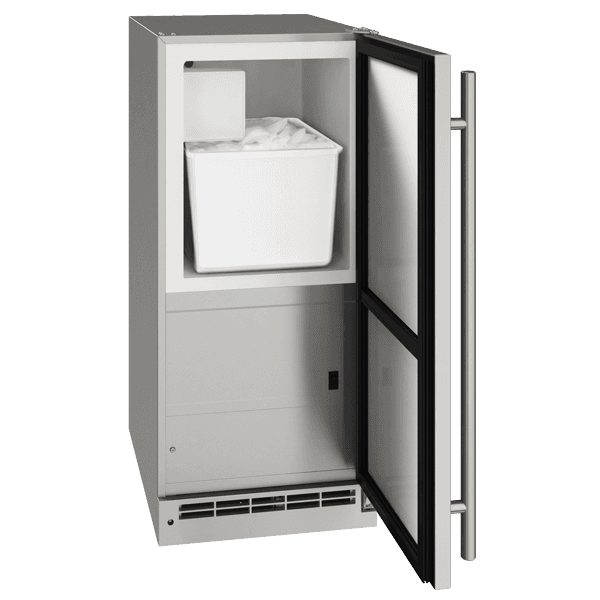
Crescent is the half-moon shape you get out of a standard indoor freezer ice maker. Fine for beers, mixed drinks, and soft drinks. Cheaper to produce, faster cycle time, and honestly what most guests do not notice. The U-Line UOCR115-SS01B makes crescent and costs about $800 less than the clear cube — that gap is what you are paying for aesthetics.
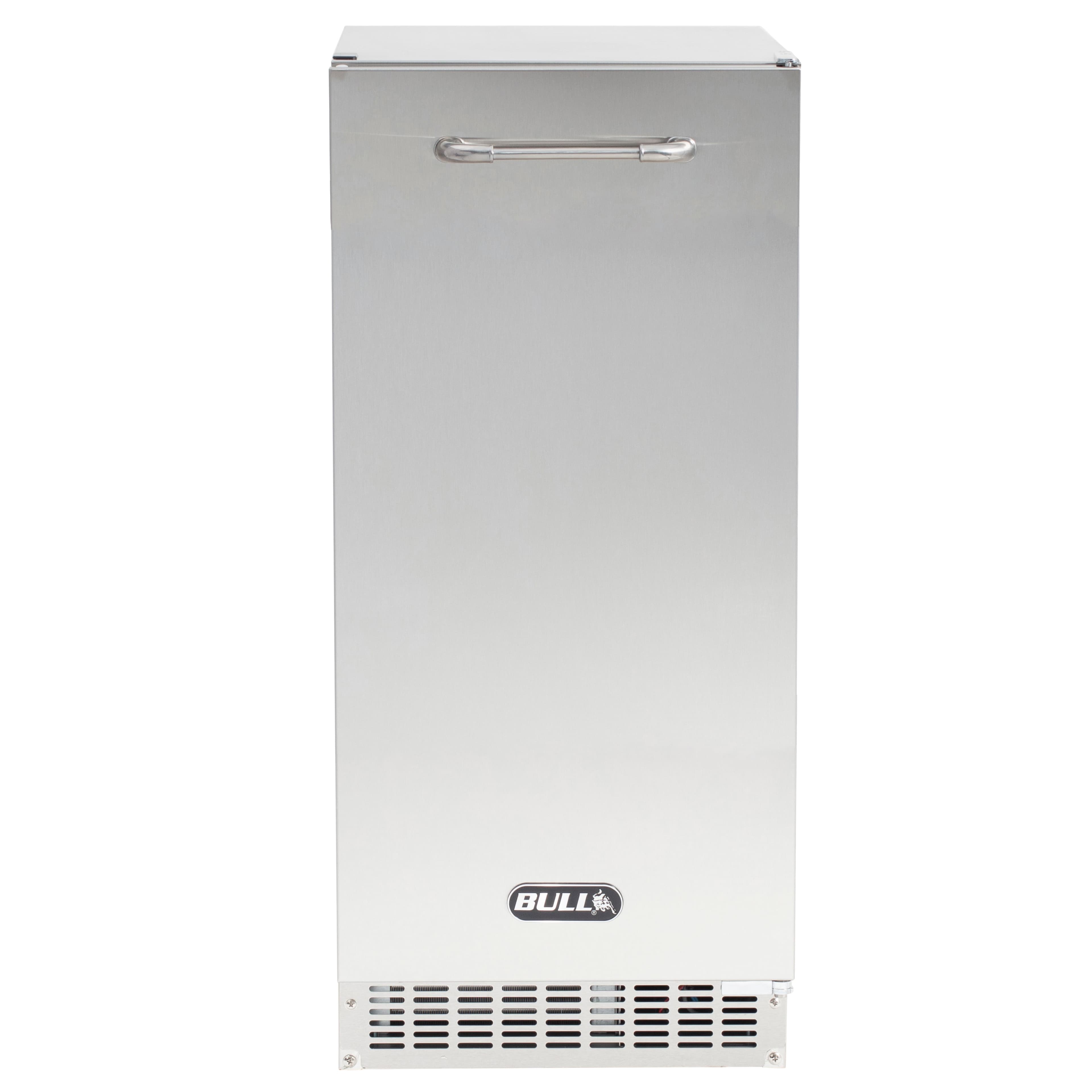
Gourmet cube is the large rounded 1.25-inch square you see at craft cocktail bars. Melts the slowest of the three (largest surface-to-volume ratio) and reads as premium. Bull's 62-pound unit makes gourmet cube, and it is the pick if you host regularly and want the ice to be part of the presentation.
A family of four with weekend entertaining goes through roughly 20 pounds of ice a day in peak summer. The 25 lb U-Line covers baseline, the 55 lb clears surges, the 62 lb Bull carries a pool party.
U-Line 55 lb Clear Cube — Our Top Pick for Entertaining Households
The U-Line UOC115-SS01B is the ice maker we sell the most, for a specific reason: it produces genuinely clear ice at home-scale prices. The daily-production spec is 55 pounds, which in real-world use (85 F ambient, 60 F incoming water) drops to about 38 to 42 pounds — still comfortably more than a household of four burns in a day. The bin holds 25 pounds at rest, so you always have ice on demand without waiting for the next cycle.
What we like at the counter: the compressor is the same platform U-Line uses in their commercial line, and we have 8-year-old units on service records that have never needed a repair. The stainless door skin matches every other U-Line outdoor appliance so the run looks intentional. The gravity drain works if your island has a downhill slope; if not, U-Line sells a $79 pump kit that mounts on the back of the unit.
What to know before you buy: the water supply needs a shut-off valve inside the island (do not skip this — you will service it eventually). The unit runs on standard 115V but pulls 4.8 amps at startup, so give it its own outlet on a 15-amp circuit. And plan the drain BEFORE the framing goes up. Cutting a drain path into a finished stone island is a nightmare.
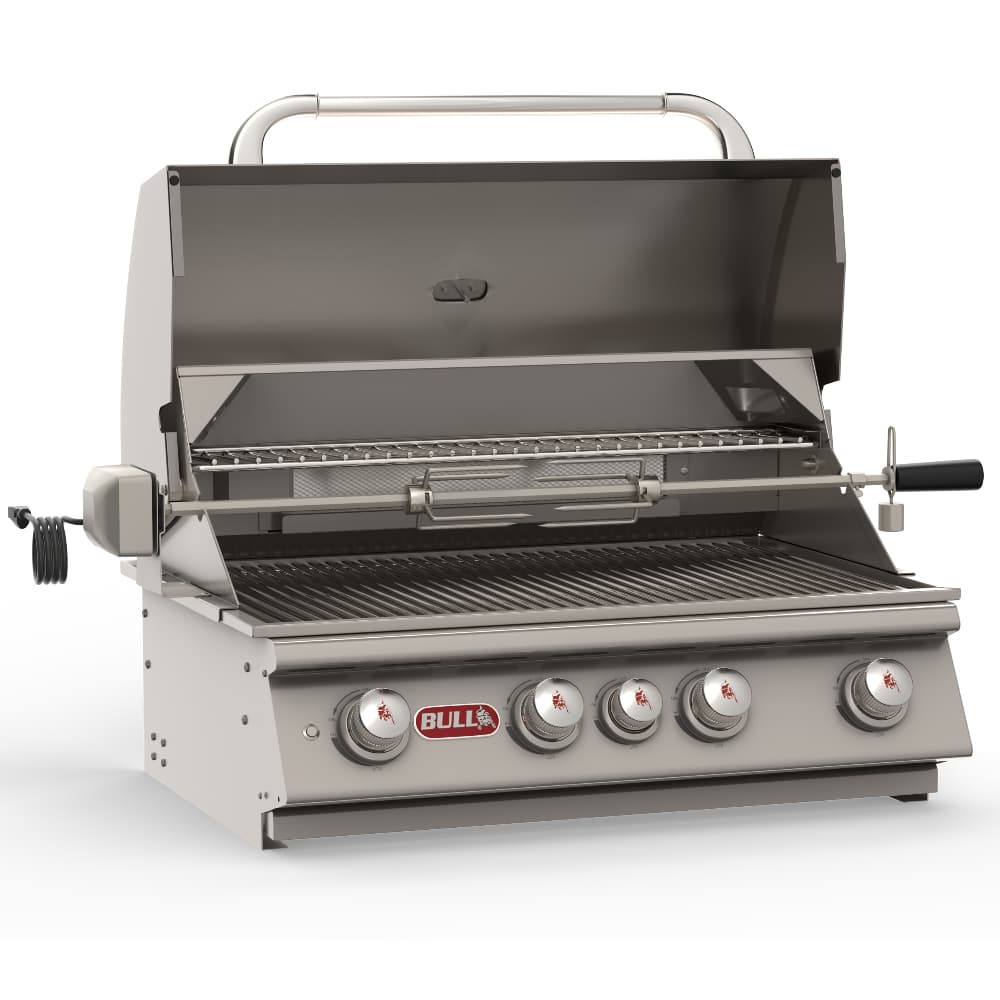
The 15-inch class fits alongside the 15-inch U-Line compact fridge and drawer refrigerators — a matched appliance run down one wall of the island. Add a Bull built-in grill to the working core and you have the full outdoor kitchen.
U-Line 25 lb Crescent — The Value Pick
The U-Line UOCR115-SS01B is the same 15-inch chassis, same compressor platform, same stainless finish — it just makes crescent ice instead of clear cube and produces less of it. Twenty-five pounds a day sounds low next to the 55, but for a family of four who entertains occasionally, that is enough. Where the crescent unit wins is the price: about $800 less than the clear-cube version, no compromise on build.
If you already have an indoor ice maker for the "good" ice and just need a workhorse in the outdoor kitchen for beer runs and pool days, this is the right one. If you plan to serve cocktails outside, spring for the clear-cube 55 lb version — the crescent shape looks cheap in a rocks glass.
Bull BBQ 62 lb Gourmet Cube — The Party Pick
The Bull BBQ 62-pound gourmet cube unit is a rebadged Marvel/AGA chassis with Bull's finishing frame and door skin, and it is worth paying for exactly one reason: you host big parties and the ice is part of the experience. The 1.25-inch gourmet cubes look like they came from a hotel bar, they melt slowly enough that a cocktail stays cold through the second refill, and the 62-pound daily spec is genuinely the highest production of any residential 15-inch outdoor ice maker on the market in 2026.
Where it makes sense: the island is Bull-framed, you host 20+ people at a time, or you have a pool bar setup that needs to keep up with a hot afternoon. Where it does not: a family of four who wants clear cocktail ice — pay $700 less for the U-Line clear cube and get better ice for your actual use case.
The Bull 62 lb ice maker matches the Bull grill cabinet and finishing frame dimensionally, so if your outdoor kitchen is already Bull-framed, this is the drop-in appliance.
The Drain Decision Nobody Plans For
This is the spec that catches people out. Every ice maker generates meltwater plus wastewater from the ice-making cycle. That water has to go somewhere. Two options: gravity drain, or pump drain.
Gravity drain requires the outlet on the ice maker to sit ABOVE whatever it drains to, with a downhill slope of at least a quarter inch per foot to a floor drain, a landscape drain, or the yard. If your outdoor kitchen sits on a raised deck or above a finished floor, gravity does not work — the drain point is at or above the unit.
Pump drain solves this. U-Line sells the 115V drain pump as a $79 kit that mounts on the back of any of their gravity units. Bull's 62 lb unit ships with pump-ready fittings and takes any 115V condensate pump. Add the pump at install time, not after. Retrofitting a drain pump into a finished island means pulling the ice maker, snaking wiring, running a new drain line, and testing — call it four hours with two people. Plumb the drain right on day one.
Install Specs — 15-Inch Cutout, Water, Power
Every unit in this guide drops into the same cutout: 15 inches wide, 34-1/2 inches tall, 24 inches deep. Leave a quarter-inch of clearance on each side of the width — the flange needs room to expand with temperature swings and the doors need to open past 90 degrees without hitting the neighboring cabinet.
Water supply: 1/4-inch copper or braided stainless line, 20 to 120 psi cold water, shut-off valve inside the island cavity. Do not use a saddle valve — they leak inside three years and you will not know until the island is flooded. Use a proper compression fitting or a quarter-turn ball valve.
Power: 115V, 60Hz, 15-amp circuit dedicated to the appliance. GFCI-protected per outdoor code. Do not share the circuit with the fridge or the grill outlet — startup surge on the compressor will trip a shared breaker on a hot afternoon.
Drain: 3/4-inch PVC or copper, sloped 1/4 inch per foot minimum for gravity. For pump drain, the discharge line can rise up to eight feet vertical and 60 feet horizontal before you need to upsize the pump.
Common Misconceptions
Three myths cost people money on outdoor ice makers. First: any built-in ice maker will work outdoors. Not true — an indoor unit installed outside voids the warranty and stops making ice around 95 F ambient. The compressor is not sealed for outdoor humidity and the reservoir is not insulated for temperature swings. Pay for the outdoor-rated version.
Second: a bigger ice maker is always better. Not if you do not need it. Sixty-two pounds a day is real party capacity, but a family of four running the unit 24/7 for that production also drives up the water bill and the compressor cycles. The 25 lb U-Line is honest for baseline use and saves $1,500 versus the top-tier Bull.
Third: you can add an ice maker later. Technically true, practically miserable. The water line, drain line, and dedicated circuit need to be roughed in before the island is finished. Add all three at framing time even if you plan to install the ice maker later — the future-you will thank the current-you.
Frequently Asked Questions
Ice maker or ice bin — which one do I actually want?+
Why 15 inches? Is that the standard?+
Clear cube, crescent, or gourmet cube — does the ice type actually matter?+
Do outdoor ice makers need a drain?+
How cold does an outdoor ice maker have to run?+
How do I winterize an outdoor ice maker?+
U-Line vs Bull BBQ — which brand should I pick?+
Is a 62 lb ice maker overkill for a home?+
Products & brands in this guide
Related reading
Reed — Reed writes the buying guides at BBQs.com — fifteen years selling and installing built-in grills means the picks here are what we'd actually put in our own outdoor kitchen.