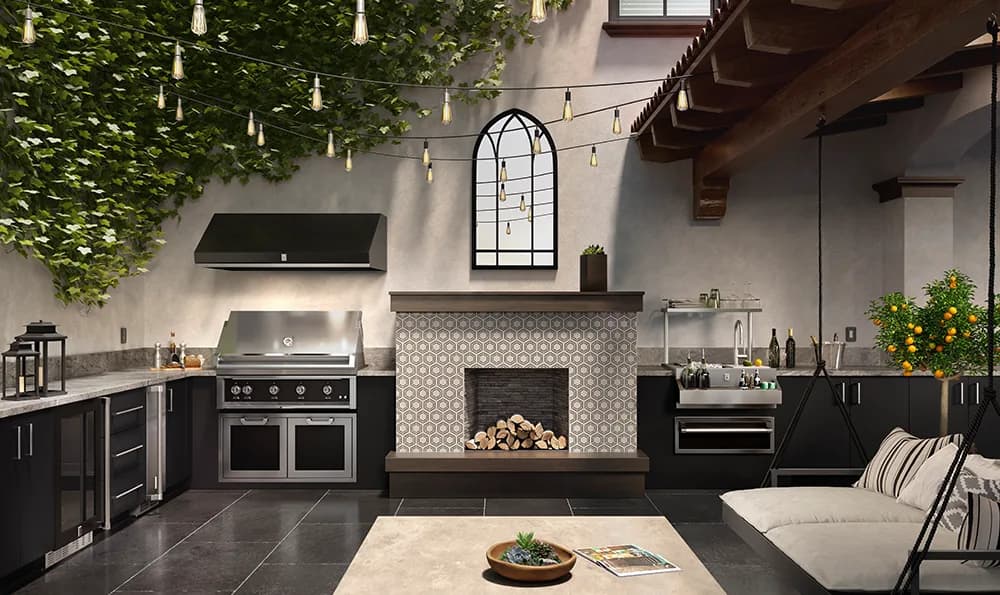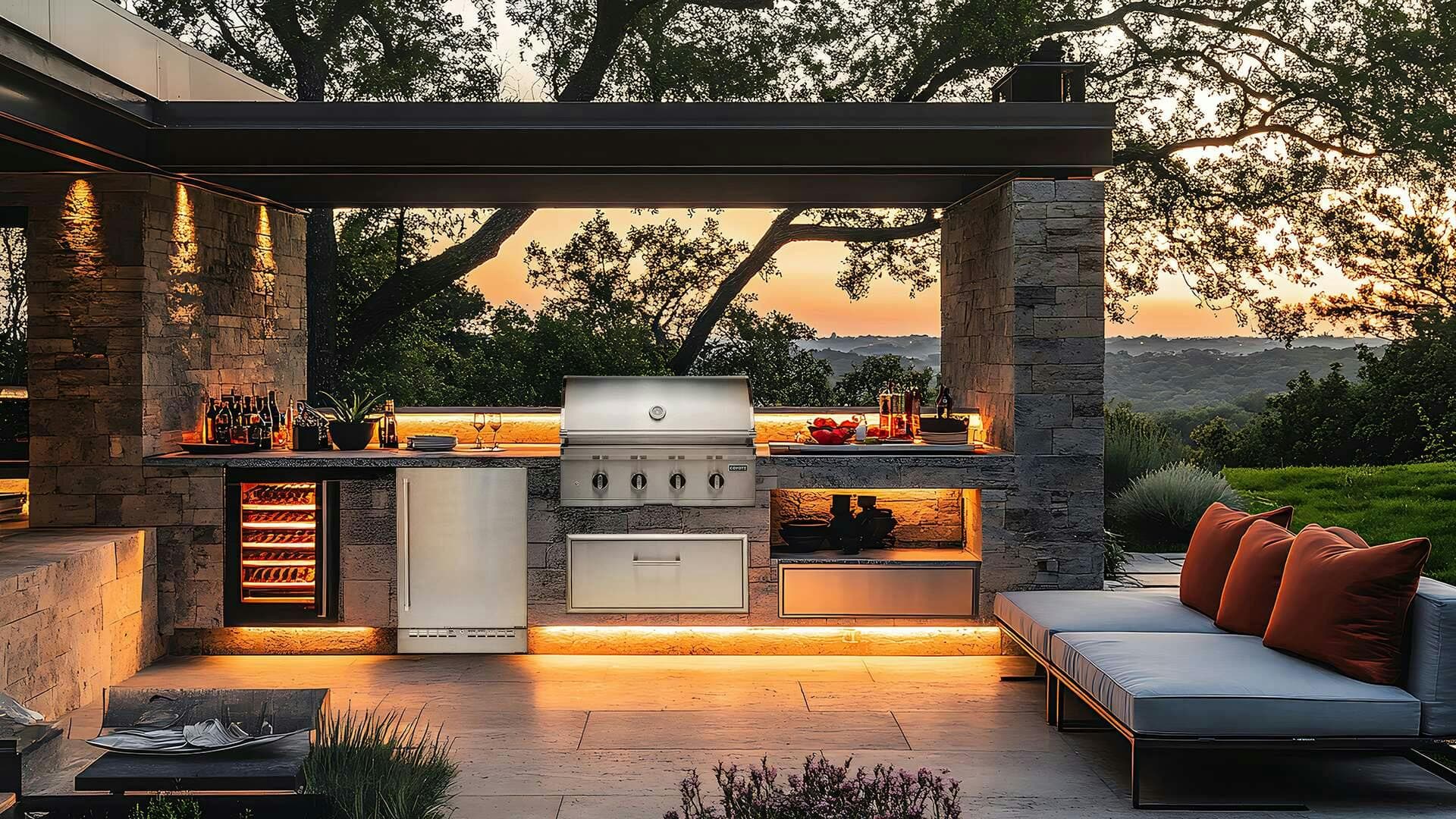
Updated October 2026. Twelve years of specifying commercial-grade grills into residential outdoor kitchens has narrowed the honest shortlist to five. The Hestan GSBR42 at $8,000 and the Coyote C-Series 36 at $4,000 are the commercial-build picks for home use — both marine 304 stainless, both ceramic infrared sear, both with 10-year burner warranties. The Bull Angus 30-inch at $3,000 is the budget-conscious commercial build. Below that, the pitch gets fuzzy fast.
What Does “Commercial-Grade” Actually Mean?
Every grill maker in the mid-premium bracket uses the phrase. Most of them earn it on exactly one spec — hood thickness, maybe burner BTU — and ride that single talking point into the price tier above where they belong. The honest definition is narrower. A grill earns the commercial-grade label when it clears four specs at once:
Material. 304 marine-grade stainless on every structural panel: firebox, hood, control face, grease tray. Not 430 (magnetic, 30% less corrosion resistance), not aluminized steel on hidden surfaces, not stainless cladding over a mild-steel chassis. We have a full breakdown of 304 vs 430 stainless if you want the metallurgy — short version: 304 is what commercial kitchens spec because it survives the daily chloride load from food and cleaning agents without pitting.
Construction. Welded seams on the firebox and hood, not sheet-metal screws through a gasket. Welded joints last 20+ years of thermal cycling. Screwed joints telegraph stress cracks at year five.
Sear performance. A dedicated infrared burner — usually ceramic — that hits grate temperatures over 1,000°F in under three minutes. This is the single spec that separates a residential grill from a steakhouse grill. Convection burners top out around 700°F at the grate; infrared starts there and goes up.
Warranty.Firebox treated as lifetime, burners 10+ years, the rest of the grill 5+ years. If the brand bundles “lifetime” into vague language about “defects” instead of calling out the firebox and burners specifically, read the actual warranty document before you spec.
Three brands we carry clear all four cleanly: Hestan Outdoor, Coyote S-Series, and Bull Angus / Brahma. One borderline case — American Outdoor Grill’s L-Series — clears three of the four (no infrared sear on the base model, which is a real gap at this price point). We’ll get to each.
Hestan GSBR42 ($8,000): The Fit-and-Finish Ceiling
The Hestan 42-inch 4-burner built-in (GSBR42) is the closest thing to a Hestan Commercial unit that will fit a residential outdoor kitchen. Same California plant, same welded marine-grade 304 stainless construction, same cast-brass burners — the only real difference from the commercial line is ergonomics (residential cook height, standard 42-inch cutout, consumer-facing controls).
Specs that matter: four 25,000-BTU main burners (100,000 total), one 18,000-BTU ceramic infrared sear burner, one 12,000-BTU rear infrared rotisserie, DiamondCut cooking grates in 304 stainless. 12-year warranty on burners and firebox, 2 years on everything else. Weight is 420 lb — your chase or island needs to be built for it.
What you’re paying for at $8,000 that you don’t get at $4,000: finish coherence. The 12 Hestan colors (Bora Bora blue, Grove green, Prince purple, the full catalog) are catalyzed porcelain fired onto the stainless at Hestan’s own paint line. No one else at this price point offers color at all. If you don’t want color, the stainless configuration is still around $8,000 — you pay the same for the build and get a $1,500 discount off the painted trim. The matched Hestan refrigeration, storage, and side burners drop into the same island with identical hardware. That ecosystem is why Hestan is the single-brand spec for architect-driven outdoor-kitchen builds.
If GSBR42 is more grill than you need, Hestan builds a 36-inch 3-burner version (GSBR36) at around $7,000 with the same construction and a slightly smaller sear-burner footprint. We spec the 42 unless the cutout genuinely won’t fit — the extra burner matters more than the extra $1,000 over a 20-year ownership window.
Coyote C-Series 36 ($4,000): The Price-Performance Pick
If Hestan is the ceiling, the Coyote C-Series 36-inch 3-burner built-in is the floor on commercial-grade — the lowest-priced grill we spec that clears all four of the commercial criteria above. Full 304 stainless, welded firebox, ceramic infrared sear burner standard, 10-year burner warranty.
Specs: three 20,000-BTU main burners (60,000 total), one 15,000-BTU ceramic infrared sear, interior halogen lights, laser-cut 304 stainless grates. Weight is 165 lb — meaningfully lighter than Hestan, meaningfully heavier than the Bull Angus. Made in the USA at the Coyote facility in Illinois.
The C-Series step-up is the Coyote SL-Series 36-inch at around $5,500 — adds hydraulic lift-assist on the hood, upgraded RapidSear infrared, dual halogen lighting, and bumps the warranty on a few hidden components. If the budget is between the C and SL, we push buyers to the C unless they’re cooking 5+ nights a week. The SL is a nicer grill. The C is a commercial-grade grill. Those aren’t the same thing — the C is already past the point of diminishing cooking-performance returns.
In my experience installing both: the only real functional gap between the Coyote C-Series and the Hestan GSBR42 is the hood hydraulic assist and the paint colors. Cooking performance on a rib-eye at 1,000°F at the grate is identical. The Coyote cooks exactly as hot. If your budget cap is $5,000, this is the pick.
Bull Angus 30 ($3,000): The Budget-Conscious Commercial Build
The Bull BBQ Angus 30-inch built-in is the honest answer when the budget is $3,000 but you still want commercial-grade construction. 24-gauge 304 stainless throughout, four 15,000-BTU stainless burners (60,000 total), one 10,000-BTU rear infrared rotisserie burner, lifetime burner warranty, lifetime firebox warranty.
What you’re giving up versus Coyote or Hestan at this price: no dedicated infrared sear burner on the main cook surface (the infrared sits in the back for rotisserie use), slightly lighter 24-gauge stainless on the firebox (versus 16-gauge on Hestan), no hood lift-assist. Those are real gaps. The Angus is 90% of a commercial-grade grill at 60% of the price — if the sear is the thing you care about most, step up to the Coyote. If what you care about is building a permanent outdoor kitchen on a $12,000 total budget including refrigeration and storage, Bull BBQ’s outdoor-kitchen ecosystem is the deepest in the market at this price point.
A real-world scenario we see weekly: Baton Rouge patio, family of four, wants a built-in grill that will last 20 years without thinking about it, cooks three or four nights a week. Angus is the right answer every time. Hestan would overshoot. Coyote would work. Angus hits the use case cleanly and leaves budget for the matched 24-inch refrigeration, 30-inch access door, and ice bin cooler that round out the island.
If you want more grill in the same build language, the Bull Brahma 38-inch 5-burner at around $4,200 adds a burner, a double-wall hood, and dual halogen interior lighting. Same 304 stainless, same lifetime warranty structure. For entertainers hosting 10+ regularly, Brahma is the pick in the Bull line.
The Honest Fourth Pick: American Outdoor Grill L-Series
The American Outdoor Grill L-Series 36-inch (AOG36L) is the quiet pick on this list — built by RH Peterson in Southern California, same shop that produces Fire Magic and the top Jackson Grills lineup. Full 304 stainless, welded construction, lifetime warranty on the firebox and the burners. Interior halogen lights, infrared rotisserie, blue LED knob lighting.
What’s missing versus the commercial-grade criteria above: no dedicated ceramic infrared sear burner on the main grate (the infrared is rear-mounted for rotisserie). That’s the one spec gap. If you don’t prioritize searing at 1,000°F — and plenty of serious cooks don’t — AOG36L is $3,100 for a genuinely commercial-grade build everywhere else. We don’t lead with it in the headline because it misses one of the four criteria, but it’s on the shortlist for anyone who cares more about build longevity than infrared sear temps.
What About Aspire by Hestan at $4,500?
The Aspire by Hestan EB42 is Hestan’s pricing-flex play — same welded 304 stainless construction, same California plant, same 12-year burner warranty as the Deluxe GSBR42. What you lose at the $4,500 price point is the painted color options (Aspire is stainless only), the DiamondCut grates (Aspire uses standard 304 bar grates), and the hood hydraulic assist. The infrared sear burner is still there. The cast-brass valves are still there. The commercial-grade construction is still there.
If the budget caps at $5,000 and you want the Hestan build without the Hestan price, Aspire is the pick. We’ve installed it side-by-side with the GSBR42 in matched builds and the cooking performance is indistinguishable. The visual gap closes once the grill is in the island with matched refrigeration — nobody looking at the finished kitchen can tell which Hestan line it is without reading the badge.
Why We Don’t Carry Crown Verity
Crown Verity comes up in every commercial-grade conversation and it’s worth addressing directly: they build genuinely excellent true-commercial equipment for restaurants, caterers, and the US military. Fantastic hardware. Wrong tool for a residential outdoor kitchen.
The reasons we don’t spec Crown Verity for home installs: the hoods are open-vented for commercial exhaust capture, so they don’t trap heat the way a residential hood does. The cook heights don’t match standard 36-inch counter cutouts. Warranty terms are commercial (shorter, with service contracts attached). Finish tier is built for a stainless-steel commercial line, not a patio island. And the pricing is actually higher than Hestan for a build with worse residential ergonomics.
If you want a true commercial build that still works on a patio, Hestan is the right answer. We’re not carrying Crown Verity because we’d be setting up every buyer who ordered one for disappointment on the install. Commercial equipment belongs in a commercial kitchen.
Install Reality: What Nobody Tells You at the Showroom
Commercial-grade grills move the install goalposts in three ways that budget grills don’t.
Weight. A Hestan GSBR42 at 420 lb needs a chase built from concrete block or a steel frame. 2x4 studs with cement board will not carry it. A Coyote C-Series at 165 lb works on a properly-framed cedar island. The Bull Angus at 150 lb sits comfortably in anything that will carry 200 lb. Weight is the first spec your mason or carpenter needs — pull it before you design the island.
Gas supply.100,000-BTU grills (Hestan GSBR42, Bull Brahma) need a 1/2-inch dedicated gas line from the meter — not a tap off the house service line. 60,000-BTU grills (Coyote C-Series, Bull Angus) run cleanly on 3/8-inch within 15 feet. Any run over 20 feet drops pressure meaningfully. Have the plumber size the line against the grill’s stated BTU, not the generic “grill install” spec most residential plumbers quote by rote.
Clearances.Every commercial-grade grill publishes minimum clearance to combustibles — typically 12-18 inches above the hood, 3-6 inches on the sides. Under a pergola with a solid roof, you need a vent hood sized to the grill’s BTU (1,200-1,500 CFM for the Hestan GSBR42). Under open sky with a steel-framed cover, you’re usually fine without a hood, but the clearance to the roof deck still matters. Pulling the clearance spec from the manufacturer PDF before the island goes up saves a very expensive rebuild.
Where to Skip the Commercial-Grade Pitch
Any grill marketed as “commercial-style” at a residential price point under $2,500 is almost certainly not commercial-grade on the four criteria above. The common tells: 430 stainless on the hood (hold a magnet to it in the showroom — 304 is non-magnetic, 430 sticks hard), gasket-and-screw firebox joints you can see from inside, warranty language that calls out “defects” without specifying firebox and burners, no dedicated infrared sear burner anywhere in the spec sheet.
If you need the commercial-grade build, buy it from the brands that genuinely do the work — Hestan, Coyote S-Series, Bull Angus, Aspire by Hestan. If you don’t need it, buy a Bull Outlaw, Summerset Sizzler Pro, or Weber Genesis and spend the saved money on the matched refrigeration, hood, and masonry that actually make an outdoor kitchen work. Overspending on the grill while cutting corners on the island is the single most common regret we see.
Our Shortlist by Budget
$3,000 — Bull Angus 30-inch. Lifetime warranty, 304 stainless, rear infrared rotisserie, deepest matched outdoor-kitchen ecosystem at this price. The budget-conscious commercial build.
$4,000 — Coyote C-Series 36-inch. Ceramic infrared sear standard, made in USA, 10-year warranty. The pick if sear temperature matters more than brand ecosystem.
$4,500 — Aspire by Hestan EB42. Hestan welded construction at the Coyote price point. Best metallurgy per dollar on the list.
$5,500 — Coyote SL-Series 36-inch.C-Series plus hood hydraulic assist and RapidSear. The “nicer commercial-grade grill” pick.
$8,000+ — Hestan GSBR42.The ceiling. Marine 304 stainless, 12-year warranty, 12 painted color options, the deepest matched kitchen line in the premium bracket. Buy this if you’re building a permanent outdoor kitchen to outlast the house.
If you’re still deciding between tiers, pull the full built-in grill catalog and filter by burner count and BTU — the specs sort out the decision faster than the marketing copy. Any of these five is a 20-year grill. The decision isn’t whether you’ll be happy with it. The decision is which tier of nice you’re buying.
Frequently Asked Questions
What does 'commercial-grade' actually mean on a residential grill?+
What's the best commercial-grade grill for most homes?+
Is Crown Verity worth considering for a home install?+
Do I really need a commercial-grade grill at home?+
What's the real downside of commercial-grade at home?+
How long do these grills actually last?+
Can I convert these from natural gas to propane later?+
What size gas line do I need for a commercial-grade grill?+
Products & brands in this guide
Related reading
Reed — Reed writes the buying guides at BBQs.com — fifteen years selling and installing built-in grills means the picks here are what we'd actually put in our own outdoor kitchen.