Weber Summit Kamado S6 Review: Steel Kamado vs Big Green Egg + Kamado Joe
By Reed · Published November 2026
Updated November 2026. The Summit Kamado S6 is Weber's one serious kamado — a 24-inch double-wall porcelain-enameled steel charcoal cooker that competes head-on with Big Green Egg Large, Kamado Joe Classic III, and Primo Oval LG. Steel instead of ceramic (lighter, no crack risk, slightly less heat retention), Weber's build quality, and a thermometer + gourmet BBQ system you can't easily hack onto a ceramic kamado. Around $1,599 depending on config. Here's what Weber got right, where the ceramic competitors still win, and who should actually buy it.
Disclosure: BBQs.com is an authorized Weber dealer. We sell this grill and earn a margin when you buy one here. We do not accept free product, and we flag the cases where a competitor is genuinely the better fit.
Pick in 10 seconds
Buy a Big Green Egg Large or Kamado Joe Classic III instead if: heat retention over 12-18 hour overnight cooks is the whole point, you have a permanent kamado location that won’t move, and you want the hardcore kamado community + accessory ecosystem that’s been building around ceramic for 30 years.
Buy a Weber Master-Touch or Performer instead if: you want charcoal flavor but don’t actually need the kamado thermodynamics. The Master-Touch at $300 does 80% of what the Summit does for 20% of the price — it just can’t hold 225°F for 18 hours without babysitting.
What the Summit Kamado S6 actually is
The Weber Summit Kamado S6 is a 24-inch-diameter charcoal cooker in the egg-shaped kamado silhouette — but built from Weber’s double-wall porcelain-enameled steel instead of the ceramic that defines the category. Primary cooking area is 452 square inches. The optional upper warming rack adds another 134. Total: 586 square inches when you use the second rack. Dome height clears a 16-inch pizza stone or a vertical brisket. Weight is right around 150 lbs assembled — 50-75 lbs lighter than the ceramic competition, which matters if you’re building on a deck instead of a concrete slab.
The double-wall construction is the headline. Instead of a 1-inch-thick ceramic wall doing the heat retention job, the Summit has an inner cooker wall + a 1-inch air gap + an outer porcelain-enameled shell. The air gap is the insulator — like a Yeti cooler, not like a ceramic egg. In practice this means the S6 heats up faster than a ceramic kamado (15-20 minutes to 400°F vs 25-35 on a Big Green Egg Large), uses slightly more charcoal to hold temp overnight (the air gap radiates more than ceramic mass), but the exterior stays cooler to the touch because the air gap decouples the shell from the firebox.
Dual-function top vent + spring-loaded hinge + an air-tight silicone gasket handle the airflow control that makes kamado cooking work. Weber also includes a proper domed thermometer on the lid (rated to 1000°F, in the grill lid rather than an aftermarket add-on), a stainless steel cooking grate with a swing-up hinged center section for easy charcoal reloading mid-cook, and a diffuser plate for indirect cooking. The whole thing rolls on a cast-aluminum cart with a side shelf — no ceramic kamado in this price bracket ships with a built-in cart; you pay $200-400 extra for the nest + wings.
The spec sheet, honestly — Summit vs the ceramic competition
| Spec | Weber Summit S6 | Big Green Egg Large | Kamado Joe Classic III | Primo Oval LG 300 |
|---|---|---|---|---|
| Cook surface (primary) | 452 sq in | 262 sq in | 254 sq in | 300 sq in (oval) |
| Cook surface (max w/ rack) | 586 sq in | ~350 w/ upper rack | 510 sq in (D&C) | 400 sq in |
| Material | Double-wall porcelain-enamel steel | NASA-spec ceramic | Ceramic | Ceramic |
| Weight | ~150 lb | 162 lb (egg only) | 250 lb w/ cart | 250 lb (no cart) |
| Cart + side shelf | Included | $350-450 extra | Included | Sold separately |
| Thermometer | Built-in, 1000°F | Add-on | Built-in | Built-in |
| Warranty (bowl/lid) | 10 yr limited | Lifetime ceramic | Lifetime ceramic | Lifetime |
| Street price | ~$1,599 complete | ~$1,049 egg-only / $1,499 w/ nest | ~$1,999-2,199 | ~$1,599 kamado-only |
| Low-and-slow hold (one load) | 10-14 hr @ 225°F | 18-24 hr @ 225°F | 18-24 hr @ 225°F | 14-20 hr @ 225°F |
| Sear hold @ 700°F+ | Drifts faster to 550°F | Holds 700°F longer | Holds 700°F longer | Holds 700°F longer |
How it actually cooks
Four cooking modes matter on any kamado: low-and-slow (225-250°F for brisket, pulled pork, ribs), mid-range roast (325-375°F for chicken, pork loin, vegetables), high-heat sear (550-700°F for steak), and dome smoke (closed-vent 180-200°F for cold-smoke cheese or long cold-smoke salmon). The Summit S6 handles all four, with the caveat that ceramic competitors edge it out on the extreme ends of that range — ceramic holds 225°F longer with one fuel load and ceramic holds 700°F+ for longer sear sessions.
Low-and-slow brisket + pork shoulder
This is where the kamado category exists — stable 225°F for 12-18 hours on one charcoal load. The Summit does it, but it’s a 10-14 hour window on one full basket of lump charcoal versus 18-24 hours on a Big Green Egg Large. In real-world terms: a 15-lb brisket (needs 14-17 hours at 225°F) will probably make it on one load; a two-brisket + four-rack-of-ribs overnight session for a backyard party might need a charcoal top-up at hour 10. Weber’s swing-up grate hinge makes that reload a 60-second operation instead of the full-strip-down ceramic kamados sometimes require.
High-heat sear
The S6 gets to 700°F reliably with the bottom vent wide open and the top vent cracked. For reverse-sear steaks, this is the right tool. Where ceramic wins: ceramic stays at 700°F+ for 15-20 minutes while you sear multiple cuts; the Summit drifts back to 550°F faster as the internal air-space surrenders heat to the environment. If you’re searing ONE steak, functionally identical. If you’re searing five ribeyes back-to-back, the ceramic kamado will hold the sear temp more consistently across all five.
Pizza + dome cooking
600-700°F dome, 16-inch pizza stone fits with room around the edges, 90-second Neapolitan-style pies are entirely realistic. The one thing the Summit does better than most ceramics in this mode is temperature recovery between pies — the lower thermal mass means it bounces back to 650°F faster after you open the dome to swap a pie, where a heavy ceramic kamado takes longer to re-equilibrate after each dome opening.
Charcoal setup — the one thing people get wrong
Kamado cooking is 80% technique, 20% grill. Skip the briquettes. Kamados run on high-quality lump charcoal — large, hardwood lump pieces that don’t off-gas the chemical binders in Kingsford-style briquettes. Fill the firebox to the top ring, bury a couple of smoke wood chunks (oak for brisket, apple for pork, cherry for poultry) in the middle third of the pile, light ONE spot with a chimney-starter cone or a MAPP torch for 90 seconds, and close the dome once you see the first wisp of smoke. The Minion method (unlit lump covered by a small chimney of lit lump on top) will give you 12-14 hours of stable 225°F from a single load. This is the difference between kamado people who love it and kamado people who return it after three tries — the technique is unforgiving if you light the whole pile at once.
Steel vs ceramic — the honest trade-off
This is the question that decides the purchase. Ceramic kamados — Big Green Egg, Kamado Joe, Primo, Vision — are the category standard for a reason: mass-storage heat retention is physics, and 1-inch ceramic walls have more of it than a double-wall steel shell with an air gap. On a 12-hour brisket cook at 225°F, you can measure the difference in charcoal use (ceramic uses less). On a 45-minute pizza session at 700°F, you can measure it in temperature drift (ceramic drifts less).
What steel wins: weight, crack resistance, faster warm-up, built-in cart + thermometer in the base price, and Weber’s general build + warranty reputation. Ceramic can and does crack — particularly from thermal shock (adding cold water to a 500°F ceramic kamado, moving a hot kamado on cold concrete, dropping something heavy on the lid). Weber’s enameled steel has none of those failure modes; the enamel can chip if you really abuse it but it doesn’t take the grill out of service. If you anticipate moving the grill, storing it in a garage without a cover, or having kids and pets around a hot cooker, steel is the safer long-term bet. If you’re building a permanent kitchen island and the grill never moves, ceramic’s thermal advantages dominate.
“The Summit Kamado S6 is Weber’s one legit kamado play — not a ceramic competitor, a different engineering answer to the same cooking problem. Buy it for the cart, the thermometer, the warranty, and Weber’s reputation. Buy a ceramic for the pure heat retention. Either way you’re getting a real kamado — just don’t buy it thinking it’s a bigger Master-Touch, because it isn’t.”
Summit vs the rest of the Weber charcoal lineup
Within Weber’s own charcoal range the Summit S6 is the top of the ladder. Below it: the Master-Touch 22-inch kettle ($329), the Performer Deluxe ($479 — Master-Touch + propane-ignited charcoal starter), and the Summit Charcoal Grill ($1,299 — a hybrid that’s basically a Master-Touch with a kamado-style insulated bowl but not a true kamado silhouette). Only the Summit Kamado S6 gives you the egg-shaped dome geometry, the 10-14 hour low-and-slow window, and the true kamado airflow control. Everything below in the Weber lineup is a kettle at heart, which means it maxes out around 6-8 hour low-and-slow sessions before you’re reloading charcoal and losing stable temp.
Kamado vs pellet grill — different tools
People shopping the Summit Kamado S6 also often look at pellet smokers (Traeger Timberline, Oklahoma Joe’s Tahoma 900, Pit Boss Navigator). They’re different tools. A pellet grill is a set-and-forget appliance — electric-controlled, PID temperature management, WiFi app monitoring. Kamados are charcoal-controlled and 100% manual — you light them, you dial in the vents, you learn your grill’s personality. If you want a smoker you can leave at 225°F for 14 hours and trust the app, buy a pellet grill. If you want the ritual of charcoal cooking, the hard-sear capability pellet grills can’t match (most pellet grills max at 500°F), and real smoke flavor instead of pellet-wood-dust flavor, kamado is the right category. Both are legitimate — they’re just answering different questions.
Who should buy this (and who shouldn’t)
Buy the Summit S6 if you already own a Weber kettle or gas grill, trust the brand’s quality, want a kamado without the ceramic weight + crack risk, and want the grill to arrive complete (no $300 cart purchase). Buy it if you build in a wood deck or a location where moving the grill matters. Buy it if you cook 2-6 times a month, including occasional 10-14 hour sessions. The warranty + Weber parts availability means this grill will still be serviceable in 15 years.
Skip the Summit S6 if you’re a competition-style smoker who needs 18+ hour stable low-and-slow on one charcoal load (get a Big Green Egg XL or Kamado Joe Big Joe III). Skip it if you want the ceramic community + accessory ecosystem — BGE in particular has decades of third-party accessories (SmokeWare chimney caps, Kick Ash Baskets, high-heat gaskets) the Weber doesn’t match. Skip it if $1,500 is a stretch and you’re buying it instead of a kettle — the Weber Master-Touch at $329 does 80% of what most people actually want from charcoal cooking.
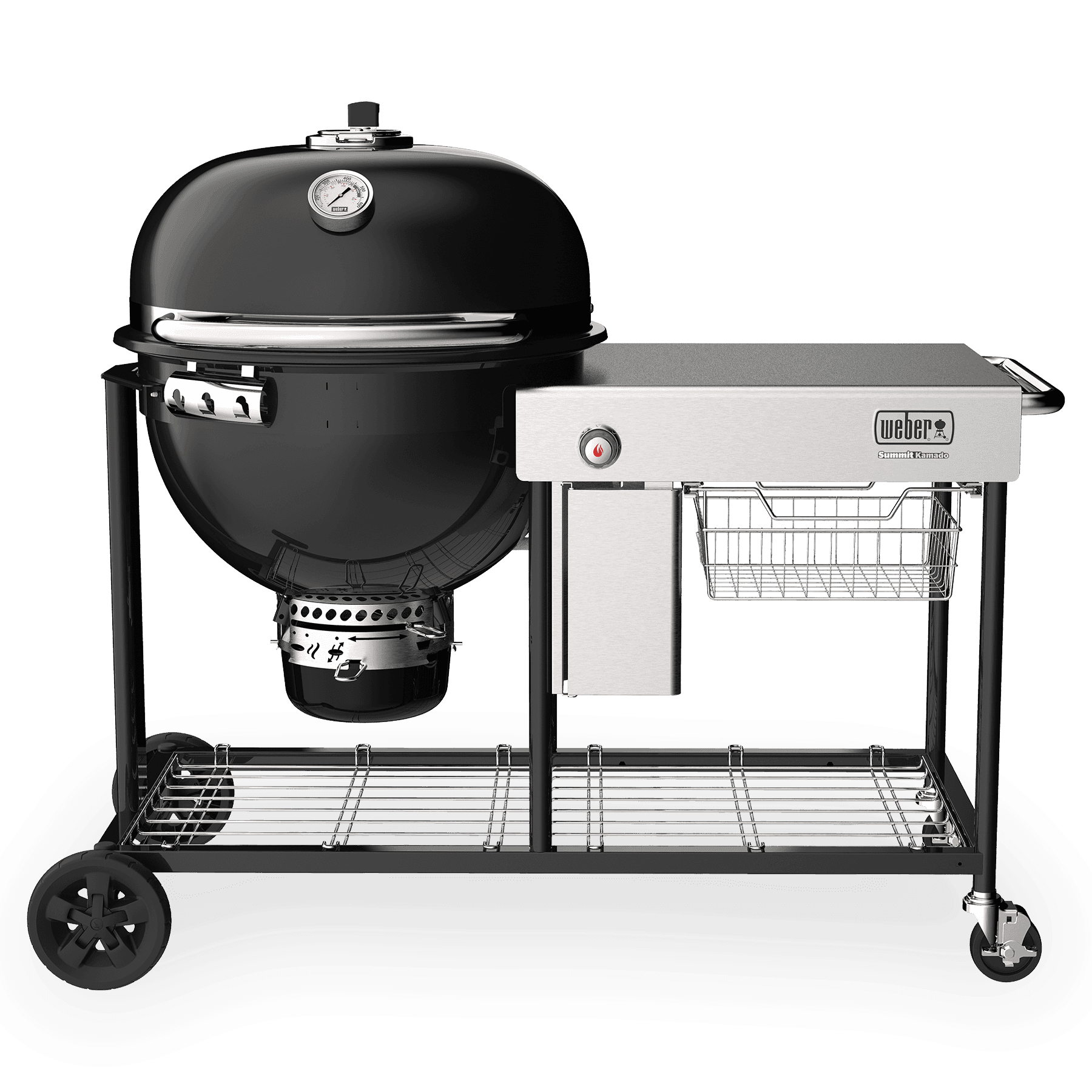
- 452 sq in primary cook surface (586 with upper rack) — largest in the kamado category
- Double-wall porcelain-enameled steel — no ceramic crack risk, 50+ lbs lighter
- Cart + side shelf + 1000°F lid thermometer included (ceramics cost $350-450 extra)
- 10-year limited warranty on bowl, lid, grates, ignition components
If you’re cross-shopping gas
A common cross-shop is kamado vs premium gas. If you’re torn, the honest frame is: do you want the cooking RESULT (sear, smoke, low-and-slow) or the cooking RITUAL? Gas wins on convenience, speed, and consistency. Charcoal wins on flavor depth and the engagement of actually running the fire. If you want a premium gas grill in the same price bracket as the S6, our Weber Genesis vs Spirit guide covers the Weber ladder, and the Hestan vs Weber Summit premium grill comparison covers the step up from Weber’s top. Also worth skimming the best charcoal grills roundup and the best smokers for beginners guide if you’re still narrowing the category.
Shop the Weber Summit Kamado S6
Check current pricing and configuration on the Weber Summit 24-inch Kamado S6 Charcoal Grill listing. Free shipping on orders $99+, backed by Weber’s manufacturer warranty, shipped from the nearest regional distribution center. If you’re torn between this and a gas grill at the same price point, our Best Grills 2026 roundup covers the full category. Looking at adjacent brands? The Weber brand hub covers Weber’s full range, and the Oklahoma Joe’s hub covers heavy-steel offsets if that’s the direction you’re leaning. All our charcoal grills live at /collections/charcoal-grills.
Frequently Asked Questions
How long does charcoal last in a Weber Summit Kamado S6?+
Is the Weber Summit Kamado S6 better than a Big Green Egg?+
Can you use the Summit Kamado for pizza?+
What's the warranty on the Weber Summit Kamado S6?+
Does the Summit S6 come with the cart or is that separate?+
Products & brands in this guide
This Season
Shop the season
Black Friday 2026
Black Friday Grills
Deepest markdowns of the year on built-ins, carts, and high-BTU gassers.
Shop Black Friday →Holiday 2026
Holiday Grill Deals
Gift-ready grills and accessories that still beat Christmas.
Shop Holiday Deals →Thanksgiving 2026
Thanksgiving Grilling
Ideas to keep the turkey outside and the oven free for pies.
Read the Guide →Related reading
Reed — Reed writes the buying guides at BBQs.com — fifteen years selling and installing built-in grills means the picks here are what we'd actually put in our own outdoor kitchen.