Hibachi vs Flat-Top Griddle vs Plancha — The 3-Surface Comparison
By Reed · Published November 2026
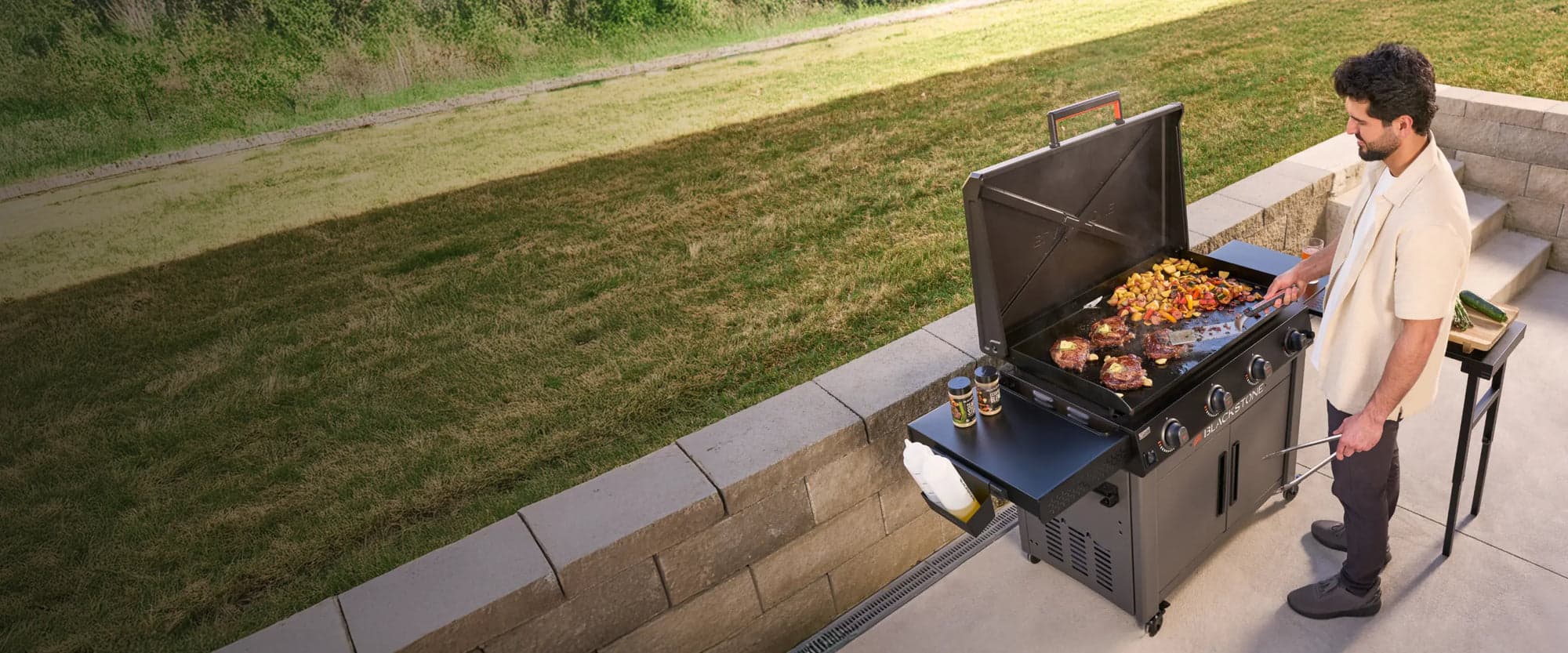
Three cooking surfaces, three cuisines, three investment levels. A real dealer's side-by-side of the hibachi grill, the flat-top griddle, and the plancha — covering what each actually is, what we see customers buy them for, and which one belongs in your backyard.
Three Surfaces, Three Different Jobs
The reason “hibachi vs flat-top vs plancha” is a hard question is that most comparisons online treat them as interchangeable flat cooking surfaces. They’re not. Each one evolved for a different cuisine, cooks at a different temperature, and costs a different amount to install. We sell all three categories end to end, and the mistake we see most often is somebody buying one when they actually wanted another — usually a buyer ordering a flat-top griddle because they saw “hibachi” and assumed that’s what Benihana cooks on.
Here’s the short version: hibachi is Japanese charcoal, small and hot, meant for skewered proteins over an open flame. A flat-top griddle is American breakfast-first cooking on a wide steel plate at moderate heat. A plancha is Spanish and Latin-American cast-iron cooking at high heat, built around seafood and chorizo. If you only remember one difference: hibachi uses fire, the flat-top uses burners under cold-rolled or stainless steel, and the plancha uses burners under thicker cast iron.
Typical surface temperature range
Who Should Buy What — The 30-Second Decision Tree
Weekend breakfast cook feeding 2 to 6 people. Buy the Weber Slate 30-inch at $699 or a Blackstone 36-inch freestanding. Rolls on a cart, runs on propane, cleans with a scraper and a paper towel. No install cost.
Building an outdoor kitchen island with a dedicated griddle station. Spec a Bull BBQ 30-inch built-in or Coyote 2-burner built-in. You’ll spend $2,400 to $2,800 on the appliance plus the cutout and gas run, and you’ll keep this surface for 15 to 20 years.
Seafood-and-chorizo cook who wants restaurant sears. A dedicated cast-iron plancha. We stock the Tagwood BBQ line of South-American cast-iron cook surfaces, which includes plancha-style slabs and Argentine-parrilla setups. See the Tagwood catalog or our Tagwood brand guide. A Hestan plancha accessory ($300 to $500) is the lowest-cost option if you already own a Hestan power burner.
Authentic Japanese yakitori over charcoal. You want a Japanese konro grill, which neither we nor most mainstream American grilling retailers carry — direct import from Japan is the right path. A small kamado like a mini Big Green Egg or Primo is the closest American-market substitute, and we cover the charcoal-side options in the best charcoal grills guide.
Hibachi Grill — What It Actually Is
The word hibachi is where this entire comparison gets muddy. In Japanese, a hibachi is a small portable fire bowl, originally a household heating container, later adopted for yakitori-style grilling over charcoal at close range. A traditional hibachi runs 150 to 250 square inches, uses binchotan or lump charcoal, and cooks at 800 to 1200°F — blistering heat on short skewers held inches from the coals.
What Americans usually mean by hibachi is the Benihana experience: a chef cooking fried rice, hibachi chicken, and vegetables on a huge flat-top steel plate right in front of you. That surface isn’t a hibachi at all — it’s a teppanyaki griddle. The naming confusion is a US restaurant-industry quirk from the 1960s. We dig into the linguistic history in what is a hibachi grill, but for buying purposes, every retail flat-top called “hibachi” in the US market is a teppanyaki-style gas griddle, not an authentic charcoal hibachi.
Practically: we don’t carry authentic Japanese konro-style charcoal hibachis. For yakitori, direct-import from Japan or a specialty Japanese-grilling retailer is the real path. For the Benihana flat-top experience most buyers actually want, keep reading — the next section is the one for you.
Flat-Top Griddle — The Teppanyaki-Style Plate
A flat-top griddle is a solid steel plate heated by gas burners underneath. Cold-rolled carbon steel on Blackstone and Weber freestanding units, 304 stainless or chrome-plated steel on premium built-ins from Bull, Coyote, and Summerset. Working temperature range is 300°F for pancakes and eggs up to 650°F for smash burgers and steak sears. The design priority is even heat across a wide surface, not maximum temperature.
What customers actually buy flat-tops for, based on the product-return conversations we’ve had with buyers: breakfast outdoors (eggs, bacon, pancakes, hash browns), smash burgers for a crowd, fried rice and hibachi-style vegetable dishes, Philly cheesesteaks, quesadillas, and fajita builds. The surface wins on versatility — there isn’t a dish that works on a hibachi charcoal setup that couldn’t be adapted to a flat-top, but the reverse isn’t true. A hibachi can’t hold temperature to cook 12 eggs without running your coals low.
Price range in our catalog runs from $699 (Weber Slate 30-inch freestanding) to $3,000-plus for a 36-inch premium built-in like the Blackstone Select built-in or Bull BBQ 30-inch built-in. Freestanding units are patio-ready today; built-ins need an outdoor kitchen island with a correctly-sized cutout and a gas run.
“If you’re searching for a hibachi grill and you want the restaurant experience, 95% of the time the right purchase is a flat-top griddle.”
BTU-per-square-inch is the spec that matters most for a flat-top. The engineering target sits between 70 and 90 BTU per square inch — enough to hold 550°F across the entire plate even when cold protein hits the steel. The Weber Slate 30-inch runs 36,000 BTU over 540 square inches (67 BTU/sq-in), which is why the edges soften under heavy load. The Bull BBQ built-in runs closer to 85 BTU/sq-in — noticeably better recovery when you’re cooking for ten.
Plancha — The Spanish and Latin-American Cast-Iron Slab
A plancha is a flat cast-iron cooking slab, Spanish in origin, adopted across Latin America — particularly Argentina, where it sits alongside the parrilla (grate grill) in restaurant kitchens. Where a flat-top griddle is engineered for even moderate heat, a plancha is engineered for thermal mass and high heat. Cast iron typically 3/8-inch to 3/4-inch thick, run at 500 to 700°F, holds temperature when cold protein lands in a way that cold-rolled carbon steel simply can’t match.
What a plancha gets you that a flat-top can’t: deep Maillard crust on seafood (shrimp, scallops, octopus), paella soccarat (the crispy rice crust at the bottom of the pan), chorizo with the rendered-fat sheen that only comes from a surface hot enough not to drop when cold fat hits it, and whole-fish sears where the skin releases cleanly because the surface temperature never dipped.
Who makes them for the US market: dedicated plancha appliances are a specialty category. Tagwood BBQ imports Argentine-style cast-iron cook surfaces including plancha slabs and parrilla setups — see our Tagwood Argentine parrilla guide for the full line. Hestan sells a chrome-plated plancha accessory (model AGGPPB) that drops into an existing Hestan power-burner module — the lowest-cost route into plancha cooking if you already own a Hestan outdoor kitchen. For most buyers who don’t have a Hestan platform, buying a dedicated flat-top griddle is the pragmatic route; buying a dedicated plancha is the enthusiast route.
Side-by-Side Specs
| Dimension | Hibachi (authentic) | Flat-Top Griddle | Plancha |
|---|---|---|---|
| Fuel | Charcoal (binchotan) | Gas (propane or natural) | Gas |
| Surface material | Grate over coals | Cold-rolled steel or 304 stainless | Cast iron (3/8" to 3/4") |
| Working temperature | 800-1200°F | 300-650°F | 500-700°F |
| Typical cook surface | 150-250 sq-in | 400-700 sq-in | 200-400 sq-in |
| Best for | Yakitori skewers, direct-heat sear | Breakfast, smash burgers, fried rice | Seafood, chorizo, paella |
| Entry price | $200-400 (direct import) | $699 freestanding | $300-500 accessory, $1,500+ dedicated |
| Built-in option | Not typical | Yes, $2,400-3,000+ | Specialty (Tagwood line) |
| Cleaning difficulty | Hardest (ash + ember disposal) | Easiest (scrape + wipe) | Medium (preserve seasoning) |
| Lifespan | Generational (if maintained) | 10-20 years built-in, 5-10 freestanding | Generational |
What We See Customers Actually Pick
Across hundreds of flat-top-category sales, the breakdown is roughly 80% freestanding flat-top (Weber Slate or Blackstone), 15% built-in flat-top in an outdoor kitchen, and 5% dedicated plancha or parrilla. Authentic hibachi charcoal buyers are rare enough we don’t track the share meaningfully — usually they land on a small kamado instead after reading our charcoal guide.
The buyers who end up happiest a year after purchase are the ones who matched the surface to the cuisine they actually cook, not the one with the coolest brand story. A plancha in a household that cooks breakfast-outdoors three times a week gathers dust — same surface, wrong recipe fit. A Blackstone in a seafood-forward household does the job but never produces the sears the owner wanted. Pick the surface for the cuisine, and the appliance choice sorts itself.
Install and Running Costs
Freestanding flat-top: zero install cost. Propane tank plus a patio slab or a backyard pad. Running cost is a 20-lb propane tank every 10-15 cooks, or $4 to $5 per cook on fuel.
Built-in flat-top in an outdoor kitchen: $2,400 to $3,000 for the appliance plus $4,000 to $12,000 for the cabinetry, countertop, gas line, and electric depending on finishes. A full outdoor-kitchen install with a griddle plus a grill runs $14,000 to $25,000 all-in mid-tier, $35,000-plus with premium brands like Alfresco or Hestan. Running cost is negligible once the gas line is tied in.
Dedicated plancha or parrilla setup: $1,500 to $4,500 for the standalone unit depending on size. Tagwood’s larger parrilla rigs land in the mid-range. Fuel is charcoal or wood, not gas, so running cost is $1 to $3 per cook plus the cost of learning to manage the fire well — the real investment is in cook technique, not consumables.
The Honest Recommendation
Nine out of ten buyers in this comparison land on a flat-top griddle, and they should. It’s the most versatile surface, the easiest to clean, the cheapest to run, and it covers the Benihana-style hibachi dishes that drew most people to this category in the first place.
The 10% where plancha or hibachi makes sense are specific: seafood-first cooks who want restaurant sears, chorizo-and-paella traditionalists, and yakitori enthusiasts with the patience for charcoal management and binchotan sourcing. If that’s you, buy the right tool — don’t compromise with a flat-top and then be frustrated it doesn’t deliver the result you wanted. If it’s not you, start with a $699 Weber Slate or a $900 Blackstone freestanding, get 20 cooks under your belt, and see whether the appetite for a dedicated built-in or a specialty plancha emerges over time.
Frequently Asked Questions
Is a hibachi grill the same as a flat-top griddle?+
What's the difference between a flat-top griddle and a plancha?+
Which is the cheapest way into flat-top cooking?+
Can a Blackstone double as a plancha?+
Do I need a hibachi grill if I already have a gas grill?+
Which surface lasts the longest?+
Which is the easiest to clean?+
Products & brands in this guide
Related reading
Reed — Reed writes the buying guides at BBQs.com — fifteen years selling and installing built-in grills means the picks here are what we'd actually put in our own outdoor kitchen.