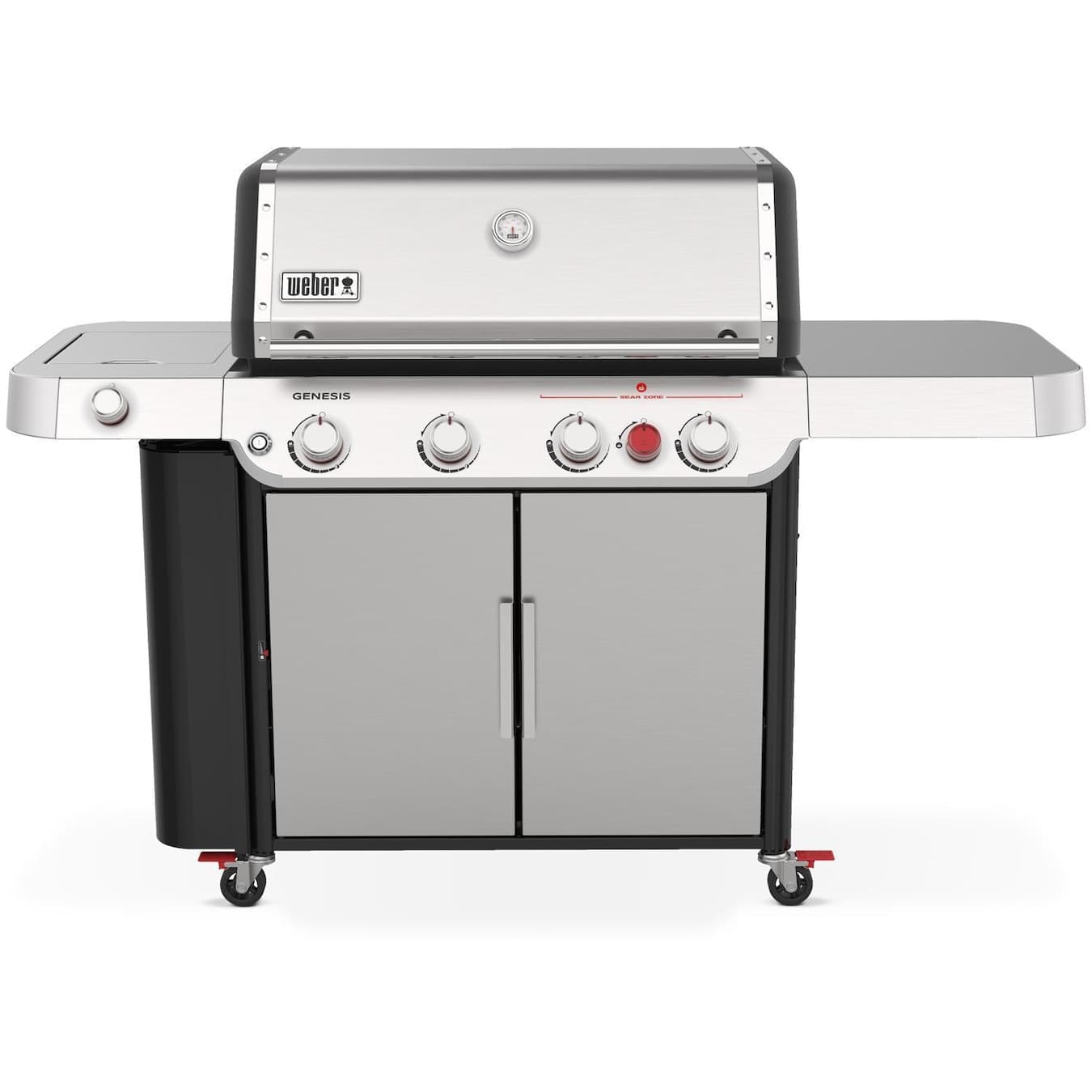
Two decisions drive almost every Weber Genesis propane-to-natural-gas search: 'we're moving the grill to a spot with a house gas line' or 'we already have a line, but the Genesis in the garage is propane.' The honest answer depends almost entirely on which Genesis you own. The current 2022-and-newer Genesis and the Smart lineup are not designed for a field conversion, and Weber's warranty position reflects that. The older Genesis II and Genesis III models can be converted, but through Weber Customer Service with a model-specific kit — not a universal part on a store shelf. This guide walks the model matrix, the actual install work for eligible grills, the plumber cost for the house line, and the warranty position so you can decide whether to convert, replace, or just order the right fuel at purchase. Updated November 2026.
The eligibility matrix is the single most important thing to settle before you buy a kit or hire anyone. Weber's position changed meaningfully with the 2022 Genesis redesign, and most of the confusion on forums and Reddit is a decade of old answers that no longer apply to grills sold this year.
Weber Genesis generation
Years sold
Field convertible?
Kit path
Genesis Silver / Gold / Platinum (Spirit era)
pre-2007
Yes
Universal orifice sets, retail/OEM
Genesis III (E/S-300, E/S-400 range)
2007-2016
Yes (authorized)
Weber Customer Service, model-specific
Genesis II / Genesis II LX (300, 400, 600)
2017-2021
Yes (authorized)
Weber Customer Service, model-specific
Genesis (current, 300 and 400 series)
2022-present
No
Buy fuel-specific SKU
Genesis SX Smart / Smart SX-335 / SX-435
2022-present
No
Buy fuel-specific SKU
Spirit II (adjacent, same logic)
2018-2021
Yes (authorized)
Weber Customer Service
Spirit (current)
2022-present
No
Buy fuel-specific SKU
Eligibility confirmed by Weber Customer Service as of November 2026. Always call Weber with your model + serial before ordering a kit — Weber has adjusted eligibility inside a generation when a specific serial range used a different manifold.
If your Genesis is in the 'No' rows, the honest recommendation is to keep it on the fuel it was built for and buy a second, fuel-correct Genesis if you've moved to a house with a gas line. The 'No' isn't Weber being difficult — the manifold regulator, the orifice sizing, and in some cases the valve seat profile are all fuel-specific, and swapping only the orifices on a current-gen Genesis leaves the regulator mismatched with the house line pressure, which is a safety issue, not just a warranty one.
For the eligible older generations, a Weber-authorized NG conversion kit contains three or four parts. First, a set of main-burner orifices sized for 7-inch water-column natural-gas pressure — one per main burner, so a 3-burner E-315 gets three orifices and an S-435 gets four. Second, a side-burner orifice if the grill has a side burner. Third, a manifold regulator or regulator-bypass component that takes the grill off the propane first-stage regulator and puts it on the house line, which supplies pressure already regulated at the meter. Fourth, a flex hose or quick-connect fitting that mates to the appliance side of the house NG line.
Weber ships these kits directly from Customer Service for a confirmed model + serial. Historical MSRP for a complete Weber OEM NG kit ran around $30 to $60 depending on burner count. Weber kits were never a retail SKU, which is why you won't find them on Amazon or in the grill-parts section of a big-box store. Anything labeled 'Weber conversion kit' from a non-Weber seller is an aftermarket substitute. Those exist and some are machined to Weber's orifice spec, but installing one voids the Weber fuel-system warranty the same way any other non-authorized conversion does.
The install, start to finish
The orifice swap is the easy part. Running the house line is the hard part. In almost every scenario, the sequence is: plumber runs or extends the line and installs the appliance-side quick-connect, you swap the orifices, you pressure-test, you cook.
Step 1 — Confirm the house line
Natural-gas service to a residential grill comes off the home's main gas line at the meter, through the house, and out to a stub at the grill location. If you don't already have a stub at the patio or an existing exterior NG appliance, a licensed plumber or gas fitter needs to run that line. The permit requirement is universal in jurisdictions I've worked in; the enforcement varies, but the homeowner's insurance implication of an unpermitted gas line discovered after a loss is not a risk worth carrying. Plumber quotes for a straight 15 to 25-foot run in an accessible wall or crawlspace typically land between $400 and $900. Underground runs or trenched routes run $900 to $1,500.
Step 2 — Turn off every fuel source
Close the propane tank valve. Disconnect the regulator from the tank. For the house NG line, close the quarter-turn appliance valve at the stub. Leave the grill in the open air during the swap so any residual gas in the manifold dissipates.
Step 3 — Pull the control panel and reach the orifices
Remove the burner control knobs and the control panel cover. On a Genesis II and most Genesis III units, three or four screws hold the panel. The main-burner orifices are brass fittings threaded into the end of each valve. A 10mm or 12mm wrench backs them out. Replace each with the matching Weber NG orifice from the kit — they are engraved with an identifier so you can confirm you're using the NG set and not the LP set that came out of the grill.
Step 4 — Swap the regulator
If the kit includes a regulator, remove the LP first-stage regulator from the manifold inlet and install the NG adapter or regulator-bypass component the kit specifies. If the kit relies on the house-line regulator at the meter, the manifold inlet becomes a straight flare fitting that mates to the appliance-side flex hose.
Step 5 — Connect the flex hose to the house stub
Use the hose and quick-connect fitting the kit supplies. Hand-tight plus a wrench-quarter-turn is the usual spec; the flare seats are soft enough that overtightening will damage them. Avoid Teflon tape on the flare itself — tape is for threaded pipe sealant, not flare-to-flare connections, which seal on the flare face.
Step 6 — Pressure-test every joint
Open the house-line valve. With all grill knobs still off, check every joint — manifold inlet, regulator or bypass, every orifice, hose connections — with a soap-water solution in a spray bottle. Visible bubbles mean a leak. The right fix is tightening one more quarter-turn or, if that doesn't close it, re-seating the fitting. Never ignore a bubbling joint by 'just lighting the grill and burning it off.' Natural gas pooling in the grill cabinet can flash-ignite when you open a valve.
Step 7 — Light-off test, slow
Open one knob to the low setting, press the igniter, and watch the burner. NG flames read slightly bluer and shorter than LP flames at the same knob setting because NG has a lower heat-of-combustion per cubic foot. Cycle each burner one at a time through low-medium-high and listen for any pop-back or yellow-tipped flames, both of which signal a mismatched orifice or a partially blocked venturi. A healthy NG burner on a properly oriented orifice runs steady blue with a clean leading edge.
Safety checklist you don’t skip
Three things go in the drawer with the grill manual and stay there as long as you own the grill. One: a photo of the orifice set with the NG identifier visible, so next time you clean the burners you don't accidentally reinstall the wrong set. Two: the model + serial + conversion date on an index card inside the control panel, so a future owner or technician knows the grill was converted and when. Three: an electronic combustible-gas detector — the $40 kind that beeps when it detects methane — kept at the grill location and used during any future maintenance that opens a joint. A soap-water test catches big leaks; an electronic detector catches small ones.
Warranty, resale, and the real decision
Weber's limited warranty covers each grill in the configuration it was sold in. A field conversion — even an authorized one — leaves a paper trail that matters at resale and at any future warranty claim on the fuel system.
If you own a pre-2022 eligible Genesis and you're staying in the house for years, the conversion is low-risk and preserves the grill you already know. Weber Customer Service has handled these conversions for well over a decade and the warranty position for an authorized conversion on an eligible model is intact for the non-fuel parts of the grill. If you're planning to sell the home or the grill inside two years, a factory-fuel grill holds its value measurably better than a converted one on the used market — buyers see 'converted to NG' as a yellow flag whether it's fair or not.
If you own a 2022-or-newer Genesis or any Smart-series Weber, the practical answer is to leave it on its original fuel, buy the fuel-matching Genesis for the new location, and keep the original grill where it works. That's the position Weber takes in writing, and it's the position that keeps the warranty and the resale value intact. Weber Genesis holds value in every generation; running two Genesis grills on two fuels is a surprisingly common setup in houses that entertain both on a covered patio and at the pool.
What to shop if you’re buying new
If today's decision is a new Genesis purchase and you have a house gas line, pick the natural-gas SKU at order. The Weber Genesis S-435, Genesis SX-335, Genesis E-315 and Genesis E-415 all ship in both NG and LP configurations; order the NG variant and the grill arrives correctly orificed and regulated with no conversion needed. If you have a propane tank and no plans to run a line, the LP SKUs — like the current S-415 freestanding propane model — are the right pick.
The fuel decision drives the orifice and regulator, not the rest of the grill. BTU output, cooking area, sear station, side burner, and the smart-grill telemetry on the SX models are identical across NG and LP builds. You don't lose features by picking the fuel that matches the house.
Frequently Asked Questions
Can you convert a new Weber Genesis from propane to natural gas?+
Weber's official position on the current Genesis 300 and 400 series (2022 and newer) and the Genesis Smart lineup is that these models are not field-convertible. The orifice sizing, manifold regulator, and burner geometry are fuel-specific, and Weber ships natural-gas and propane as two different SKUs so the right parts are installed at the factory. If you have a home natural-gas line, the clean path is to order the natural-gas version at purchase. If you already own the propane version, keep it on propane rather than attempting a conversion that voids the warranty.
Which Weber Genesis models are field-convertible?+
Weber Genesis II (2017 to 2021), Genesis II LX, Genesis III (2007 to 2016), and the earlier Genesis Silver/Gold/Platinum Spirit family had Weber-authorized field conversion paths. On these units, Weber Customer Service shipped an orifice set plus regulator components for a specific model and serial number range. The 2022-and-newer Genesis redesign closed that path. If you own a pre-2022 Genesis and have the original owner's manual, call Weber Customer Service with the serial number to confirm eligibility before ordering anything.
What's in a Weber natural-gas conversion kit?+
A Weber-authorized natural-gas conversion kit for an eligible Genesis contains a set of main-burner orifices sized for 7-inch water-column natural-gas pressure, a side-burner orifice, a manifold regulator or adapter that bypasses the LP regulator, and a flex hose or quick-connect fitting for the appliance end of the house line. Historical MSRP for Weber OEM kits ran about $30 to $60 depending on burner count. Weber shipped the kit directly from Customer Service; it was not a retail SKU at any time. Any 'Weber conversion kit' sold on Amazon or eBay with a non-Weber part number is an aftermarket substitute and is not covered by Weber's warranty position.
Can I install a Weber natural-gas conversion kit myself?+
The orifice swap is a short job: shut off fuel, pull burner knobs and control panel, back out each LP orifice with a 10mm or 12mm wrench, thread in the matching NG orifice, and reassemble. Most DIYers can do it in under an hour. The part most people cannot DIY is running the actual natural-gas line. In almost every US jurisdiction, running a new gas line or extending an existing one is work that must be done by a licensed plumber or gas fitter, both for permit and for homeowner's insurance to remain valid. The Weber owner's manual states the house line should be run by a licensed professional.
What does a pro Weber natural-gas conversion cost?+
If the house has an existing NG stub at the grill location, a plumber's fee to swap the final flex connection and pressure-test the appliance is typically $100 to $200 in most US markets. If a new gas line has to be run from the home's manifold to the grill location, the total ranges from $400 to $1,500 depending on distance, whether the trench is open or underground, and the local gas code. The orifice swap itself adds very little labor. The expensive line item is the line, not the kit.
Does a conversion void the Weber Genesis warranty?+
Weber's limited warranty explicitly covers only the configuration the grill was manufactured and sold as. An unauthorized conversion voids the fuel-system portion of the warranty on every current-generation Genesis. Weber-authorized conversions on eligible older Genesis II and Genesis III units preserved warranty when performed with Weber's own kit and documented through Customer Service. If warranty protection matters and you're shopping new, the right move is to buy the Genesis configured for the fuel you have.
Reed — Reed writes the buying guides at BBQs.com — fifteen years selling and installing built-in grills means the picks here are what we'd actually put in our own outdoor kitchen.