Bromic is an Australian outdoor-heating specialist that engineered around a problem the mainstream patio-heater category ignored: wind. Traditional radiant heaters bleed BTU output the moment there's a breeze, which is exactly when a shopper actually wants supplemental outdoor heat. Bromic's Smart-Heat platform uses a directed-infrared glass-ceramic emitter that stays effective in winds up to 12 mph, holding its heat zone where you sit instead of letting it dissipate up into the air column. That single engineering decision is what separates Bromic from everything else in the category.
Who Bromic Is For
Bromic sits in the $800-to-$2,500 per-unit tier and is designed for permanent installation — wall-mounted, ceiling-mounted, pole-mounted, or recessed into a pergola post. It is not a freestanding propane mushroom heater and it is not a competitor to Lava Heat Italia flame-tower units.
The right buyer for Bromic is doing a permanent outdoor room — covered patio, pergola, screened porch, pool cabana, or commercial deck — and wants heat that stays effective across a real California, Pacific Northwest, Northeast, or Midwest cold season. The wrong buyer wants a portable heater to roll out when guests come over; that buyer wants a Lava Heat flame tower or a traditional propane mushroom.
The Three Series
Bromic’s current catalog runs three series: Platinum Smart-Heat (premium), Tungsten Smart-Heat (value), and Eclipse / Cobalt Smart-Heat (specialty).
Platinum Smart-Heat is the flagship — heavier 500W stainless housing, dual-input regulator on the gas models, direct-ignition electronics with automated re-ignition (light it once at the start of the evening, forget it the rest of the night). Available in natural gas, liquid propane, and 240V/208V electric (2300W and 3400W). Marine-grade variant for coastal and poolside installs. This is the Bromic to buy if you’re heating a primary entertainment zone and want the longest service life.
Tungsten Smart-Heat is the value tier — same Smart-Heat infrared emitter, same wind-resistance rating, slightly lighter housing. Priced to spec across an entire patio without breaking the budget. Available in natural gas, liquid propane, and electric. The right pick when you’re mounting three or four units across a long pergola and cost-per-zone matters more than per-unit housing weight.
Eclipse and Cobalt cover specialty configurations — the Cobalt is a dual-element infrared designed for taller mounting heights and higher ceilings; the Eclipse is a portable 28-inch floor-standing electric for rental and semi-permanent install scenarios. Eclipse exists for the use case between “freestanding mushroom” and “permanent wall mount” — restaurant pop-ups, rental venues, and seasonal patio deployments.
Gas vs Electric — The Real Trade-Off
Gas (natural or propane) delivers higher BTU output per unit: a Platinum gas 500 Series publishes 39,800 BTU; the equivalent Platinum electric 3400W publishes 11,600 BTU-equivalent. For large open patios in cold climates, gas is the right call because the output volume matters more than operating cost.
Electric wins on operating cost (roughly 40 to 60 percent lower cost per hour at typical US power rates vs. propane), on under-cover install safety (no combustion by-products means no code concerns under enclosed porches), and on retrofit scenarios where running a new gas line is cost-prohibitive. The Platinum Smart-Heat Electric is our most-recommended Bromic for covered outdoor rooms where a gas line doesn’t already exist.
The right wiring for electric Bromic is 240V or 208V on a dedicated circuit — this is not a plug-in heater and it is not standard 120V. If your electrician quotes a 20-amp 240V circuit run from the panel, that’s the right spec; budget $400 to $900 for the run depending on routing distance.
Mounting Options
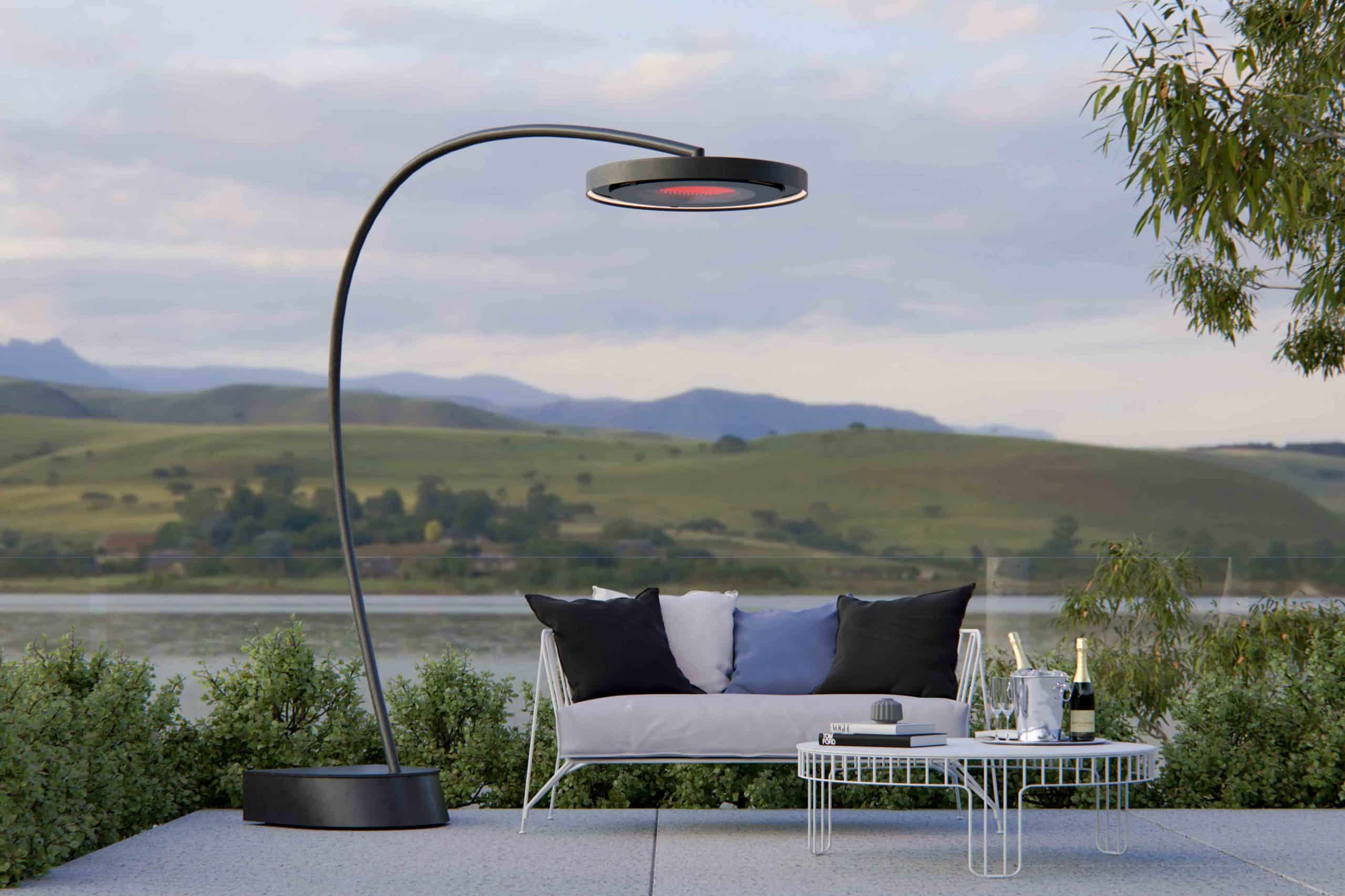
Bromic ships mounting hardware for four configurations: wall-mount (bracket pivots to aim the heat zone), ceiling-mount (fixed-angle downward infrared), pole-mount (compatible with Bromic’s own stanchions or standard patio posts), and pergola-post mount (recessed into a 4x4 or 6x6 post for low-profile installs).
The mounting flexibility is where Bromic reclaims real floor space vs. a freestanding heater. A Platinum wall-mount is the same footprint as a security light; a ceiling-mount is invisible from the seating area and only announces itself when it starts heating. For small patios where every square foot of floor space is contested, a mounted Bromic beats a freestanding anything.
Pivot brackets on the wall-mount let you aim the heat zone at the primary seating group rather than straight down into empty floor space. This is the small detail that separates “we installed a patio heater” from “we actually heated the people on the patio.”
Honest Downsides
Install is not optional. A Bromic heater is not plug-and-play — gas models need a gas line and a fitter; electric models need a dedicated 240V/208V circuit and an electrician. Both are permitted trades in most jurisdictions. Budget $200 to $900 per unit on top of the heater cost for the fuel/power connection.
Not portable. If you want to move the heater around based on where guests are sitting, Bromic is not the pick. Buy a Lava Heat flame tower or a traditional propane mushroom for that use case. Bromic is designed to be installed once and used for a decade.
Short warranty terms. 2 years parts, 1 year labor is below some competitors (Infratech runs 10 years on heating elements). Bromic’s real-world service life is excellent — in our install history, 10-plus-year-old Bromic heaters are common in commercial deployments. But the paper warranty is shorter than the service life suggests.
Bromic vs Infratech vs Freestanding Alternatives
Infratech is Bromic’s primary competitor in permanent-mount electric patio heaters. Infratech is US-made (Southern California), carries a 10-year warranty on heating elements, and offers a wider range of custom finishes and recessed-mount options. Bromic is Australian-designed, carries the 2-year warranty, and offers the Smart-Heat gas lineup Infratech doesn’t match. If you want the longest paper warranty and recessed-ceiling installs, Infratech. If you want the Smart-Heat gas platform or you’re working with Australian-design aesthetics, Bromic.
Vs. freestanding propane mushroom heaters (the $300 Costco specials): Bromic wins on reliability, heat zone control, wind resistance, and service life. The $300 mushroom is the right call for occasional use or short-term rentals; Bromic is the right call for a backyard you’ll be heating for the next 10 years.
Vs. flame-tower units (Lava Heat Italia): different categories. Flame towers are decorative primary features that produce visible flame; Bromic is a workhorse heat source that disappears into the architecture. In a well-designed outdoor room, both can coexist — a Lava flame tower as the visual anchor, Bromic Smart-Heat mounted to actually hold temperature across the seating area.
What to Ask Before You Order
Confirm the fuel decision up front — gas, electric 240V, or electric 208V. The install cost on each is different and the heater choice downstream is fuel-specific. If you don’t already have a gas line, electric is usually the better pick even if the per-hour operating cost is slightly higher.
Measure the actual seating area dimensions and run them through Bromic’s heat coverage planner before ordering. Over-speccing is expensive and under-speccing leaves cold spots. In our install experience, buyers often underestimate the heat loss from an open-sided pergola and need one more unit than they initially plan for.
Confirm the mounting surface can support the unit weight. Platinum Smart-Heat gas is roughly 35 pounds mounted; the ceiling or wall surface needs structural backing (not just drywall) at the mount point. The install electrician or carpenter should spec backing before the heater arrives.
Order marine-grade for coastal installs. Standard stainless corrodes in salt-air environments within 2 to 4 seasons; the marine-grade variant is engineered for the exposure. The price premium is small relative to the service life extension.
Frequently Asked Questions
What's the difference between Bromic Platinum and Tungsten?+
Do I need a gas fitter or electrician to install Bromic?+
Can Bromic heaters install under a covered patio or pergola?+
What's the difference between gas and electric Bromic heaters?+
How many Bromic heaters do I need for my patio?+
What's Bromic's warranty?+
Products & brands in this guide
Related reading
Reed — Reed writes the buying guides at BBQs.com — fifteen years selling and installing built-in grills means the picks here are what we'd actually put in our own outdoor kitchen.