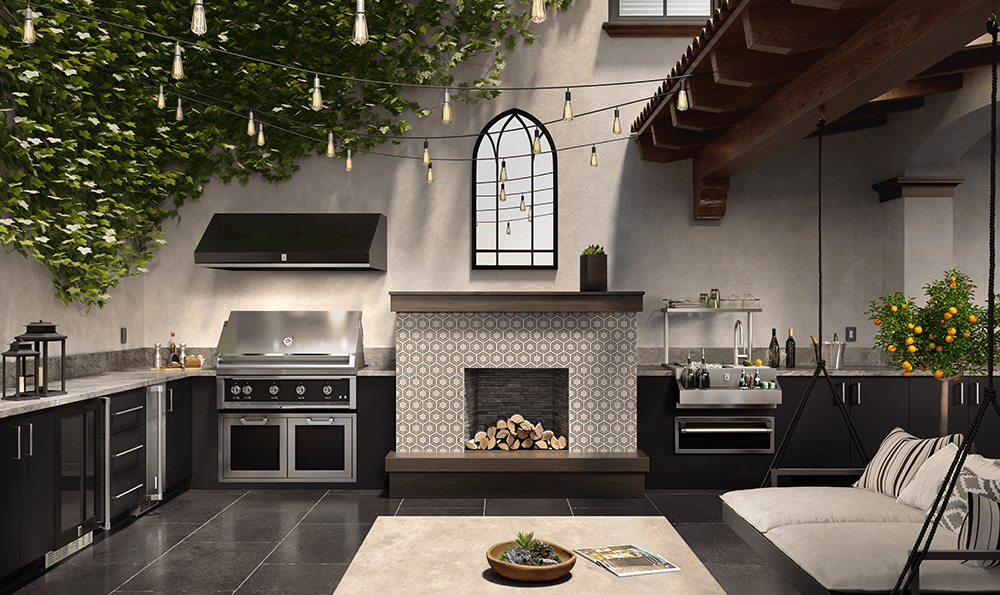
Azure Refrigeration: The Honest Guide to Milestone's Outdoor-Rated Wine and Beverage Line
By Reed · Published September 2026

Updated September 2026. Azure is Milestone Refrigeration’s outdoor-rated line — sister brand to Marvel, direct competitor to U-Line and Perlick in the built-in beverage and wine cooling category. This is the honest guide to their four core product families, when to buy Azure over U-Line, and how to spec the right unit for a real outdoor kitchen.
Brand Background
Azure is a Milestone Refrigeration brand — the same US-based engineering and manufacturing operation behind Marvel Scientific and Marvel Beverage. Milestone has been building specialty refrigeration for 60+ years, originally as a supplier to laboratory and medical markets where precise temperature control matters. The consumer outdoor line is a newer wing of the business, but it inherits the same compressor engineering and thermal-management approach as the scientific line.
Azure sits in the mid-premium tier of the outdoor refrigeration market. Above the volume brands you find in big-box retailers, below the ultra-commercial tier occupied by Perlick and True Manufacturing. If you’re building an outdoor kitchen with Hestan or Summerset grills, refrigeration by Azure or its sister Marvel is a natural design match.
What separates Azure from the flood of cheap outdoor-branded refrigeration that hit the market in the post-2020 outdoor-living boom is genuine outdoor engineering — a compressor tuned for wider ambient temperature swings, sealed electrical, and 304 stainless-steel exteriors rated for real weather exposure. Cheap outdoor-branded units are typically indoor refrigeration in weather-resistant panels; they last 12-24 months before the compressor fails from cycling stress. Azure’s outdoor-rated units carry a 5-year sealed-system warranty because Milestone stands behind the compressor engineering.
The Four Product Families
Azure’s outdoor line splits into four families. Understanding which is which is the whole game.
Beverage Centers run single-zone 34-42°F with adjustable shelves sized for 12-oz cans, 750ml bottles, and soft drinks. The 24-inch stainless-trim glass-door beverage center is the volume seller — 5 cubic feet of storage, roughly 154 cans or 60-70 mixed bottles. This is the right pick for buyers whose entertaining leans more toward beer, cocktails, and canned drinks than wine specifically.
Wine Centers run dual-zone 40-65°F with wood-fronted horizontal wine cradles. The 24-inch stainless-trim glass-door wine center holds roughly 46 standard 750ml bottles across two independent temperature zones — one calibrated for whites (45-50°F), one for reds (55-65°F). The right pick when wine is the primary beverage for the outdoor space and the client entertains around a dinner table rather than a bar.
Dual-Zone Beverage/Wine Centers combine both — one zone for beer and canned drinks, one for wine bottles — in a single 24-inch cabinet cutout. Azure’s ADA-height version (5 cu ft, French doors, dual-zone) is the most versatile SKU in the line for outdoor kitchens that need to cover both use cases without dedicating two 24-inch spaces to refrigeration.
Outdoor Refrigerators are the solid-door general-purpose fridges for the outdoor kitchen — food storage rather than beverage display. Available in solid stainless or overlay-door variants (the overlay door accepts a custom panel matching the surrounding cabinetry, for a fully-integrated look). These are the right pick when the outdoor kitchen has a full cook flow and food staging is part of the workflow.
Beverage vs Wine vs Dual-Zone: Which Belongs In Your Kitchen?
The single biggest decision for an Azure buyer is which family fits how you actually use the space.
Buy Beverage if your entertaining leans toward canned drinks, beer, cocktails made at an outdoor bar, and soft drinks — kid-friendly parties, backyard game days, casual entertaining. The single-zone temperature range and adjustable shelving are tuned for high-turnover beverages served cold.
Buy Wine if wine is the point of the outdoor space — the dinner table under the pergola, the sunset entertaining flow where whites go out first and reds come out with the second course. The dual-zone control matters because whites and reds have genuinely different serving-temperature ranges, and holding both at the same 42°F setting compromises the reds.
Buy the Dual-Zone combo if the outdoor space needs to cover both use cases and you don’t have room for two 24-inch cabinet cutouts. The ADA-height dual-zone Beverage/Wine center is the most flexible Azure SKU — half the cabinet holds cans and cocktails, half holds bottles at wine-appropriate temperature.
Buy the outdoor Refrigerator in addition to a beverage or wine center — not instead of. The general-purpose fridge handles cook flow (meat marinating, cheese boards, dessert staging) while the beverage-specific unit handles service.
Sizing the Unit for Real Entertaining Loads
Azure’s coverage numbers assume steady-state operation. Real entertaining loads swing wider than the datasheet reflects, and most buyers who end up unhappy with their beverage center underestimated the load.
A 24-inch beverage center (5 cu ft) comfortably serves 6-8 people at a small dinner. Push it to 12+ people and it becomes the bottleneck — restocking mid-party interrupts the flow, and the compressor works harder trying to recover after the door opens repeatedly. If you host groups of 12+ regularly, budget for either the dual-zone combo (twice the useful storage) or a second dedicated unit.
Wine centers hold 46 bottles on the datasheet — plan on 32-38 useable slots after you factor in bottle-neck shape variation and space for a couple of magnums or larger-format bottles. If your household drinks 3-4 bottles a week, a single 24-inch wine center is right. If you host wine-forward dinners for 12+ regularly, plan on either the 30-inch version (78 bottles) or a wine center plus a beverage center for the non-wine drinkers.
Install Considerations Most Buyers Miss
An Azure installation done right will run 10-15 years without service. Done wrong, the compressor fails inside 18-24 months. Three things to get right.
Ventilation clearance. Azure specifies 1-2 inches of clearance at the top and rear of the cabinet cutout for compressor heat exhaust. Cabinet builders who don’t know outdoor refrigeration will build the unit flush into the surround and box out any airflow path. The compressor runs continuously trying to shed the trapped heat, and the sealed system fails inside a year or two. Confirm the cutout drawing includes explicit ventilation cutouts before your outdoor kitchen builder starts the surround.
Dedicated GFCI-protected circuit. Azure requires a dedicated 115V/15A outdoor GFCI circuit. Don’t share with lighting, don’t share with grill igniters, don’t share with the outdoor speaker system. Shared circuits with intermittent loads cause voltage sag that shortens compressor life. A dedicated circuit is $150-300 more at install and adds meaningful years to the unit’s service life.
Level installation. Refrigeration compressors are sensitive to install angle. A unit that’s 1-2 degrees off level develops uneven wear on the compressor bearings and shortens sealed-system life. Cabinet builders often build outdoor kitchen counters with a slight slope for drainage, then install the refrigeration flat into the sloped opening. Insist on a level shim under the refrigeration unit even if the surround is intentionally sloped.
What Makes Azure Different From U-Line and Perlick
The three brands are direct competitors in the outdoor beverage refrigeration category. Real differences worth naming.
Design language. Azure’s French-door beverage/wine centers and clean stainless trim read as more modern-minimalist than U-Line’s heavier utilitarian panel work. If the outdoor kitchen is designed by an architect or the client cares about matching a modern interior aesthetic, Azure’s panels tend to fit better. U-Line is the safer choice when the aesthetic is transitional or traditional.
Price positioning. Azure’s 24-inch units run roughly $1,900-$2,800 depending on configuration. U-Line runs $1,600-$2,800 for equivalent capacity — cheaper at the entry tier, comparable at the top. Perlick runs $2,800-$5,500 for commercial-grade builds. If your budget is $2,000-$3,000 for a 24-inch outdoor beverage center, Azure and U-Line are both in-frame; Perlick starts above that band.
Warranty and service network. All three ship with 1-year full plus 5-year sealed-system warranty (industry standard). Milestone (Azure’s parent) and U-Line both have established US service networks with parts shipping from domestic warehouses. Perlick’s commercial roots give it a slightly deeper service bench, but for residential outdoor use, all three deliver comparable service response.
Honest Downsides
Azure’s outdoor line is smaller than U-Line’s or Perlick’s. If you need a specific niche configuration — kegerator with tap tower, ice maker with pump drain, undercounter freezer — Azure may not have that SKU. Marvel (the sister brand) fills some gaps, but for kegerators specifically, U-Line has the deepest catalog.
Azure’s cabinet dimensions are slightly non-standard on a couple of SKUs — worth confirming the cutout dimensions match your outdoor kitchen surround BEFORE you order rather than after. Building a 24-inch cutout for a unit that’s actually 23-7/8 inches wide leaves visible cabinet gaps. Bring the datasheet to the cabinet build meeting.
Overlay-door variants require a custom panel from your cabinet builder — Azure ships the door frame and hinge hardware, but the panel itself comes from the outdoor kitchen build. Coordinate the panel spec (thickness, weight, mounting screws) with the cabinet builder at design time. Overlay doors added retroactively rarely fit as cleanly as ones planned in at cabinet-design stage.
Who Should Buy Which
Buy the 24-inch Beverage Center (stainless trim glass door) if canned drinks and beer are the primary use case, you entertain 6-8 people at a time, and you want a clean glass-door look that displays what’s inside. About $1,900.
Buy the 24-inch Wine Center (stainless trim glass door) if wine is the point of the outdoor space, dual-zone temperature control matters, and you want a bottle display that reads as premium. About $2,400.
Buy the 24-inch ADA-Height Dual-Zone Beverage/Wine Center if the space needs to cover both wine and beverage use cases and you only have one 24-inch cutout to work with. The most versatile SKU in the Azure line. About $2,800.
Buy the Outdoor Refrigerator (solid stainless door) in addition to a beverage or wine center — not instead. Food staging is a different job from beverage service. About $2,200 for the solid stainless door variant.
Buy the Overlay Trim variants if the outdoor kitchen design brief calls for fully-integrated cabinetry where the refrigeration disappears into the surround. Coordinate the custom panel spec at cabinet-design stage, not after order.
What to Ask Before You Order
Confirm the exact cutout dimensions from Azure’s spec sheet — bring them to your cabinet builder before the surround gets built. Azure publishes cutout drawings for every SKU on their spec pages; the dimensions matter to the eighth-inch.
Verify ventilation clearance is drawn into the cabinet plan. 1-2 inches at top and rear, with a clear path for the exhausted heat to escape the surround. This is the single most-missed install detail and the single most-common cause of premature compressor failure.
Confirm the dedicated GFCI circuit is spec’d in the electrical drawing. If the electrician is drawing a shared circuit with lighting or other appliances, push back — Azure’s warranty explicitly requires a dedicated circuit and shared-circuit failures aren’t covered.
If you’re ordering an overlay-door variant, coordinate the custom panel spec with your cabinet builder before you order. The panel weight, thickness, and mounting-screw pattern need to match what the hinge is designed for.
Register the warranty within 30 days of installation to lock in the extended sealed-system terms. A step that’s easy to skip and expensive to regret in year four.
Frequently Asked Questions
What's the difference between an Azure beverage center and a wine center?+
Is Azure actually rated for outdoor use, or is it an indoor unit dressed up?+
How does Azure compare to U-Line and Perlick?+
How much can I actually fit in a 24-inch Azure beverage center?+
What's the install requirement — hardwired or plug?+
What's Azure's warranty?+
Products & brands in this guide
Related reading
Reed — Reed writes the buying guides at BBQs.com — fifteen years selling and installing built-in grills means the picks here are what we'd actually put in our own outdoor kitchen.