A serious outdoor kitchen rarely leans on the grill's own factory side burner. The output is too small, the real estate is compromised, and the shared gas manifold means every time you crank the grill hot, the side burner weakens. That is why Alfresco sells side burners as standalone appliances, each with its own regulator, its own ignition, and an output calibrated for actual cooking. This guide walks the two platforms Alfresco actually ships to the US market — the 30,200 BTU Sear Zone Side Burner for cast-iron pan work, and the 65,000 BTU Versa Power Cooker for everything else — plus the Versa accessory ecosystem that turns one base module into a teppanyaki griddle, a commercial wok, or a cart-mounted freestanding appliance.
The short answer first: if the build has room for one standalone side burner and the cook does more than pan-sear, buy the 65,000 BTU Versa Power Cooker. If the build already has a four-burner ALXE main grill and the side burner is dedicated to cast-iron pan work, the 30,200 BTU Sear Zone is the right-sized specialist. Everything below unpacks that call plus the install, gas-line, and finish decisions that come with it.
The two platforms Alfresco actually sells
Alfresco keeps the standalone side-burner lineup tight: one Sear Zone platform and one Versa Power Cooker platform. Every standalone side-burner SKU in the current catalog is a permutation of those two base units, either on fuel (natural gas vs propane) or on finish (stainless steel plus 15 color options matched to the ALXE grill color palette).
Sear Zone Side Burner — 30,200 BTU single burner under a heavy cast-iron grate, in a built-in chassis designed to drop into a cutout next to a main grill. Built-in flange only; no cart option. Lid is stainless steel regardless of body color.
Versa Power Cooker — 65,000 BTU open burner in a built-in chassis, with a modular top that accepts three separate attachments. Built-in by default; an optional 24-inch Cart accessory converts the module into a freestanding appliance for installs where the kitchen is still being designed around the cook.
Sear Zone Side Burner: 30,200 BTU for high-heat pan work
The Sear Zone is designed for one job. It drives a heavy cast-iron grate with 30,200 BTU of concentrated open-burner heat, which is enough to bring a 12-inch cast-iron skillet to serious searing temperature in under five minutes and hold it there through a pan of steaks or chops. That is the reverse- sear finish that a main grill struggles with — grates cool when four steaks land on them; cast iron on 30,200 BTU does not.
The secondary use case is anything that wants concentrated heat into a pan: hot stocks, pan sauces, reduction work, deep frying in a smaller volume, blistering shishito peppers. It is not the right unit for stocks in volume or for a wok — the pan geometry does not match the burner footprint, and the 30,200 BTU is single-stage, not stepped for simmer work.
If the ALXE main grill next to the Sear Zone is a 36-inch or 42-inch with 4 burners, the kitchen is covered. The main grill handles direct-grate searing, backburner rotisserie, and the bulk of the warm-weather cooking; the Sear Zone handles the cast-iron work that the main grill is not ideal for.
Versa Power Cooker: 65,000 BTU for everything else
The Versa is the general-purpose power burner. 65,000 BTU is restaurant-grade output — more than the burner under most home soup pots, more than most dedicated outdoor wok ranges sold to residential buyers, and plenty for deep-frying a turkey without the fuel starvation that haunts under-sized setups. The base unit is a single open burner with a temperature range from a true simmer up to the full 65,000 BTU, which means the same module runs a reduction for 40 minutes and then sears a stir-fry an hour later.
The Versa Power Cooker is what the Alfresco catalog calls a side burner but what a working cook will recognize as a standalone power range. It is the module you buy when the outdoor kitchen is also the home kitchen, when the cook makes stocks for the week outside instead of smelling up the house, when the household does seafood boils in summer, or when the design brief includes any form of frying.
The Versa accessory ecosystem
Three bolt-on attachments turn the single Versa base into three different cooking surfaces without buying three appliances:
19-Inch Teppanyaki Griddle — a heavy flat-top surface for smash burgers, breakfast scrambles, Hibachi-style teppanyaki service, and anything else that wants a direct griddle surface. Drops onto the Versa base in under a minute and converts the 65,000 BTU output into even, controlled griddle heat.
22-Inch Commercial Wok — the single best residential wok setup Alfresco offers. The curved wok sits inside a locating collar on the Versa base so the concentrated burner heat hits the wok bottom at the correct geometry for real breath-of-the-wok stir-fry. For an outdoor kitchen that wants genuine stir-fry capability, this is the attachment that justifies the Versa over the Sear Zone.
24-Inch Cart — converts the built-in Versa module into a freestanding appliance on wheels. For a kitchen still under design, for a client who wants to try the Versa before committing to a built-in cutout, or for a seasonal space where the unit needs to come inside in winter, the cart makes the Versa portable without sacrificing the 65,000 BTU output.
Built-in flange vs cart-mount
The Sear Zone is built-in only. If the kitchen is not already designed around a cutout, the Sear Zone is a hard pass for that build.
The Versa is built-in by default with the optional cart. Designers who want to deliver a built-in look but keep flexibility for the client specify the Versa built-in plus a plumbed quick-disconnect so the base can be lifted into the 24-inch cart for events or seasonal relocation. This is one of the best use patterns in the Alfresco lineup and nobody at the brand actually advertises it.
BTU reality: what 30,200 and 65,000 actually mean
A typical Weber integrated side burner publishes somewhere around 11,500 BTU. A typical mid-range standalone residential side burner publishes 15,000 to 18,000 BTU. The Alfresco Sear Zone at 30,200 BTU is roughly double the category average, and the Versa Power Cooker at 65,000 BTU is roughly five times the integrated side-burner category.
Published BTU is input heat, not output. Real-world heat at the pan is also a function of burner geometry, pan sizing, and wind exposure in an outdoor kitchen. The practical read is this: the Sear Zone will sear in cast iron the way a good indoor gas range will. The Versa will boil a stock pot the way a commercial wok range will. Neither is marketing inflation; both numbers reflect units engineered to hit a higher capability band than integrated side burners.
Sizing and gas-line considerations
Gas-line sizing is the single most under-appreciated install variable with high-BTU outdoor appliances. A 65,000 BTU Versa sharing a 1/2-inch natural gas line with a 90,000 BTU grill will not deliver 65,000 BTU. The grill pulls first, the pressure drops, the Versa underperforms, and the customer complains that the burner is weak.
For natural gas installs, 3/4-inch black pipe from the regulator is the practical minimum when the Versa shares a manifold with a grill over 60,000 BTU. For runs over 20 feet, step up to 1 inch. For propane, 3/8-inch flexible connectors are often sufficient for the Versa alone, but any propane install that shares a regulator with an ALXE main grill should size the regulator and connection at the BTU sum of every appliance on it, not the largest single appliance.
Alfresco publishes install manuals with BTU-by-distance tables; a good outdoor-kitchen installer will read them. If the installer does not, the client calls back in six weeks complaining the Versa is weak, and the fix is almost always re-piping the line — which is expensive after the hardscape is finished.
Which Alfresco grill pairs with each side burner
Sear Zone pairs with ALXE 36-inch and 42-inch main grills, which are the most common residential builds. The combined kitchen then has four main grill burners for direct-grate work, a dedicated infrared sear station inside the grill, and a 30,200 BTU Sear Zone next to it for cast iron. The footprint is typically a 60-inch to 72-inch run, which fits most outdoor kitchen island designs.
Versa Power Cooker pairs with ALXE 42-inch, 56-inch, and the Luxe series grills. The outdoor kitchen is larger, the design brief includes real cooking, and the cutout bay has room for both the main grill and the 20-inch or so of island width the Versa needs. For a 56-inch ALXE freestanding on a cart plus a cart-mounted Versa, the combined footprint is a complete outdoor-kitchen alternative to a built-in — and plenty of clients run exactly this setup on a covered patio without hardscape.
Install: cutout, ventilation, electrical
Both units require a non-combustible surround. Alfresco’s published cutout dimensions call for stainless-steel liner panels or masonry framing on all four sides of the cutout. Combustible materials — wood, treated lumber, HDPE — are not allowed inside the required clearance zone, and the install manual spells out the clearance distances per surface temperature at full output.
Ventilation: both units are open-flame appliances in an outdoor install, so ambient ventilation is sufficient for a standard uncovered or partially-covered patio. For a fully enclosed or partially enclosed outdoor kitchen under a roof, the local AHJ may require a vent hood or forced-air ventilation above the cooking surface. This is jurisdiction- specific; ask your installer to pull the local code before finalizing the cutout plan.
Electrical: neither the Sear Zone nor the Versa requires a 120V outlet for standard operation — both are purely gas appliances with battery-powered or piezo ignition. If the install includes an Alfresco lighting kit or an integrated drop-in sink next to the side burner, those may require a GFCI outlet nearby, but the side burners themselves do not.
Warranty and service-tech reality
Alfresco publishes a lifetime warranty on main burner tubes, cooking grates, flame-tamers, and the cookbox on its main grills, and the side-burner warranty covers the burner, body, and frame on a similar long-term basis against defect in materials or workmanship. The warranty is not a service contract — it covers failures of the hardware under normal residential use, not wear items, not damage from gas-line issues, and not commercial installs.
The practical question for a buyer is whether an authorized Alfresco service tech is reachable in the local market. Alfresco’s distributor network is strongest in the California, Nevada, Arizona, Texas, and Florida markets; service-tech response in the Midwest and Northeast can be slower, and remote installs sometimes wait a week or two for a tech. If the install is in a market where the local outdoor-kitchen supplier is not an authorized Alfresco dealer, verify tech coverage before ordering.
Finish selection: 16 color options
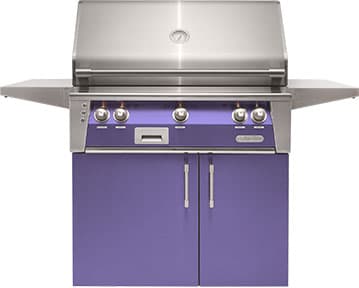
Both the Sear Zone and the Versa ship in stainless steel plus 15 additional color options that match the standard Alfresco color palette: blue lilac, carmine red, jet black gloss, jet black matte, light green, luminous orange, raspberry red, signal grey, signal white gloss, signal white matte, traffic yellow, ultramarine blue, and others.
For a kitchen that is already specifying a color-matched ALXE main grill, the side burner should match — the color palette on the Alfresco catalog is deliberately coordinated so a built-in run reads as one appliance line, not three mismatched boxes. For a stainless-steel build, the stainless finish is the catalog default and is slightly cheaper than the color options.
The decision in one sentence
If you already have a 4-burner main grill and the side burner is dedicated to cast-iron pan work, buy the Sear Zone. If the side burner is the general-purpose cooking surface for stocks, boils, deep fries, wok, or teppanyaki, buy the Versa Power Cooker and the attachments that match your actual cook style.
Products & brands in this guide
Reed — Reed writes the buying guides at BBQs.com — fifteen years selling and installing built-in grills means the picks here are what we'd actually put in our own outdoor kitchen.