We sell more grill covers as warranty replacements than as original purchases. Every one of them is the same story: the buyer spent $8,000 on a built-in, saved money on the cover, and watched it disintegrate in a single winter. A quality grill cover costs $150 to $400. A replacement cooking grate set costs $500 and up. The math writes itself, but only if you know what actually makes a cover last past its second season.
Canvas Weight Is The Whole Game
Denier — abbreviated D — measures fiber thickness in the canvas. 300D is what discount-store covers are made from; it tears in one season and UV-cracks in two. 600D is the entry point for a real grill cover and will last three to five seasons in inland climates with reasonable care.
900D or 1200D is what we sell for coastal installs and grills that live uncovered year-round. The difference is measurable — 600D canvas resists roughly 40 pounds per square inch of tear force; 1200D resists over 100 pounds. For high-wind climates (Colorado Front Range, Rocky Mountain foothills, the coast), 900D minimum is the price of admission.
If a cover doesn’t publish denier, it’s under 600D. That’s your first filter when shopping. Every quality manufacturer discloses denier openly; anyone hiding it is hiding a low number.
Sealed Seams and Reinforced Corners
Every failure we see on quality covers starts at the seams. Cheap covers use single-needle stitched seams that separate under load. Quality covers use double-needle stitching plus a heat-welded seam tape on the interior — that’s the sealed seam that keeps water out and holds the cover together in wind gusts.
Corners are the other failure point. A quality cover doubles the canvas at every corner and uses either a stitched reinforcement or a welded patch on the underside where the cover meets the grill’s sharp edges. Cheap covers skip this and you get corner tears within a year.
Check the corner reinforcement before you buy — flip the cover inside out at the corner and look for the doubled canvas plus the seam tape. If it isn’t there, the cover isn’t built for repeated use.
UV Coating and Fade Resistance
Direct sun destroys grill covers faster than anything except mechanical abrasion. The UV coating on quality covers uses either an acrylic or PVC backing on the interior of the canvas plus a UV-inhibitor treatment on the exterior fibers. Without both, the cover cracks and fades in one summer of Southwest sun.
Test claim: a cover with proper UV treatment fades by no more than 10 percent over a full year of Arizona or coastal California sun exposure. An untreated cover fades noticeably and gets brittle within one summer in the same conditions.
Ask about UV rating — quality manufacturers publish it. If the answer is ’it’s treated’ without a rating number or a warranty term that covers UV degradation, walk. The treatment either exists as a spec or it doesn’t.
Exact Fit vs Universal
Universal covers are always the wrong answer for built-in grills. They don’t seal at the base, they hang loose at the corners (which lets wind catch and rip them), and they don’t accommodate side burners, backsplashes, or hood shape variations across brands.
Every major brand — Bull, Hestan, Coyote, Summerset, DCS — sells OEM covers designed for their specific hood profiles and backsplash geometries. Those covers cost 30 to 50 percent more than a universal at the same nominal size, and they last two to three times longer because they fit the actual grill they’re protecting.
OEM is nearly always the right choice for a built-in. The exception is discontinued models where the OEM cover is no longer produced — in that case, buy the OEM cover for the current-model grill of the same size and expect a slightly imperfect fit rather than gambling on a universal.
Cinch Straps and Wind Anchoring
Any cover without cinch straps at the bottom is going to blow off in the first real storm. Look for quality covers with adjustable straps at each corner plus a full-perimeter cinch cord or elastic hem to snug the cover against the grill base.
For high-wind installs, we recommend covers with strap-and-buckle systems rather than elastic — elastic degrades in UV exposure and loses tension within two years, at which point the cover no longer stays put in weather. Strap-and-buckle stays tight for the life of the cover.
Also look for tie-down loops on the corners that let you anchor the cover to the outdoor kitchen structure if wind is a real concern. A cover that blows off in a storm isn’t protecting anything and often lands somewhere it does damage on the way.
Mesh Vents Prevent Moisture Trap
A sealed grill cover with no vents traps humidity between the cover and the grill. That humidity condenses on the stainless and, over time, causes tea-staining and pitting on 430 stainless components and even some grades of 304 in wet climates. Quality covers have mesh-covered vents on both sides of the hood that let air circulate while blocking water intrusion.
If a cover claims to be waterproof and has no vents, it’s actively bad for your grill. You want water-resistant with airflow, not sealed and stagnant.
Every OEM cover from Bull, Hestan, Coyote, and Summerset includes vent panels for exactly this reason. If the cover you’re looking at doesn’t have visible mesh vents on the sides, keep shopping.
Brand-Specific Recommendations
For Bull built-ins, order the model-specific OEM cover directly — Bull publishes cover part numbers for every head size and every backsplash configuration. Their heavy-duty cover is vinyl-backed canvas with sealed seams and a multi-year warranty. Don’t order a Bull universal cover; they make model-specific ones for a reason.
For Hestan Outdoor, only the OEM cover fits the actual hood profile — third-party covers hang wrong on the Hestan geometry because the hood radius is distinctive. Hestan covers are heavy-canvas with strap-and-buckle closures and can be ordered to match the color finish of your grill.
For Coyote C-Series, the OEM cover is marine-grade canvas with mesh vents; the fit tolerance is tight and worth the upcharge over universal. For Summerset Sizzler, OEM is again the correct pick — the Sizzler backsplash geometry doesn’t play well with universal covers, and Summerset’s OEM cover is one of the better-value premium covers in the category.
Common Buyer Mistakes
Mistake one: buying by grill width alone. A 30-inch grill can have a 34-inch hood with a 6-inch backsplash — a cover sized 30 inches wide won’t fit either dimension. Measure hood width, hood depth (front to back including knob protrusion), and full height including backsplash.
Mistake two: ignoring backsplash height. Built-in grills have backsplashes that stick up 8 to 14 inches above the hood on most brands. Covers sized only to hood height leave the backsplash exposed to weather, which defeats the purpose. Measure to the top of the backsplash, not the top of the hood.
Mistake three: skipping vents to ’keep water out.’ Vents are what keep the grill dry, not sealed covers. Trapped moisture destroys stainless faster than an occasional water intrusion, and it does the damage slowly enough that you don’t notice until the grates are already pitted.
When You Actually Need A Cover
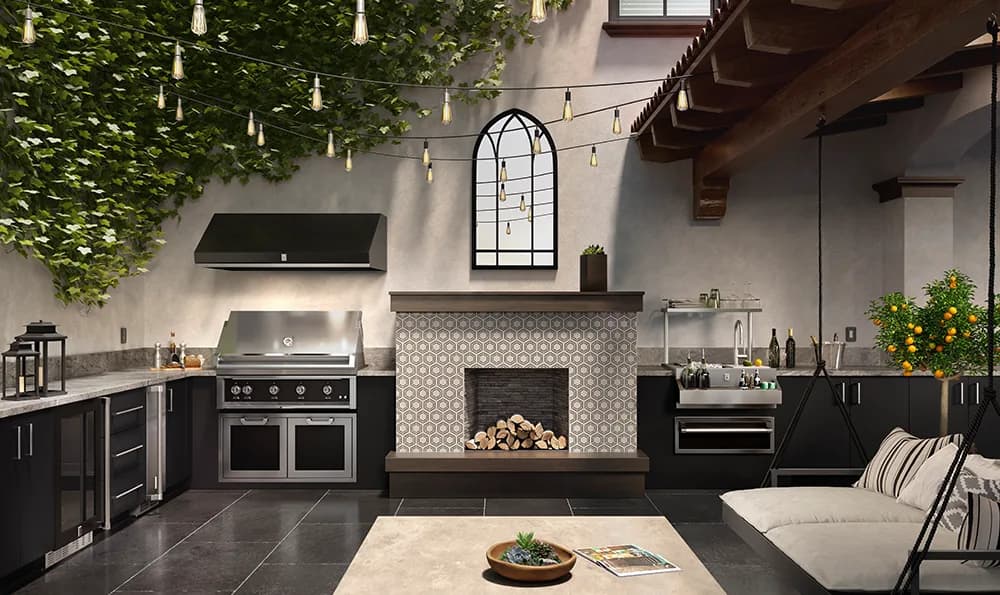
A grill under a fully covered outdoor kitchen with a hood, side walls, and a solid roof — no cover needed. The structure is doing the job. Grills in this scenario benefit from wipe-downs, not covers, and adding a cover just traps humidity where the roof was already keeping water out.
A grill in the open with any of: coastal air, tree drip (sap and bird activity), heavy pollen season, or any winter freeze — cover it every time. A quality cover pays for itself in one year in these conditions. The stainless stays cleaner, the ignition system stays dry, and the burner tubes don’t fill with debris.
Anywhere in between is a judgment call, and we default to recommending a cover for anything not fully enclosed. The math is asymmetric: worst case you spent $250 on a cover you didn’t strictly need. Alternative worst case, you skipped it and replaced $2,000 in stainless and burners at year four.
Frequently Asked Questions
How much should I spend on a grill cover?+
What canvas weight do I need for a grill cover?+
Are grill covers waterproof or water-resistant?+
Do I need a cover if my grill is under a covered patio?+
How do I measure my grill for a cover?+
Will a Bull cover fit my Hestan or Coyote grill?+
Products & brands in this guide
Related reading
Reed — Reed writes the buying guides at BBQs.com — fifteen years selling and installing built-in grills means the picks here are what we'd actually put in our own outdoor kitchen.